Abdul Wahab Khan
Panaji
A frog belonging to an endemic Western Ghats species has been discovered by researchers with a severe limb abnormality, indicating possible environmental stress in the region’s fragile ecosystem.
The finding, published in the journal Herpetology Notes in February 2026, documents an abnormality in the Amboli Leaping Frog (Indirana chiravasi), a species native to the Western Ghats.
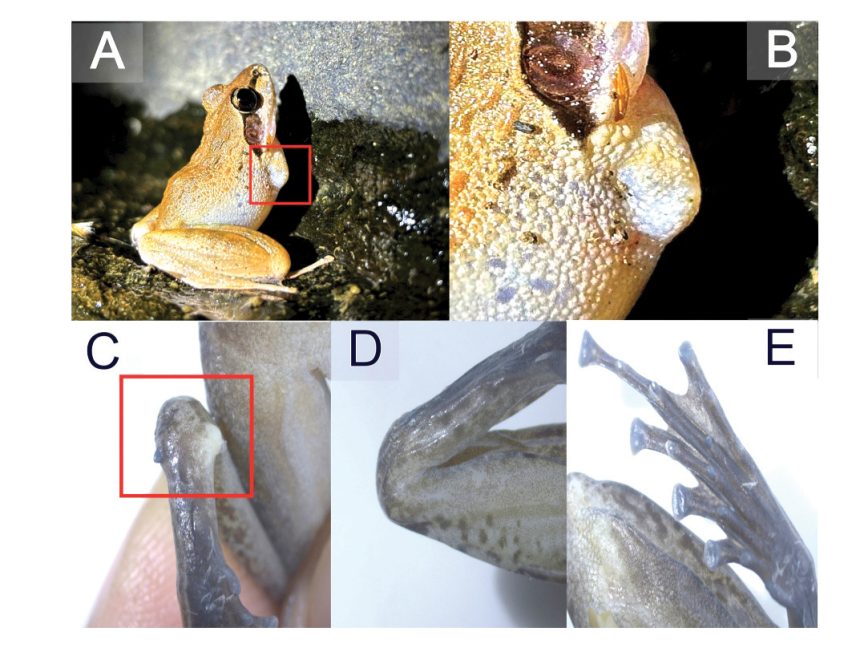
During a field survey conducted on November 20, 2024, the researchers encountered an adult frog along a stream near Morlem village in Sattari taluka with its right forelimb missing. According to the study, the frog was discovered during a nighttime search along the stream bank in moist deciduous forest terrain.
Describing the abnormality, the researchers wrote that “the frog lacked its right forelimb and there did not appear to be any visible scarring or tissue damage at the expected limb site”. They further noted that “the absence of external injuries suggests that the abnormality is a form of amelia, a congenital malformation resulting from genetic or environmental factors during embryonic development”.
While the researchers could not determine the exact cause of the deformity, they concluded that the observation was “consistent with embryopathy arising from multifactorial environmental and low-level anthropogenic influences and not from a single causative agent”.
In addition to the missing limb, the frog also showed unusual features on one of its hind limbs. The paper states that “hard spiny projections [were] protruding from the proximal end of the left tarsus,” while the right hind limb showed no such structures. Researchers also recorded a measurable difference in hind limb lengths.
The study stresses on the ecological significance of such findings, noting that amphibians are highly sensitive to environmental disturbances. According to the researchers, “Amphibians are globally
recognised as bioindicators due to their permeable skin, complex life cycles and sensitivity to environmental changes.”
Globally, amphibians are experiencing alarming declines, with about 41% of the species threatened with extinction, according to the International Union for Conservation of Nature (IUCN). Stream-associated species, including Indirana chiravasi, are considered particularly vulnerable.
The researchers noted that while amphibian deformities have been reported from several parts of India, this is among the first documented observations of such abnormalities in Goa.
The scientists emphasised that documenting such abnormalities in under-studied regions like Goa is critical for understanding the broader ecological impacts on amphibian population and for shaping future conservation strategies.
The study was carried out by Shubham Rane, Sagar Naik, Jalmesh Karapurkar, and Nitin Sawant from Goa University and the Arannya Environment Research Organisation, Morlem.