Kolkata: In a mandate as sweeping as it is symbolic, the BJP on Monday scripted history by winning 202 seats to secure more than a two-thirds majority in the West Bengal assembly polls, ending the TMC’s 15-year rule, and decisively shifting the state’s ideological and political centre of gravity.
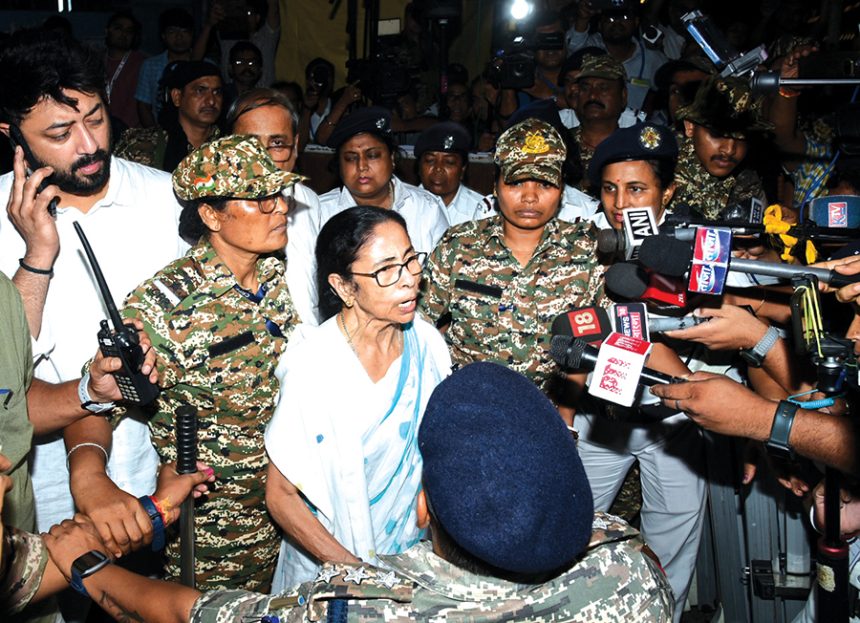
The verdict acquired added political drama and symbolic heft as Chief Minister Mamata Banerjee was defeated in the prestigious Bhabanipur seat by BJP’s Suvendu Adhikari, capping a stunning turnaround after initial trends appeared to favour the TMC supremo.
What began as tentative early leads soon hardened into a decisive wave, with the BJP winning 202 seats and leading in five, while the TMC trailed far behind, managing to win 73 and leading in eight seats, according to Election Commission data at 11.10pm.
The scale, spread and speed of the BJP surge -breaching the halfway mark of 148 in the 294-member House well before counting reached its midpoint- pointed not merely to a change of guard but to a structural realignment in Bengal politics.
For the first time since 1972, West Bengal appears set to be governed by a party that is also in power at the Centre -a shift with deep administrative and political implications.
The result also marked the BJP’s decisive breach of its last major eastern bastion, completing its saffron arc across ‘Anga, Banga and Kalinga’ (Bihar, Bengal and Odisha) and significantly altering the national political balance.
Prime Minister Narendra Modi hailed the mandate, saying the “Lotus blooms in West Bengal” and that the party would work to fulfil the aspirations of the people. At the heart of the BJP’s campaign was Modi himself, whose high-voltage rallies and direct voter connect made him the central face of the party’s push in Bengal, while Union Home Minister Amit Shah functioned as the chief strategist -stitching together booth-level networks, candidate selection and social coalitions.
The party’s rise in Bengal has been neither sudden nor accidental.
Since its 2019 Lok Sabha breakthrough, the BJP has treated the state not merely as another electoral target but as a political and ideological challenge.
From a marginal vote share of around four per cent in 2011, the BJP surged to nearly 40 per cent in 2019 and then secured 77 seats in the 2021 Assembly elections, displacing the Left and Congress as the principal challenger to the TMC. Yet, converting that expansion into power had remained elusive until now.
As counting progressed through the day, early leads consolidated into a near sweep. The BJP’s advance cut across geographies -from north Bengal to Junglemahal to south Bengal, from border districts to industrial belt- indicating a statewide wave rather than region-specific gains.
Seats such as Dinhata, Gosaba, Baghmundi, Bankura, Binpur and Nayagram pointed to deep inroads in tribal and rural belts, while gains in Asansol Dakshin, Durgapur Purba and other urban pockets reflected consolidation in industrial and semi-urban regions.
Early wins in Kalimpong, Darjeeling, Monteswar, Bhatar, Medinipur and Asansol Dakshin reinforced the breadth of the surge.
In contrast, the TMC’s resistance appeared fragmented. District-level patterns pointed to a sharp erosion, with the TMC struggling to hold ground in several regions of north Bengal and Junglemahal.
The vote share data underscored the depth of the shift. The BJP’s vote share climbed to around 45 per cent from 38 per cent in 2021, while the TMC’s dropped to nearly 40.94 per cent from 48 per cent.
A key point lay in the 177 constituencies where voter deletions had exceeded past victory margins -a latent factor that appears to have translated into a decisive political shift.
In these seats, the BJP not only retained its earlier gains but also made significant inroads into TMC-held territories, suggesting a deeper realignment rather than a mere swing.
The scale of the setback was also reflected in the fortunes of senior TMC leaders.
At least 20 ministers were defeated, including Bratya Basu, Manas Ranjan Bhunia, Shashi Panja and Chandrima Bhattacharya.
In Sabang, Bhunia, a multi-term winner, lost, while in Dinhata, Udayan Guha was defeated. In Kolkata, BJP’s Purnima Chakraborty defeated state industry minister Shashi Panja, pointing to cracks even in urban bastions.
For a party that had built its dominance on welfare delivery, centralised authority and booth-level control, the erosion appeared simultaneous across organisational layers.
In a dramatic, high-stakes contest that mirrored the political theatre of Nandigram five years ago, Adhikari defeated Banerjee in Bhabanipur by 15,105 votes after all 20 rounds of counting, according to Election Commission data.
“I thank the people of Bhabanipur for voting for me and ensuring a margin of over 15,000 votes,” Adhikari said after securing victory and collecting his winning certificate.
The outcome was a replay of the 2021 Nandigram election, where Adhikari had unseated Banerjee in a fiercely fought battle that reshaped Bengal’s political narrative.
Adhikari, once a close aide of Banerjee and a key architect of the TMC’s rise in districts like East Midnapore, now emerges as a frontrunner in discussions over the chief ministerial face of the BJP government.