PTI
New Delhi
Prime Minister Narendra Modi on Saturday urged political parties to rise above differences to help secure 33 per cent reservation for women in legislatures, called on the youth to take the lead in building a developed India, and warned that armed Naxalism has been eliminated but “dimagi Naxals” still lurked.
In his 13th consecutive Independence Day address to the nation, next only to 17 by Jawaharlal Nehru in a row, Modi sought to rally parties and young Indians around his Viksit Bharat 2047 vision while laying out a roadmap for India’s economic and strategic rise through what he described as seven streams, or “saptadharas”, of development.
Referring to the successes achieved in the government’s fight against the Naxals, Modi said for years individuals harbouring Maoist ideologies had entrenched themselves within the corridors of power in the country and through their roles as advisors on government committees.
This “Maoist mindset”, he said, had influenced policy making.
“We have succeeded in eliminating armed Naxals from the forests and liberating the nation from that crisis. However, while armed Naxals are gone, ‘dimagi’ (intellectual) Naxals are lurking around,” he said.
While the Prime Minister has earlier talked about ‘urban Naxals’, the new coinage sparked a buzz with some translating it as ‘mental Naxals’ and others as ‘people with Naxal mindset’.
Reaching out to the youth in a big way from the ramparts of the Red Fort on the country’s 80th Independence Day, weeks after widespread student protests over paper leaks and irregularities in exams, he made a series of announcements – free online coaching for competitive exams, AI training for one crore youth, a sports talent hunt and a vibrant civil defence network.
He also listed opportunities for them in areas ranging from manufacturing, space and nuclear to semiconductors.
He referred to the youth more than 50 times in the course of his 75-minute speech.
Modi reiterated his call for taking Indian companies to the global high table, saying there should be at least 50 Indian firms on the Fortune 500 list of the world’s biggest corporations and the country must have presence in top five lists across sectors like banks and pharma.
He also asserted that the Centre, states and all other stakeholders have a role to play in speeding up reforms.
Days after a near washout of the monsoon session of Parliament, he called for setting aside political wrangling to ensure implementation of 33 per cent reservation for women in Lok Sabha and state assemblies, saying all must venerate women power.
“I urge all political parties to come forward in implementing the women reservation bill and honour them. They should also take credit for its passage and contribute, but give that right to our women,” he said.
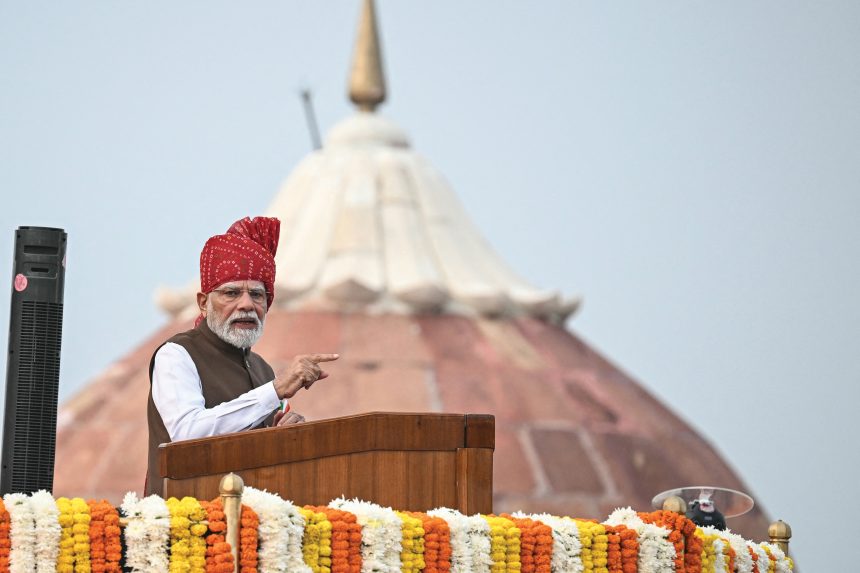
Sporting a traditional tie-and-dye red turban, popular in Rajasthan and Gujarat, Modi listed seven streams (‘saptadharas’) – manufacturing, power, agriculture and food processing, technology and innovation, gatishakti, defence power, green economy and blue economy, and soft power – to drive India forward and take the nation to greater heights.
For the first time, the full six stanzas of the national song was rendered during the celebrations at the Red Fort. An Army band played the tune of “Vande Mataram” as the guests present on the occasion sang the national song. This was followed by the Prime Minister unfurling the national flag, and then the singing of the national anthem.
The Prime Minister received the guard of honour from the personnel of the three armed services.
In his speech, Modi also paid homage to all freedom fighters and took a few names, including that of first prime minister Jawaharlal Nehru, and remembered their sacrifices. Earlier in the morning, he paid floral tributes to Mahatma Gandhi at his memorial in Raj Ghat.
The Prime Minister pitched for making India a global hub for defence manufacturing, placing special emphasis on self-reliance in advanced capabilities such as hypersonic technology and drone systems.
On the education sector, he struck an emotive note while highlighting how coaching classes had become a burden for the poor and middle class.
“Keeping the concerns of poor and middle class families in mind, we want to help save them the thousands of crores of rupees they spend on coaching. Our young people should be able to stay close to their families, receive their care, and avoid placing an additional financial burden on them,” he said while announcing free online coaching for competitive exams.