

PTI
Kathmandu
The death toll from the massive Nepal-Tibet flash floods rose to 392 on Thursday, as rescuers raced against time to trace hundreds of people still missing, including 290 Indian nationals.
Of the 392 victims, 389 died in the flash floods in Nepal, while three were killed in neighbouring Tibet.
A Nepal Police statement said 796 people, including 50 foreigners, have so far been rescued from affected areas by helicopters, while another 796 have been evacuated by land.
It did not, however, specify the nationalities of the foreigners.
The death toll from the floods has risen to 389, the statement said.
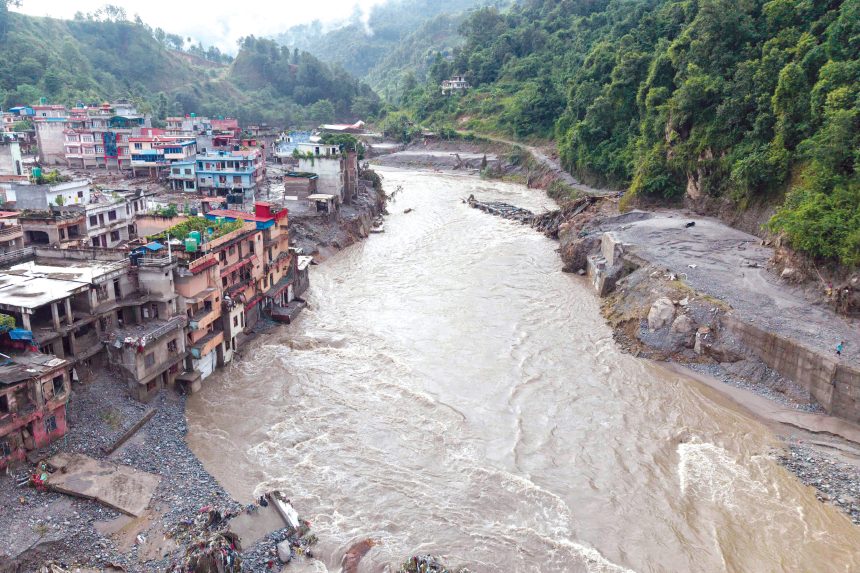
An ice-rock avalanche triggered by a glacial collapse near the Nepal-Tibet border sent a torrent of water, mud and debris downstream through central Nepal on Wednesday, devastating towns and villages, washing away homes, vehicles, roads and bridges, and damaging hydropower projects.
A fresh flood threat persisted downstream after a new barrier lake formed near the source of the Bhote Koshi river system, with authorities warning that a possible breach could trigger another surge in the river and downstream areas.
Nepal authorities reported 910 people missing, as rescuers searched river corridors clogged by mud and debris and families crowded hospitals in a desperate hunt for loved ones.
The disaster also left 558 people missing in Tibet, officials said, taking the number of people reported missing on the two sides of the border to 1,468.
The disaster has also triggered an urgent effort by India to trace its nationals, with the Ministry of External Affairs (MEA) saying 290 Indian nationals remain uncontactable.
New Delhi is making “urgent efforts” to ascertain their whereabouts and coordinate their rescue, the ministry said.
The MEA said 84 Indian nationals had been rescued, including 63 workers employed at the under-construction Trishuli-I run-of-river hydroelectric project and 21 from Tamil Nadu.
Around 200 Indian nationals on the Tibet side have sought assistance for evacuation, the MEA said.
External Affairs Minister S Jaishankar, after a high-level meeting attended virtually by India’s envoys in Kathmandu and Beijing, said urgent efforts were underway to ascertain the status and well-being of Indians in the flood-affected areas.
Chinese authorities estimated that about 2 million cubic metres of water had accumulated in the new barrier lake by Thursday morning, with another 3 million cubic metres potentially flowing into it over the next three days, raising concerns that the natural barrier could breach.
The lake has formed near the confluence of the Chhochen Khola and Purepu Tsangpo rivers, which originate in Tibet and flow into Nepal as part of the Bhote Koshi river system.
Nepal’s Department of Hydrology and Meteorology said it had received information from Chinese authorities about the lake and warned of a continuing risk of flooding in the Bhote Koshi and Trishuli river areas. It urged people to stay away from riverbanks and remain in safe places. Travellers, security personnel and search-and-rescue teams were also advised to remain alert.
Nepalese security personnel have so far evacuated more than 800 people from affected districts, while helicopters, drones and ground teams continue to search isolated settlements, riverbanks and downstream areas.
The floods first devastated Rasuwa district, about 160 km from capital city Kathmandu, after the ice-rock avalanche and debris flow near the Nepal-Tibet border. A torrent of water, mud, rocks and debris tore through settlements including Timure and Rasuwagadhi before surging downstream through the Bhote Koshi and Trishuli river system.
A preliminary assessment by Nepalese authorities and a revised analysis by the US Geological Survey (USGS) have identified a glacial collapse and debris flow, rather than an earthquake, as the trigger for the disaster.
The ice-rock avalanche struck the Lhende river, temporarily blocking its flow before the natural barrier gave way and unleashed a massive surge downstream into the Bhote Koshi and Trishuli river system.
Nepal’s disaster management authority said a debris-laden flood occurred in the Lhende following an ice-rock landslide near the Nepal-China border, about 20 km northeast of Rasuwagadhi border city. The same flood subsequently entered the Trishuli river after passing through Timure, it said.
The USGS said its analysis of long-period seismic waves showed that the event initially reported as a 4.4-magnitude earthquake was generated by a glacial collapse and debris flow, rather than an earthquake.
Authorities are still assessing the full extent of the destruction.
Nepal’s Prime Minister Balendra Shah visited Bidur Municipality in Nuwakot on Thursday to inspect areas affected by the flash floods.

