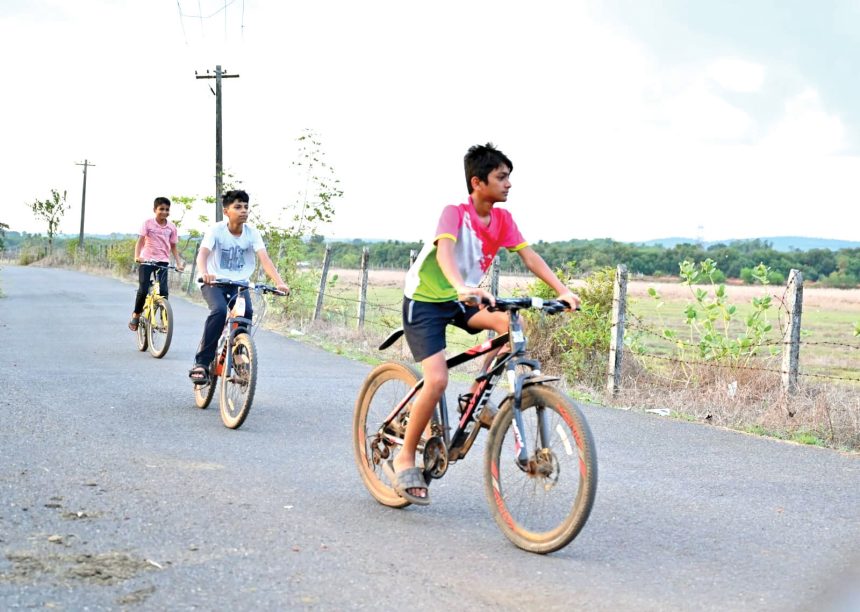
Ahead of World Bicycle Day on June 3, cyclists from Goa share their love for the sport while pointing to narrow roads and poor motorist awareness as persistent safety concerns
RAMANDEEP KAUR | NT NETWORK
Most of us begin with a few wobbly laps around the neighbourhood as children before cycling becomes second nature. As motorised vehicles become the primary mode of travel, cycling still stays part of life for commuting, fitness, leisure and competitive sport.
Cycling into adulthood
Among them is Margao-based Sanil Pai Fondekar, who has been cycling since childhood and sees it as a simple, fuel-free way of getting around.
A member of Xaxti Riders, he covers 30–35 km on weekdays and 60–75 km on weekends, with longer rides of around 100 km planned for December and January.
“Cycling relieves anxiety, boosts confidence and keeps me fresh throughout the day,” he shares, adding that he prefers group rides to solo cycling, as fellow riders can help during breakdowns and other on-road issues.
Others, like Keith Saldanha from Cansaulim, returned to the cycle after a gap. Saldanha began cycling at the age of 10, using a cycle gifted by his grandfather for local errands and visits to relatives. The habit gradually faded but picked up again during the COVID-19 pandemic, when outdoor exercise became a necessity after gyms shut down. Today, he usually rides 10–15 km and has covered distances of up to 80 km on longer routes.
Priests on the saddle
Fitness was also the main reason Jesuit priest Fr. Denzil Rodrigues took up cycling in 2016 after a basketball injury and limited sporting options left him with few alternatives for regular exercise.
Fr. Rodrigues started out on a second-hand Merida Ride 500, riding between villages for Eucharistic services before taking on longer routes across the Western Ghats.
He now rides around 350 to 400 km in a day when time permits and tries to plan one “epic ride” every year. He recently completed a 350 km ride to Vijaydurg Fort in about 15 hours and is preparing for another endurance route later this year.
His long rides have led to memorable roadside interactions, including early-morning assistance from toll staff and truck drivers slowing down on steep stretches to give cyclists space. “Cycling has brought me in contact with the kindness of strangers and helped me make many friends,” he says, adding that it has brought him closer to nature.
A teacher at St. Britto High School, Mapusa, he draws on these journeys in the classroom, referring to places such as Panhala Fort, Hampi and Badami to explain
geography and history.
At Loyola High School, headmaster Fr. Anand D’Souza, SJ, is likewise setting an example through his cycling routine.
A long-distance runner who has completed more than 50 marathons across Goa, Bengaluru and Mumbai, he began cycling in 2014 as a form of cross-training but it gradually became part of his weekly routine.
He now cycles at least three times a week, covering around 25 to 30 km per ride. He shares, “It helps me unwind and get fresh air after work.”
He often rides through quieter stretches of South Goa, including Raia and Maina. “I enjoy the calm of the interiors and the greenery along the way,” he says, adding that cycling takes him through routes that are otherwise less accessible, including paddy fields where he spots migratory birds and cranes.
Fr. D’Souza’s active lifestyle has not gone unnoticed by students and parents. Many are surprised to see him swap his white cassock for cycling shorts, helmet and full safety gear. He believes his personal commitment to fitness gives his message greater weight when he speaks to students about physical health.
He also encourages educational institutions to promote cycling through organised events involving students, parents and management.
Cycling after retirement
There is no age limit to taking up cycling. Following his retirement in 2021, former section officer Shivdas P. Govenkar from Merces decided to hop onto his son’s cycle, which had been lying unused at home.
Starting with short rides, he built up his distance over time and later switched to geared cycles. He has now logged nearly 23,000 km on his bicycle and recorded multiple achievements on Strava, including a KOM (King of the Mountains) segment. He is also participating in the ongoing Pandharpur Wari 1,000 km cycling challenge, which has more than 2,300 participants. After completing the challenge, he plans to extend his rides to other states.
From lockdown to competition
Beyond enjoying cycling for its physical and mental benefits, many riders have also taken it to the competitive level. One such cyclist is Kaivalya Karkare of Dona Paula.
Kaivalya, who works in luxury real estate and financial investments, started cycling recreationally in 2020 after joining the Panjim Cycling Club. Already a runner, he used the lockdown period to build his cycling endurance, completing BRM rides of 200 km and 300 km before entering competitive racing.
His first major result came with a win at the Equipe Goa Crit Race at the Goa University loops, which shifted his focus towards competition. He has been training under a professional coach for the past two years and was selected for the 10-member Goa state team for the national championships in 2025.
“It’s a very high-adrenaline sport,” he says, referring to the constant movement, positioning and close racing conditions, especially in races in Bengaluru and Chennai where 150 to 200 riders compete.
Karkare credits cycling groups across Goa with driving participation in the sport. He has since expanded his training to include duathlons and triathlons and follows a weekly routine of 10 to 12 hours of training, including 150–200 km of cycling, 20–30 km of running and 3–4 km of swimming.
Women in cycling
Many women, too, have been pedalling with considerable success at the competitive level.
A dentist from Colva, Dr. Blanche Themudo, began cycling during the COVID-19 lockdown. The habit later progressed into competitive cycling.
She has since represented Goa at major events, including three National Cycling Championships and the National Games held in Gujarat and Goa. “It was an experience I’d never forget,” she says, recalling racing against experienced cyclists from across the country in varied conditions.
Most recently, she participated in the King of Kumbharli, an annual hill-climb cycling event in Chiplun in the Western Ghats, where she finished on the podium in a
750-metre ascent.
Dr. Themudo maintains a fixed training schedule. During peak periods, she rides four to five times a week, with Sunday rides lasting up to five hours, supported by strength training twice a week.
“Being consistent is a choice,” she says, adding that she uses an indoor trainer when weather conditions or clinic hours make outdoor rides difficult.
Another competitive cyclist, psychiatrist Dr. Belinda Viegas Mueller from Varca, began cycling in 2012 when her husband took up the sport.
Her defining performance came in 2014 during a 1,200-km BRM in Rajasthan organised by the Delhi Cycling Group, part of the Brevet des Randonneurs Mondiaux series, where she faced hail, strong headwinds, and long stretches of unsupported riding. She was the only woman in a field of 12 riders and also the oldest participant. Most others rode lightweight road bikes; she used a hybrid cycle.
“My husband dropped out because of mechanical issues, while others missed cut-offs. I just kept going checkpoint to checkpoint,” she says. Dr. Mueller finished within the 90-hour limit, the only rider in her group to do so and the first Indian woman to complete the full distance.
That year, she completed three such 1,200-km BRMs, earning a place in the Limca Book of Records. She says, “I never set out thinking I would set a record. I just kept signing
up for rides.”
Her endurance riding has since taken her to events such as the Tour of Nilgiris and the Tour of Goa.
Now nearing 65, Dr. Mueller balances her medical practice with a training routine, riding early mornings to avoid traffic. Her week typically includes a 100-km ride on Sundays and 40-km rides on Tuesdays and Thursdays before work.
“I believe sport is very important, not only for physical but also mental health,” she says, noting with humour that her cycling peers are unlikely to become her patients.
Roads, risks and rider experience
But cycling is far from safe in Goa currently, with riders having to ride at their own risk.
Arpora-based endurance cyclist Anuradha Guglani, who has participated in brevet rides (BRMs and LRMs) of up to 1,000 km, says conditions have changed over the years. The architect recalls that in the past, she would go for slow rides through South Goa’s village roads, taking in the architecture, sunrise light and stretches lined with coconut trees. Today, she has cut down on outdoor cycling.
She says, “North Goa roads are not safe anymore, especially with potholes and
heavy traffic.”
The conditions, she adds, are particularly worrying early in the morning, with speeding vehicles, drunk driving, and large buses on narrow stretches. Guglani believes the gap can be addressed through infrastructure planning, including dedicated cycling lanes, structured EV cycle rental systems with designated pick-up and drop-off points and basic commuter facilities such as showers at workplaces. She also calls for a rethink of road priority, noting that cyclists currently have little protection in mixed traffic conditions.
Fondekar too suggests workplace facilities such as showers and changing rooms for those who cycle to work and agrees that riders are frequently expected to give way to others. “On roads dominated by motors, the bicycle is always given the least priority,” he says. He also cites discomfort from vehicle exhaust during climbs and says stray dogs are a regular hazard, recalling an incident in which a fellow cyclist was thrown off his bicycle after colliding with a dog.
Broken glass, stray dogs, cattle and unpredictable traffic are major risks for cyclists in Goa, adds Fr Rodrigues. He also point to the unpredictability of longer and remote routes. During one ride through the Western Ghats, Fr. Rodrigues encountered a tiger at Anmod Ghat crossing the road ahead of him. He says, “The animal moved calmly towards a water source without reacting to my presence.” He continued the ride and completed the remaining 100 km in under four hours. He also mentions coming across bison at Anmod and Chorla Ghat.
Cyclists say even within the state, caution is essential. Dr. Blanche Themudo notes the lack of dedicated cycling lanes in Goa, especially on high-traffic roads, adding that she takes strict precautions, including avoiding earphones, staying alert at all times and using a Garmin Varia radar device that alerts her to approaching vehicles and also functions as a rear light.
For women riders, long-distance cycling outside Goa brings additional concerns. Guglani says that while cycling within Goa feels manageable, longer rides outside the state raise personal safety worries. On isolated stretches, she has to stay alert to potential risks. She says, “The fear of being followed or attacked is something women think about on long rides.”
Saldanha, meanwhile, urges a change in how the bicycle is viewed in parts of society. “In the older generation, cycling is seen as a poor man’s mode of comfort,” he says, adding that it needs to be seen as a practical and healthy way of getting around.