Original Marathi article: Roshan Ara
Originally published in: Kadbole
Writer: Atmaram Jog
Translator: Dhananjay Jog
It was about the year 1951. I was with the Police of then Bombay State, comprising of today’s Maharashtra and substantial areas of Karnataka and Gujarat. I was posted at Bijapur. Language-based States reorganization brought about by the fast unto death by Pottu Shreeramlu had not yet happened. The Marathi, Gujarathi and Kannad speaking populace lived peacefully together. Language related riots and unrest were yet to commence.
I had a working knowledge of Kannad but only enough to speak. I could neither read nor write. Yet I spent four years in Bijapur and earned commendation from seniors and appreciation from the people. Such were the times then.
A ‘Police Patil’ (village police chief) from a remote village under my jurisdiction reported that one Shahabuddin, a field worker had murdered his wife Zebunissa and alleged paramour Hanumant. I was requested to come over urgently. We were a poorer nation then, or at least my department was! No vehicle, even a two-wheeler could be spared for a sub-inspector. Accompanied with a bedding and provision for a three-day stay, I cycled the 16 miles (about 26 km) to the village.
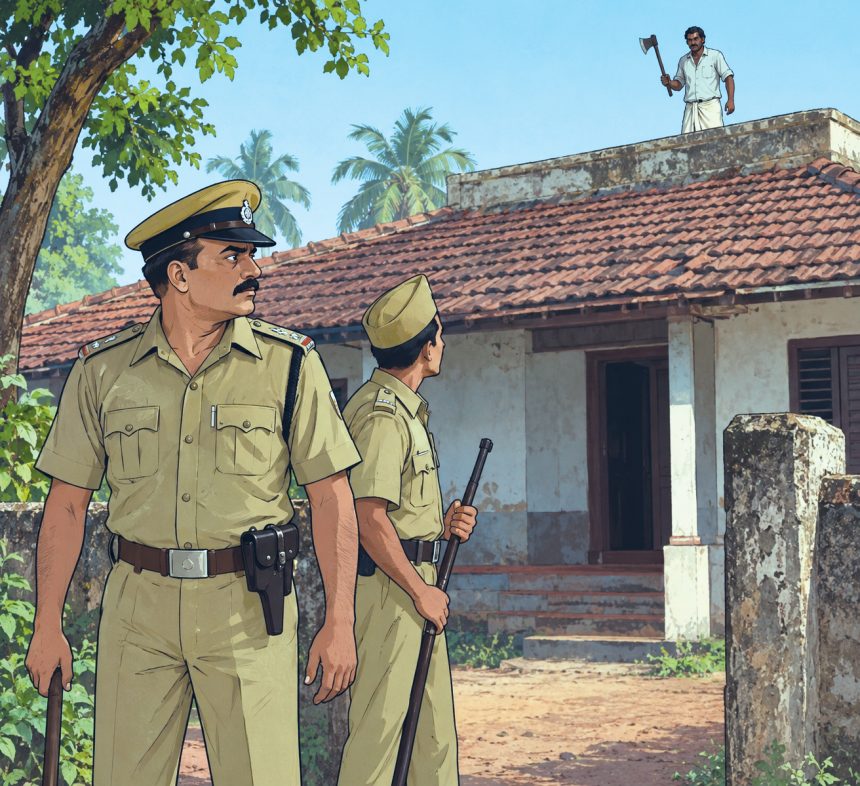
A dramatic situation awaited me – the Police Patil and all 200 villagers were gathered in the central square. The Patil reported that Shahabuddin had climbed atop the local mosque, the bloodied axe in hand. He was furious and none dared approach. “I have already put two people to death and will not hesitate killing more if you try to capture me”….he had threatened.
Vides the then ‘Bombay Village Police Act’ a Police Patil was not only authorized but responsible to arrest an accused. He had hence tried to take Shahabuddin captive with the help of villagers but none now showed interest in becoming the latter’s third victim. “Sir, you are now here. I have ensured that the Accused does not escape. Please take charge” he said to me, wiping his brow with obvious relief.
In 1951, James Bond books and films didn’t exist (the first book came in 1956, and ‘Dr. No’ was released in 1962). The ‘Action Man’ Amitabh of Hindi films was probably yet a child in shorts. I had no such thrilling idols to look up to. But capturing Shahabuddin was my duty, however dangerous the task may be.
I walked up to the mosque. Its terrace had heaps of stones piled on it, as was usual to village structures then, in defense against frequent dacoit gang attacks. I told only the Patil to accompany me, and ordered all else to move back and away. If Shahabuddin decided to throw these stones, the villagers would stand exposed. I also ensured that the Patil and I walked a distance away from each other so that he would not have a single easy target.
A proven technique in an armed attack is to do what the enemy least expects. If he discovers that something unexpected has been done, he becomes confused. His prepared plans are largely useless with no time to make new ones. Shahabuddin most likely expected that the police team and all 200 villagers would surround him and the mosque. I decided not to do this.
This, then, was the situation – Shahabuddin stood atop the mosque, armed with his axe and stones. No stairway led to the terrace – access was by ladder. He had climbed and pulled up the ladder behind him. I shouted: “Get down quietly, Shahabuddin. If you don’t I will be forced to climb up and then will show no mercy”. Here was an angry and desperate man who had just killed two. He cared not a fig for my warning!
I instructed that another ladder be brought over. But both the Patil and the lone constable who had cycled with me entreated that I do not take the risk. They argued that thirst and hunger would eventually bring the murderer down.
I was a relatively fresh officer out of the PTC (Police Training College), Nasik. (Goa’s police officers are still trained there. Constables, on the other hand, pass out from the Police Training School, Valpoi, which I headed much later.). I explained that I was expected to take steps and arrest the accused, if necessary at risk of life. If Shahabuddin jumped down and was wounded or died, I would be rightly said to have simply acted as an observer. The unsaid risk also existed that he kills himself with the axe he held.
Is it not ironic that the officer who arrests an accused, collects evidence and files a case in the court seeking a death sentence, does not wish death of the accused at this stage. “It is my duty to arrest Shahabuddin without harming him – that is where the Police Department’s status and prestige lie. I shall attempt the arrest irrespective of the risk,” I told them.
I was well aware of criminal psychology. Fighting against the law and society, he is usually battling his conscience too, which tells him “You have committed a crime. Accept this and surrender”. This is reinforced if the police do not use third-degree methods. Unfortunately ‘third-degree’ is the practice rather than the exception today.
I was aware that this man hadn’t had a sip of water since last evening. I said to him, “How long do you wish to stay without water and food? I want that you first eat and drink – we shall look at your crime later. Should you decide not to descend, I’ll climb up myself with water for you and risk slipping off the ladder”. I had a pot of water brought over. I also ostentatiously disarmed in his view – took off my holster and gun. I, of course, held a second weapon in the sock of my shoe, invisible to the onlooker. Just as I stepped up the first rung of the ladder, Shahabuddin said, “Do not trouble yourself Sahib. I will come down”. I did not wish his descent axe in hand, for the obvious danger to the villagers. I shared my observation that climbing down the height with axe in hand would be risky for him. I hence asked him to either leave it up there or first throw it down.
Shahabuddin had never encountered a policeman concerned about his wellbeing. He threw down the axe and descended. As directed, only the Patil, my constable and I were there to receive him. Reception by so small a committee was surprising. He expected a large crowd and to be thrashed mercilessly, especially by the kin of the dead Hanumant. This was indeed a strangely behaving police officer- it added that much to his mental pressure.
I said to him quietly, “We will walk to the ‘chavdi’ (dispute resolution & governance place in a village). I stand re-armed. If you try to run I shall reluctantly shoot you without hesitation. Don’t create such a situation. But first, have this drink of water.” He accompanied us quietly to the chavdi, where I handcuffed him and put him in the constable’s charge.
The ‘panchnamas’ of the dead bodies, of the murder weapon, of the crime scenes etc. took about 4-5 hours. I had instructed my constable that no one speak a word to Shahbuddin or ask him anything in my absence. Shahabuddin expected an interrogation…What and how it all happened, why did he do so etc. But I instead enhanced pressure on him with silence. Too much of this, and a criminal blurts out a confession on his own. I knew that accumulated evidence would reveal a lot. There was no point in a premature interrogation tempting him to falsehood. Zebunissa was killed at home and Hanumant later in a field. I had noted an empty crib in the house. Enquiry revealed that they had a 6-month old daughter. This was Roshan Ara (..the principal character in this story). Wife and mother Zebunissa lay dead on a mat near the crib. She had been killed when asleep post a mid-day meal. The same axe was used for both the murders.
(To be continued)