CHRISTINE MACHADO
NT NETWORK
The Gawda ‘kapod’, or what is today more popularly known as the Kunbi sari, has been proudly worn by the crème de la crème of society recently. This is a far cry from its humble beginnings as the daily wear of the women belonging to the indigenous Catholic Gawda community.
Tribal beginnings
According to architect and heritage enthusiast Pritha Sardessai, the traditional ‘kapod’ was made in red and white checks using natural dyes, with a border comprising two rows of ‘rudraksha’ motifs. Women draped it around the waist and tied it with a knot on the right shoulder called the ‘dettli’. The drape fell well above the ankles, which made it easier to work in the fields and was also suited to Goa’s humid climate.
“The red colour matches the soil of Goa. While red was the festive colour, maroon and blue were the colours of mourning,” says advocate and tribal rights activist Joao Fernandes.
Fernandes says the ‘kapod’ gradually fell out of use, partly because it came to be seen as a marker of tribal identity. “It carried a stigma. People used to tease them. And so they gave up on wearing it.”
The rising cost of cotton and changing fashion preferences among younger generations also affected the ‘kapod’. The older folks who still wore it also began opting for polyester silk fabric instead. As demand fell, the handlooms too shut down.
“The only occasions where one could hope to get a glimpse of it was on Republic Day tableaus or at programmes showcasing the cultural aspects of Goa. And even then, these groups who were putting up performances were not particular about wearing the exact cotton weave,” says Sardessai.
Fashioning a change
The winds of change began blowing in 2009 when textile designer and researcher Poonam Pandit contacted late fashion designer Wendell Rodricks about working together. Rodricks then invited her to Goa to study the indigenous Kunbi sari.
“When I began my research, the ‘kapod’, had almost no visible presence. There was barely any information to be found and most people I spoke to insisted there were no weavers or handlooms in Goa,” recalls Pandit. After much persistence, her research led her to the Tilves of Pernem, the last practising traditional handloom weaving family.
“When I first met the Tilves, they were working on a single loom, weaving the ‘kashti’, the red and white checked loincloth traditionally worn by men, and occasionally the ‘valo’ and ‘pancha’,” says Pandit. They faced competition from cheaper powerloom substitutes, while demand for the ‘kashti’ was declining as it gave way to mill-made innerwear and other machine-made products. Despite this, the Tilves continued weaving.
Creating new designs using traditional methods thus gave the ancestral looms new purpose. “Baburao Tilve, affectionately known as “Kaka”, brought decades of weaving knowledge to the table, and together we developed the Wendell Rodricks Kunbi Tribe collection sari and fabrics for garments showcased at the 2010 Wills India Fashion Week,” says Pandit. While these designs retained certain traditional elements, Pandit emphasises that Rodricks’ creation was not the traditional sari. But the collaboration brought the weave greater attention.
Other designers also began taking an interest in the fabric, among them fashion designer Verma D’Mello, who began working with the ‘kapod’ in 2014. “I wanted to take the sari beyond its traditional form,” she says.
D’Mello began buying the saris from Goan tribal communities and turning them into garments suited to modern tastes. “I believe that if we want our traditions to survive, we must make the younger generation proud to wear them,” says D’Mello, who describes herself as a heritage textile revivalist.
Over the years, she showcased her work in San Francisco, Africa, Dubai and Paris. She also received accolades, including being honoured as a Best Carpet Designer at the Cannes Film Festival and Fashion Festival for her work with the Kunbi weave.
During the COVID-19 pandemic, D’Mello began spending more time with the communities associated with the sari to understand more about its soul. “The more I learned, the more I fell in love with it all,” she says, while refering to the sari “a living story of Goa”. “It carries the identity of our people, their relationship with the land, their connection with nature, and the wisdom passed down through generations,” she says.
Fashion designer Ninoshka Delaney too has worked with the ‘kapod’. After working with weavers from other states in Mumbai and on other weaves, she came to Goa in 2011 and wanted to continue this work by focusing on the state’s traditional textiles. Her work won her the National Award for Handloom in 2016.
Back to the loom
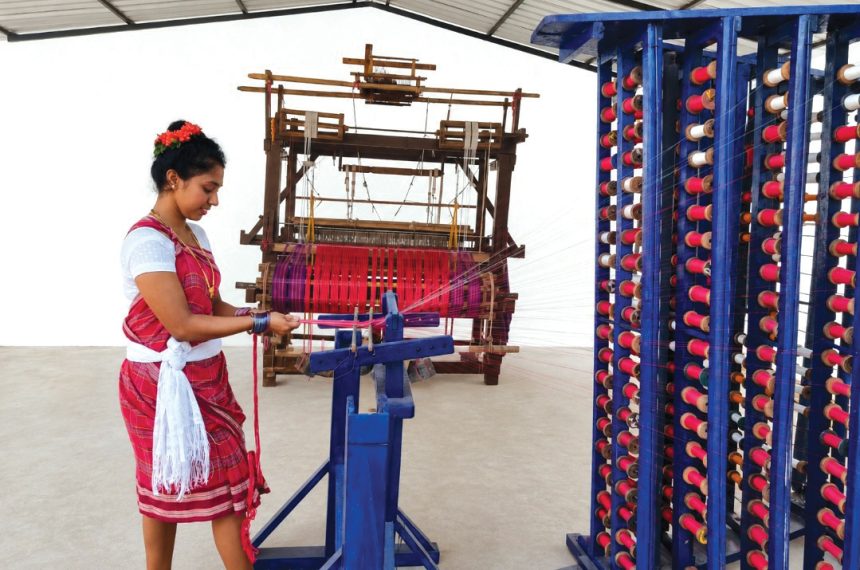
With growing interest in the weave, the Department of Handicrafts, Textile and Coir began handloom training programmes for women around 2014.
Today, around 20 centres across Goa, including in Pernem, Bicholim and Shiroda, conduct training in the Kunbi weave.
Director of the Department of Handicrafts, Textile and Coir, Sagun Velip, says, “The training is for six months and if necessary, can be extended. After this, we provide nine months of handholding support, including free looms, raw materials and a monthly stipend.” He says the programme is being implemented under two schemes, Vishakarma Kaushal Yojana and Swavalamban Yojana for Handicrafts Artisans. Besides this, the weavers can also avail of the government scheme – Samarth which provides 45 days adavance training.
“We also exhibit their products at exhibitions like the Delhi Haat and once a year this is also taken to the international level. Currently, we have also put in an application for installing solar lights for the looms,” he adds.
The women weavers have also begun to experiment with products beyond the sari. “College-going students may find the saris too expensive, so the women have begun making smaller items such as stoles. One of the groups has even tried making dresses, skirts, and baby clothes,” says social worker Mahalaxmi Bhobe, who has been working with these women weaving groups. Some have also added variations to the sari, such as golden threads.
“They are trying to evolve with the market,” says Bhobe, while Velip adds, “They have to match up with the recent trends and designs. If they don’t adapt, they won’t survive.”
Similarly, others too have begun getting innovative with the heritage textile. After her project with Rodricks, Pandit continued working with the weavers and founded her own brand, Kalakar, which focuses mainly on scarves and fabrics.
“We have never attempted to weave the traditional ‘kapod’. The weaves we worked with were the lenço, which, when tied as a loincloth, is known as the ‘kashti’, the ‘valo’ and the ‘pancha’, which we turned into scarves, shawls and fabrics in new designs and colours,” she says.
These products have found buyers beyond Goa, in Mumbai, Delhi, Bengaluru, Kochi and Puducherry, as well as in Germany, France and the U.K. “There is a demand for saris too. I am asked about it often and I hope to address in the near future,” she says.
Kalakar works with two colour ranges. One uses natural dyes, including indigo, manjistha and black derived from iron filings. The other uses azo-free chemical dyes that are industry-approved and of good quality.
“We started with one loom, grew the work to three looms and are currently back to one. Kaka wove well into his 80s, until a health condition forced him to stop, though he continued to oversee the work for some time after. Apa, Baburao’s younger brother, also wove right through the start for a good number of years. Kaka’s son Dilip took over, he and I now work together for the past few years,” says Pandit. Kaka’s youngest son Ravi also helps with the warping process.
However, younger members of the family have other interests and aspirations. “Keeping the work going through these transitions has not been easy, but we have enjoyed the work all along,” she says.
Another entrepreneur working with the weave is Sneha Naik, who founded Kunbi Goa in December 2022.
“I observed that the exquisite Kunbi weave was largely confined to saris and was losing everyday relevance. My aim was to reimagine it through modern, functional products that people could proudly use and wear, while also creating sustainable livelihood opportunities for rural women artisans,” she says.
Kunbi Goa offers ready-to-wear Kunbi saris, stoles, jackets, blouses, tote bags, pouches, diary covers, photo frames, hats, gift hampers, yoga mats, and home decor items.
However, expanding the business comes with challenges. “We face constraints in terms of the availability of skilled weavers, production capacity and expanding market awareness,” says Naik. As each item is handcrafted, fulfilling larger orders while maintaining consistent quality requires planning.
D’Mello, executive director of Goa Sudharop, a not-for-profit organisation, has installed a handloom in Orlim and conducts workshops to create awareness about the weave and
build skills.
But she too admits that in terms of production, a key challenge is procurement of cotton yarn since Goa’s climate is not conducive to
cotton cultivation. “I have to source it from neighbouring states. This adds to transportation costs and procurement time. Ensuring a steady supply of good-quality yarn at the right time and price is another challenge,” she says, adding that they are in the process of installing more looms.
GI tag and authenticity
While the return of handloom production to Goa is a positive development, Delaney points out that the training provided by the Department of Handicrafts, Textiles & Coir does not cover the finer details of the traditional technique.
“The weavers are weaving the basic weave. They’re not yet doing the borders, which is actually what sets this weave apart from weaves in other states. We still have a long way to go to come to that level,” she says.
With the weave awaiting a GI tag, documenting its original form becomes even more important, says Pandit.
““Before a GI tag can mean anything, the work of truly understanding and documenting what the traditional ‘kapod’ weave actually is needs to be done. The thread, the colour, the check patterns, the weave construction, the border design, and the original technique all need to be established with care and rigour. A GI tag without that foundation risks certifying something that has not been fully understood,” she adds.
Bhobe, however, believes the current weaving training provides a starting point. “That is the first thing, right? Then we can focus on the conservation of the traditional sari. So let the weavers learn and grow first and then we can widen the net,” she says.
Historian Rohit Phalgaonkar, who, along with folklorist Vinayak Khedekar, has been involved in efforts to revive authentic Adivasi weaves, also welcomes the
government initiative.
“There were only two or three weavers that survived even after the liberation of Goa. So this training by the government is commendable. In some other states that I have been to, there has been no revival initiative taken up by the government for weaves that have died out,” he says.
Meanwhile, the not-for-profit initiative Goa Adivasi Parampara has been working to reproduce the sari using the same techniques and designs.
“We have also stuck to the same colour combination because historically these have been the colours,” says Sardessai, who is part of the initiative.
The only change, she adds, is that they have made the fabric slightly less coarse than the traditional version to make it more comfortable for
the wearer.
Rooting for
community benefits
But has this revival benefited the community to which the sari traditionally belonged? Sardessai says it has not, largely because of the price.
“The community does not wear this sari on a daily basis now and the women are not going to pay about Rs. 4,000 and then wear it to go to the field,” she says.
Through their project, they supplied the community with a number of saris at a reduced price. “Even then, I don’t think that anyone individually picked these up. Their ‘sangatana’ bought them so that at least they have them in their repository and can use them when needed, like when they showcase their culture at different festivals or hold their own community events at the ‘maand’,” says Sardessai.
Fernandes says the community now recognises the value of its traditional sari, they have not benefitted from it. He too points out that the pricing is high now.
Passing on the wheel
He also emphasises the need to correct the use of the term ‘Kunbi’ sari. “This sari was worn by the Gawdas. If you want to connect it to its roots, then it should be known as ‘kapod’,” he says, adding that he is doubtful whether those who are gung-ho about owning the attire today know
its history.
Pandit agrees. “The story of the ‘kapod’ deserves to be told alongside the sari itself,” she says.
In addition to this, Bhobe says people also need to know where products made by the new generation of women weavers can be bought. “How many people know that there are people doing this in villages? How many people know which villages it is happening in? People usually learn about and get in touch with these women at exhibitions,” she says.
With a Kunbi Handlooms and Crafts Village in Sanguem also in the works, Delaney says it’s an excellent move. “We don’t have any other hand weaving happening in Goa. This at least has got the ball rolling,” she says.
As the revival efforts increase, Phalgaonkar believes more young people need to take up the craft. “Instead of running behind white-collar jobs, the youth should realise that today handloom products of India are in demand. People can take up this weaving craft, get innovative with the products and develop their entrepreneurship in this,” he says. “Unless and until the young sector picks this up, these efforts will only go so far.”
In this regard, the Department of Handicrafts, Textiles and Coir has begun introducing the craft to youngsters and have begun tie-ups with Government College of Arts, Science and Commerce, Quepem, and Sapteshwar College, Mandrem.
D’Mello is also conducting workshops for students through Goa Sudharop. “I want every child to know where our textiles come from, who made them, and why they matter,” says D’Mello. “I want them to feel proud of our roots and carry this legacy forward.”