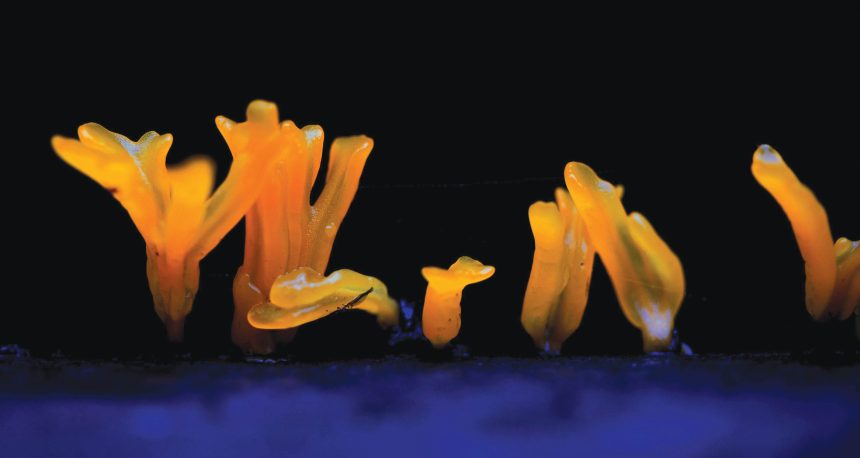
With World Environment Day recently observed on June 5, some of Goa’s nature photographers reflect on the environmental change they have
observed and documented through their lenses
VINIKA VISWAMBHARAN
NT NETWORK
For Bandora-based Gautam Kamat Bambolkar, photography emerged from a desire to reconnect with nature amid the pressures of everyday life.
But what keeps him returning to forests and natural spaces is the storytelling. “Nature doesn’t use words, but it speaks volumes,” says the alumnus of Goa College of Art in Panaji, who gained international recognition when he won the gold prize at the World Nature Photography Awards 2021 in the United Kingdom. “Whether it’s a monumental landscape or a wild animal looking back at you, there are profound stories of resilience, companionship and survival happening every second. Being able to capture those silent dialogues and share them with the world keeps me hooked.”
One of his most memorable experiences came while photographing two bonnet macaques sheltering from a monsoon storm at Chorla Ghat. “Looking at them, I realised that companionship, empathy and courage aren’t exclusively human traits. Nature teaches us how to survive storms together.”
For conservationist Nirmal Kulkarni meanwhile, photography was a way to connect to people beyond academic circles. “I wished to showcase India’s vast but often ignored lesser-known biodiversity of reptiles, amphibians and insects to a larger audience,” he says.
Over the past two decades, he has been practising conservation photography, where the imagery acts as a tool for environmental advocacy. “Every image is a conservation story, of hope or despair, or a call for action,” he says.
Signs of our times
And indeed, given that nature photographers often revisit the same locations over years or decades, they notice subtle changes that can easily escape the attention of casual visitors. And many signs are becoming impossible to ignore.
“The temperature has increased a lot, bird sightings have dropped, bird activity goes down sooner, fruiting cycles have changed for certain trees, and streams in the forest start drying sooner,” says Stephen Menezes, whose fascination with nature photography began in childhood, most notably with a Malabar Grey Hornbill that used to visit his home.
Bambolkar meanwhile points to increasingly unpredictable weather patterns. “When I shoot in places like the Western Ghats, the monsoons feel different, sometimes dangerously intense, other times delayed.” What concerns him most is the gradual disappearance of natural buffers that once protected
ecosystems.
One of his photographs, ‘Last Tree Standing’, captures a solitary dried tree on a beach in Florida. “A visitor was constantly moving his chair just to catch a tiny sliver of shade to read his book,” he explains. “It was a stark reminder of a harsh reality. If we don’t start protecting our environment, finding a simple patch of shade under a tree will soon become a luxury.”
Photographer Rakesh Dhareshwar says the problem extends across a range of ecosystems. “Human activity continues to steadily erode natural habitats, whether laterite plateaus, scrublands, forests, grasslands, marshes or other open spaces. In nature, there is truly no such thing as wasteland.”
This sentiment is further echoed by bird photographer Harsh Zaveri, who says that Goa’s laterite plateaus which often seem like wastelands have different wildlife species thriving in them. “Goa has lost many such plateaus to industrial estates,”
he laments.
The loss of these habitats has implications far beyond wildlife photography. “A simple but alarming example is that potable drinking water is directly linked to forest cover. It could possibly be the biggest challenge populations across the planet, and specifically in India, will face because of deforestation,” says Dhareshwar
The vanishing wild
There has also been a decline of species that were once commonly encountered. “A lot of birds like vultures and many raptors have disappeared from Goa,” says Zaveri.
Kulkarni points to mammals that have become increasingly difficult to observe. “The golden jackal and the Indian mongoose in Goa were once common but now very few sites remain where they roam freely.”
Dhareshwar has observed similar trends across the country. “I have personally witnessed significant declines in flamingo, Great Indian Bustard, Floricans and waterbird populations,” he says. He also highlights the near disappearance of the Malabar Large Spotted Civet from parts of the Western Ghats. According to Menezes even small creatures like fireflies are becoming harder to find.
The reasons are often interconnected. Habitat fragmentation, urban expansion, infrastructure projects, and changing land-use patterns all place increasing pressure on wildlife. “When we build roads through forests or convert wetlands, we don’t just destroy trees. We disrupt entire nesting grounds and migratory paths,” says Bambolkar. He adds that wildlife does not vanish overnight. “They just retreat deeper into the remaining fragments of wild spaces where they feel safe.” Today, he says, photographers often have to travel much further and wait much longer to encounter species that once lived close to
human settlements.
And Dhareshwar cautions that increased sightings of some animals near villages and towns should not be mistaken for conservation success. “They are often not a sign of population growth, but rather evidence of human encroachment into their habitats.”
From photography to conservation
For many photographers, documenting nature eventually leads to a deeper engagement with conservation.
“There is a huge difference between reading a scientific statistic about habitat loss and actually looking into the eyes of an animal. Photography bridges that gap. It translates dry facts into raw human emotion,” says
Bambolkar.
Dhareshwar believes that conservation begins with something simple. “Understanding often begins with seeing,” he says, while placing particular emphasis on proper environmental education. “If we can make future generations aware of the incredible natural wealth that surrounds them, they are far more likely to develop a sense of connection and ownership towards it. The desire to protect then naturally follows.”
Opportunity and responsibility
Despite the environmental challenges, the lensmen believe Goa remains one of the most rewarding places in India for aspiring
nature photographers.
Dhareshwar points out that although Goa accounts for only a tiny fraction of India’s land area, it supports remarkable biodiversity. “The state is blessed with forests, wetlands, rivers, estuaries, mangroves, beaches, laterite plateaus and agricultural landscapes.” The Western Ghats alone offer enormous opportunities for learning and exploration.
Among the many amateur photographers is Mugdha Prabhugaonkar who was introduced to cameras by her father at a young age. “Experimenting with different cameras meant going into nature,” she says. “Still photography is what made me happy.”
Most of her nature photography comes from travelling and exploring different places, where she has noticed wildlife appearing in unexpected spaces. “Sometimes you don’t have to go into nature. Its nature coming back where it once belonged,” says Prabhugaonkar who hopes to pursue nature photography more seriously in the future, although she remains unsure about opportunity and money.
And while the picture looks rosy, Dhareshwar and Kulkarni caution against romanticising nature photography as an
easy profession.
“It may seem like it is just about clicking images in the wild, living a carefree jungle life and occasionally selling your images to earn a living. But in reality, very few committed and talented photographers are able to make a living solely from wildlife photography,”
says Kulkarni.
Nature also rarely follows a plan, says Zaveri while narrating how he travelled to South Goa last month in the hopes of photographing an owl that had been regularly sighted in the area. But just as he arrived, it began to rain and the owl never appeared. Yet, nature also has a way of surprising those willing to be patient. On another outing in search of a Bluethroat, Zaveri reveals how he instead found himself face-to-face with an unexpected visitor. “There was a beautiful Greylag Goose waiting for me,” he recalls.
A double-edged ethical sword
Currently, Prabhugaonkar primarily photographs using her iPhone, finding it easier to carry while travelling and exploring. She sees it as a practical way to continue honing her skills before investing in more
specialised equipment.
And there is no denying that technology has transformed nature photography. Today, almost everyone carries a camera in their pocket. Most photographers welcome this democratisation of photography. “It has made nature accessible to everyone,” says Bambolkar.
Platforms such as eBird have also helped create communities of birdwatchers and citizen scientists.
However, several photographers warn that increased visibility comes with risks. Anish Thimanna, an avid bird watcher turned photograpger, recalls a Black-backed Dwarf Kingfisher nesting site that became widely known among photographers. According to him, around 70 photographers eventually visited the site. “The bird abandoned the chicks and abandoned the
nest,” he says. The incident highlights the importance of ethics. “We need to move from using nature as a mere backdrop for social media clout to genuinely respecting it as a living space,” says Bambolkar.
Dhareshwar echoes the concern. “You simply cannot treat wildlife habitats as picnic spots,” he says.
Ask any experienced nature photographer about their greatest challenge and the conversation eventually shifts from equipment to ethics. “The biggest challenge is the self-discipline to know when not to take a shot,” says Bambolkar. Indeed, photographers repeatedly emphasise that no image is worth disturbing wildlife or damaging the environment. Kulkarni advocates strong field ethics, securing permits, and never handling wildlife. “Respect nature and be safe in the wilds,” he says.
And patience remains one of the most valuable skills a photographer can develop. “The best photographs often come from spending time observing and understanding the behaviour of the subject rather than chasing it,” says Dhareshwar.
A reason for hope
Despite the concerns, the photographers remain hopeful. Several point to a growing number of young people taking an interest in birdwatching, photography, conservation, and citizen science. “That is a good sign and gives hope for a better future,”
says Zaveri.
There are also reminders that nature remains remarkably resilient when given the opportunity. Reflecting on an abandoned house in Raia reclaimed by vegetation, Bambolkar says, “You see how nature stubbornly rebuilds and regenerates. We just have to give it the space and time to do so.”
And photography encourages people to pay closer attention to environmental issues, believes Prabhugaonkar. “Nature photography is a reminder that without a good balance, we cannot survive for long,” she says. “The increase in temperature these days is a good reminder of what damage we have done.”
With Nature Photography Day approaching on June 15, the photographers hope people will look beyond the aesthetics of an image and recognise what it represents. “I hope my photographs remind people that we are not separate observers of nature; we are a part of it,” notes Bambolkar. “When we protect wildlife and preserve our forests, we aren’t doing Earth a favour, we are saving ourselves.”
(With inputs from Christine Machado)