

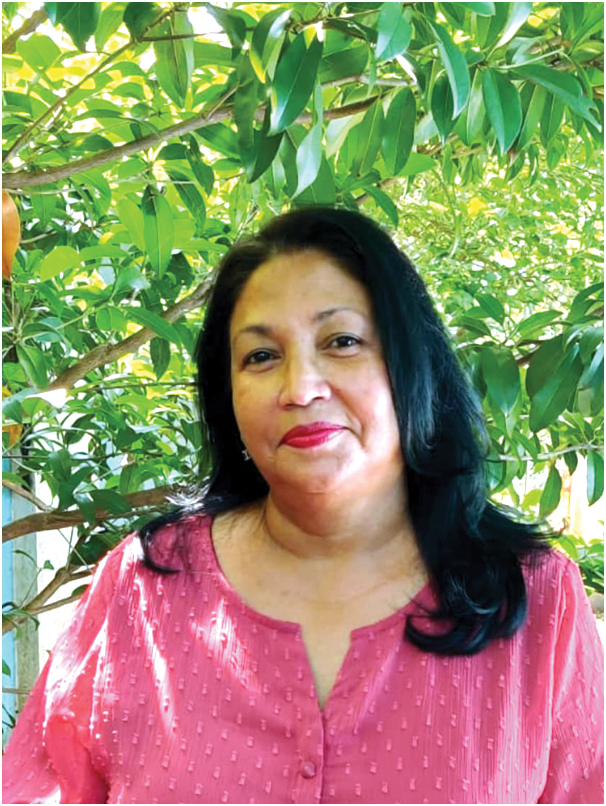
CHRISTINE MACHADO
NT BUZZ
What real-life events does the book draw from?
‘Romance on the Airwaves’ is the true story of my parents, Antonio Rodrigo Aguiar (Rodrigo) and Marjorie (Marge) Lobbo. Their love unfolded during the 1950s and 1960s, a time when Portuguese-ruled Goa and India were politically divided.
The narrative is largely based on their letters, filled with real incidents from their lives. Through these, I have tried to preserve both their romance and the mood and memory of that era.
My father was an announcer on the English programme of ‘Emissora de Goa’ (Radio Goa), whose broadcasts reached Bombay, coastal Karnataka, Maharashtra and parts of East Africa. My mother, who lived in Hubli, was among the regular listeners who wrote in with song dedications. Her warm, articulate letters first drew him to her, long before they met.
How long has the idea for this book been brewing in your mind?
My parents’ story has always fascinated me. Even as a child, I knew I wanted to tell it one day, as it holds many layers beyond romance and history
Marge was Anglo-Indian by birth, while Rodrigo was born to a Goan mother and a Portuguese father. He was astute and practical, while Marge was lively and full of energy. They were very different people, yet their worlds collided.
As their five-year long-distance relationship moved towards marriage in 1955, Marge, in particular, endured immense hardship during their courtship. Political tensions between India and Portuguese Goa had led to an economic blockade. Anyone travelling from India to Goa required a visa and permission from Portuguese authorities, with interviews conducted in Bombay, now Mumbai.
Marge’s frequent correspondence was closely monitored by Indian authorities, who often summoned her to explain her letters, sometimes questioning the meaning of each sentence. She was suspected of spying for the Portuguese government. Officials also conducted searches at her home in Hubli, leaving her to live under constant fear and uncertainty.
She fought relentlessly for permission to leave India to marry in Goa. After months of effort, the Indian authorities refused visas to her family for the wedding and instead issued Marge a one-way permit, never to return to India.
Why do you feel that this story deserved to be penned?
This is not a work of fiction but a true account shaped by a period that has largely gone undocumented. That is what compelled me to tell this story, to give voice to a time about which very little has been written.
Did you ever consider writing a book before?
Yes. I was a small-time writer, contributing articles to dailies such as Deccan Herald (Bengaluru edition) and The Vijaya Times, alongside my 9-to-5 job. I always had a persistent voice at the back of my mind saying, “Write that story”, but it was journalist and publisher Frederick Noronha who finally pushed me to sit down and do it.
What kind of research did you undertake while writing the book?
I read extensively but found important references in João de Menezes’ ‘The Portuguese Presence in India’, Maria Aurora Couto’s ‘Goa: A Daughter’s Story’ and Gemma M. D’Cunha’s A Leap of Faith… Short Stories’. A few excerpts from these works have been included in ‘Romance on the Airwaves’.
Did you take inspiration from other authors while penning this book?
My father was a journalist who reported for the Associated Press of America and served as a correspondent for The Times and Reuters, among others. My mother was also a gifted writer who contributed to newspapers. My inspiration comes from their lives and memories as writers.
This is your first book. What were the challenges you faced while writing it and how long did it take?
I had to sift through nearly 50 letters written more than 70 years ago. They were on flimsy paper, brittle with age with many damaged by termites. My mother’s letters were often lengthy. One ran to 26 pages, while another consisted entirely of song titles. These letters revealed much about life during that period.
Having lost both my parents, my father when I was seven and my mother when I was 19, I relied heavily on historical accounts to piece together events alongside their personal story. I matched the letters with fragments of memory and stories my mother had shared over the years. It took several years, but I was eventually able to bring everything together.
How does it feel to have your first book in hand now?
I’m truly excited to have finally completed this book. I loved writing it and I hope readers enjoy the journey I take them on through its pages.
Tell us a little more about the work of announcers.
I can speak about my father’s time as an announcer. He wrote his own scripts, filling them with quips, tongue-twisters, jokes, anecdotes and music trivia that left his “aerial sweethearts” wanting more. Through his presentation, he conveyed a deep passion for music, which is what fascinated Marge.
He carefully maintained a notebook recording the names and correct pronunciations of composers and operas, along with quotes and snippets about musicians and vocalists, which he incorporated into his programme. At a time when libraries and print publications were the only sources of information, he devoted considerable time to research and preparation and truly cherished his work.
In their early correspondence, Rodrigo wrote to Marge:
“It is quite a difficult task for us announcers to carry out, as we have to stand and announce with no earphones to hear how it is being radiated or how we sound. But I am happy that conditions are gradually improving and I love my work.”
Do you hope to pen more books going forward?
Yes, I already have another book in mind. As an animal lover, my next work will be a collection of stories about animals, many of which are already planned.
(The book, published by Goa 1556, will be launched on January 9, 6 p.m. at the Xavier Centre of Historical Research, Porvorim)

