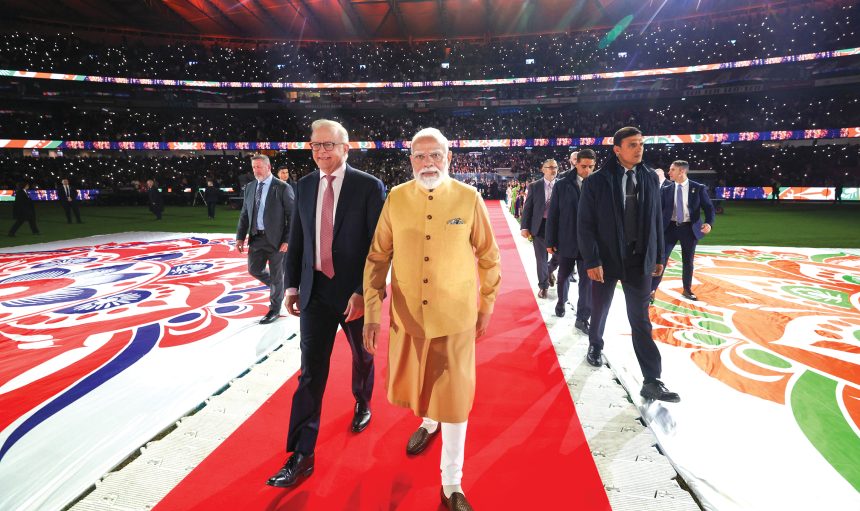
Both sides push for swift trade and investment frameworks
Melbourne: India and Australia on Thursday sealed a raft of landmark pacts spanning civil nuclear energy, maritime security and critical minerals sectors, as Prime Minister Narendra Modi and his Australian counterpart Anthony Albanese reinforced the vital role of the bilateral partnership in ensuring a peaceful Indo-Pacific.
A major highlight of the summit talks between the two leaders was their focus on significantly ramping up defence ties, especially in the maritime domain, a move that came amid heightened regional anxiety following China’s test of a submarine-launched, long-range ballistic missile earlier this week.
Notably, the agreement on civil nuclear energy to facilitate the commercial supply of uranium from Australia to India to fuel New Delhi’s nuclear power projects was sealed after over two years of negotiations, and it followed nearly 12 years after the two countries inked a historic civil nuclear cooperation pact.
In another significant decision, India and Australia decided to work expeditiously to firm up the proposed Comprehensive Economic Cooperation Agreement as well as a bilateral investment protection framework to further enhance the trade and investment relations.
A joint declaration on defence and security cooperation, a maritime security collaboration roadmap, a joint statement on energy security and a partnership for cyber, critical technologies and supply chains were among 18 pacts signed following summit talks between the two prime ministers.
Modi described as “unparalleled” the outcomes from his talks with Albanese, especially in areas of renewable energy, climate action, nuclear energy, critical minerals, technology and education.
The agreements sealed at the summit also included one between the Indian Coast Guard (ICG) and the Maritime Border Command (MBC) of Australia, and it will provide cooperation in the field of maritime law enforcement, domain awareness and maritime border protection. The two sides also vowed to work closely in shipbuilding, ship repair and maintenance.
Modi landed in Australia from Indonesia on the second leg of his three-nation tour, aimed at boosting trade, energy and defence ties against the backdrop of an increasingly fractured geopolitical environment.
Under the provisions of the energy security framework, India and Australia vowed to strengthen energy security by maintaining a stable, secure and reliable supply of coal, diesel, other liquid fuels and natural gas.
The maritime security roadmap provides for defence and security collaboration with a long-term perspective to enhance collective strength, besides deepening cooperation in the defence industrial sector to co-develop military hardware and build supply chain resilience. It will also accelerate efforts to build inter-operability and information sharing between the defence forces of the two sides and expand aircraft deployments from each other’s territories, the document said.
At a media briefing, Foreign Secretary Vikram Misri, replying to a question on China’s missile test, said the Australian Prime Minister flagged the issue with concern and that both, India and Australia would like to see peace, security and stability in the Indo-Pacific.
In his media statement, Modi elaborated on the outcomes in areas such as renewable energy, climate action, nuclear energy, critical minerals, technology and education.