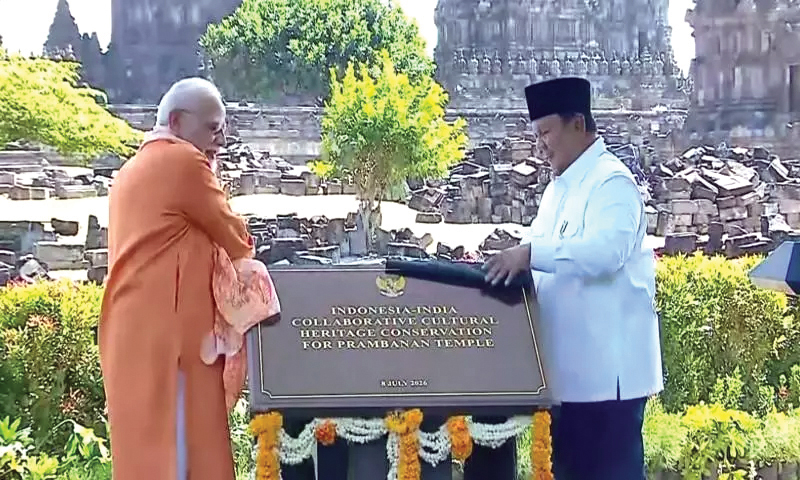
Yogyakarta: Prime Minister Narendra Modi, along with Indonesian President Prabowo Subianto, on Wednesday visited the centuries-old iconic Prambanan Temple complex in Yogyakarta, marking the inauguration of a joint conservation project for this UNESCO World Heritage Site.
Modi described the initiative as a “shining example of the enduring civilisational bonds” between India and Indonesia, rooted in a shared heritage that has connected the people of the two countries for centuries.
“Built in the 9th century, the Prambanan Temple complex is the largest temple complex in Indonesia dedicated to the Trimurti-Lord Brahma, Lord Vishnu and Lord Shiva. The temple complex stands as an enduring symbol of the shared civilisational and cultural heritage between India and Indonesia,” the Ministry of External Affairs said.
PM Modi’s visit came a day after both countries exchanged a Letter of Intent to start the project for the conservation and restoration of the temple complex with assistance from India.
The joint conservation project, in which the Archaeological Survey of India (ASI) will be the lead agency from the Indian side, and the visit by PM Modi and President Prabowo to the iconic temple complex in the Yogyakarta region reflect the emphasis New Delhi puts on cultural diplomacy in boosting bilateral ties, according to experts.
Modi, who landed in Jakarta on Monday to a grand welcome on the first leg of his three-nation tour, and President Prabowo travelled to Yogyakarta on Wednesday. They visited the Prambanan Temple complex and also unveiled a plaque, marking the commencement of the ASI’s conservation and restoration project at the temple site.
“President Prabowo Subianto and I inaugurated the UNESCO World Heritage Prambanan Temple Compound Restoration and Conservation Project,” Modi posted on X after his visit.
“The magnificent Prambanan Temple stands as a timeless symbol of our cultural and spiritual links. Preserving such heritage is about safeguarding the traditions that continue to inspire generations,” he said
Modi said India is privileged to partner with Indonesia in this important endeavour. “As nations with deep cultural connections, India and Indonesia will continue to work together to celebrate our shared past while building an even stronger future,” he added.
On arrival at the Prambanan Temple complex, Modi was accorded a traditional welcome, following which the Prime Minister, accompanied by the Indonesian President, took a tour of the ancient site. Both leaders shook hands and stood for a photo opportunity, with the central spires of the temple complex in the backdrop.
During his visit, Modi was also given a glimpse of the project and history of the temple, depicted on a ceremonial panel titled ‘Indonesia-India Collaborative Cultural Heritage Conservation for Prambanan Temple Compound’.
The centuries-old temple, located approximately 17 kilometres northeast of Yogyakarta city, is considered Indonesia’s largest Hindu temple.
In his address, while visiting the UNESCO-listed site, Modi said it was his honour to be part of the inauguration of the joint conservation project for the temple complex.
By visiting this place with “friend, President Prabowo”, this occasion has become special for me, he said.
The warmth between the two leaders was visible throughout the visit to the Prambanan Temple complex, signified by cordial handshakes, waving of their hands at the gathering and a warm hug towards the end of the visit to the heritage site.
“In conversations I hear, the winds here carry a scent of culture. That scent which we feel every moment on the soil of India. This scent, this cultural heritage, connects us,” Modi said.
“1,200 years…I thank the people here (in Indonesia)…The way they have preserved this grand heritage, and maintained it, and done it with a devotional faith. So, I also wholeheartedly greet people of Indonesia and all the rulers (of Indonesia) who have been, so far,” he said.
Modi described his experience of visiting the temple as a “’Chaitanyapurn chhann’ (a moment imbued with a sense of divinity)”.
“I prayed to the Almighty for strengthening the India-Indonesia friendship, for the welfare of citizens of the two countries, and for swift development of the two nations, and offered worship with devotional faith,” he said.
While delivering his remarks, PM Modi, alongside President Prabowo, stood at their podiums, with the spires of the grand temple in the backdrop.
“As we begin the conservation and restoration work at Prambanan Temple complex, which is a UNESCO World Heritage, I am very assured that Indian tourists will definitely visit this place,” he said.
India said its support for the restoration and conservation of the temple complex “reflects its enduring commitment to preserving shared civilisational heritage”.
The conservation project follows the understanding reached between the two sides during President Prabowo’s State Visit to India in 2025 to explore India’s assistance for the restoration of the temples at the Prambanan complex, the MEA said in a statement.
“India has had a successful track record of heritage restoration and conservation of several World Heritage Sites in Southeast Asia. ASI has also earlier undertaken extensive documentation of the Borobodur Temple Compounds in Indonesia,” it said.
In his address at the temple site, Modi said, “In far-off places of the world, wherever we go, we witness the cultural heritage of India. In Southeast Asia, this is the second-largest identity of our heritage. This temple has statues of Lord Shiva, Goddess Durga, and Lord Ganesha. For centuries, people have offered worship at this temple, and today I, too, had the fortune to visit this temple and offer prayers at this temple,” he said.
The original plan of the Prambanan temple was rectangular, consisting of an outer courtyard, middle courtyard and inner courtyard. The temples are subdivided into a higher and a lower terrace.
On the higher terrace are three major temples dedicated to Shiva, Vishnu and Brahma, with three smaller temples of their animal vehicles in front of them. The inner side of the walls of the Shiva temple is decorated with reliefs illustrating the epic Ramayana.