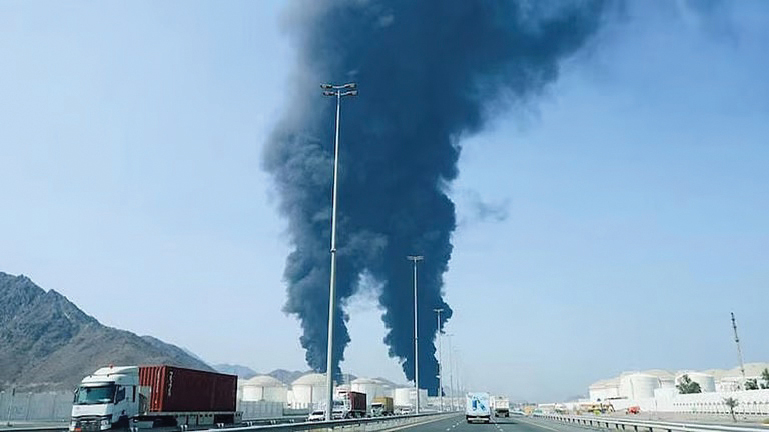
Retaliates after Israel hits important gas field
Dubai: Iran intensified its attacks on oil and natural gas facilities around the Gulf on Thursday, raising the stakes in a war that is sending shockwaves through the global economy.
The strikes, in retaliation for an Israeli attack on a key Iranian gas field, sent fuel prices soaring and risked drawing Iran’s Arab neighbours directly into the conflict.
Tehran’s targeting of energy production further stressed global supplies already under pressure because of Iran’s stranglehold on the Strait of Hormuz, a strategic waterway through which a fifth of the world’s oil is transported.
Since the US and Israel launched the war on February 28, Iran’s top leaders have been killed in airstrikes .
The country’s military capabilities have been severely degraded. Still, Iran – now led by the son of the supreme leader killed in the war’s opening salvo – remains capable of missile and drone attacks rattling its Gulf Arab neighbours and a global economy dependent on the energy they produce.
Underscoring the danger to ships in the region, a vessel was set ablaze off the coast of the United Arab Emirates and another damaged off Qatar. But efforts to bypass the strait were also under pressure: An Iranian drone hit a Saudi refinery on the Red Sea, which the country had been hoping to use as an alternative exit route.
Brent crude oil, the international standard, spiked to as high as $118 a barrel, up more than 60% since Israel and the United States started the war. The European benchmark for natural gas prices rose 17% on Thursday and has doubled in the past month.
Qatar, Saudi Arabia and the UAE denounced the Iranian attacks. Arab League Secretary-General Ahmed Aboul Gheit called them a “dangerous escalation”. But Iran showed no signs of backing down.
Saudi Arabia said its SAMREF refinery in the Red Sea port city of Yanbu was hit. Saudi Arabia had begun pumping large volumes of oil west toward the Red Sea to avoid the Strait of Hormuz.
Qatar, a key source of natural gas for world markets, said extensive damage was caused by Iranian missiles hitting the Ras Laffan LNG facility where production had already been halted after earlier attacks. Damage to the facility could delay Qatar’s ability to get supplies to the market even after the war ends.
Two refineries in Kuwait and gas operations in Abu Dhabi also were targeted by Iran, local authorities said.
In Israel, more than a half-dozen waves of Iranian attacks targeting large parts of the country sent millions of people to shelters. The strikes caused damage to buildings but no significant casualties were reported.
After the latest Iranian barrage, Israeli Energy Minister Eli Cohen said the electricity grid in northern Israel sustained some damage. He said crews had restored electricity to some areas and were working to restore it in others. Israeli media showed images of black smoke rising from an oil refinery in the northern city of Haifa.
Pentagon seeks $200 bn in addl funds for war
Washington: The Pentagon is seeking $200 billion in additional funds for the Iran war, a sizeable amount that is certain to be met with questions from Congress, which would need to approve any new money. The department sent the request to the White House, according to a senior administration official, who spoke on condition of anonymity to discuss the private information. Asked about the figure at a press conference Thursday, Defense Secretary Pete Hegseth did not directly confirm the amount, saying it could change.
India condemns strikes on hubs
New Delhi: As fresh attacks on West Asian gas hubs triggered global concerns, India on Thursday said the strikes are “unacceptable and need to cease” even as Prime Minister Narendra Modi reached out to top leaders of Oman, Jordan, France and Malaysia, emphasising the urgency to restore peace in the volatile region.
Following his phone conversation with Jordan’s King Abdullah II, Modi said the attacks on energy infrastructure in West Asia are “condemnable and can lead to avoidable escalation”.
New Delhi described the attacks on the gas infrastructure as “deeply disturbing”.
It said that the assaults will only serve to further destabilise an already uncertain energy market globally.
India’s reaction to the attacks on the energy infrastructure appeared to mark a nuanced shift in its position as it did not distinguish between Israeli strike on the Iranian gas hub and Iran’s counter attack.
New Delhi had earlier only condemned Iran’s attacks on civilian infrastructure in several Gulf nations, including Oman, Saudi Arabia and the UAE, but stopped short of denouncing attacks on Iranian facilities.
“India had previously called for the avoidance of targeting civilian infrastructure, including energy infrastructure, across the region,” External Affairs Ministry spokesperson Randhir Jaiswal said at his weekly media briefing.
“The recent attacks against energy installations in different locations across this region are therefore deeply disturbing and only serve to further destabilise an already uncertain energy scenario for the whole world,” he said.