AP
Washington
As the war in the Middle East intensifies, US President Donald Trump said that the US has “the capability to go far longer” than its projected four-to-five-week time frame for its military operations against Iran.
Across Tehran, the sound of explosions rang out through the night and into the early morning hours on Tuesday, as the US and Israel have continued to pound Iran since killing its Supreme Leader Ayatollah Ali Khamenei on Saturday.
Tehran and its allies have hit back against Israel, neighbouring Gulf states, and targets critical to the world’s production of oil and natural gas.
The intensity of the attacks and the lack of any apparent exit plan set the stage for a prolonged conflict with far-reaching consequences. Israel and the US have given conflicting answers about what exactly the war’s objectives are or what the endgame might be.
Israeli Prime Minister Benjamin Netanyahu late Monday defended the decision to go to war, contending in an interview on Fox News Channel’s ‘Hannity’ that Iran was rebuilding “new sites, new places” that would make “their ballistic missile program and their atomic bomb program immune within months,” without providing evidence.
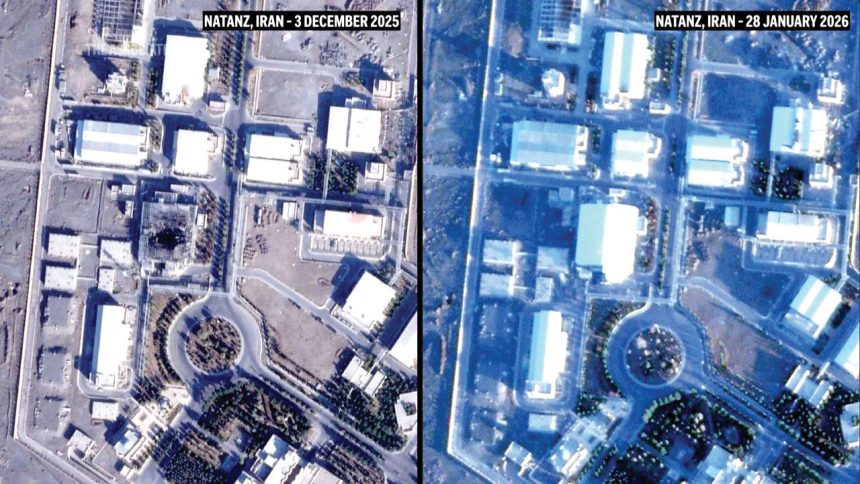
Satellite photos showed limited activity at two nuclear sites in Iran before the war, with analysts saying it was likely Tehran was trying to assess damage from American strikes in June and possibly salvage what remained there.
Turkish Foreign Minister Hakan Fidan renewed his call for an end to escalating violence and a return
to diplomacy.
“Our fundamental request and demand is clear: the mutual attacks must stop immediately, and diplomacy must resume,” Fidan said, according to a transcript of his remarks to journalists late Monday.
The minister said Turkey consistently emphasises this message during talks with other leaders.
Commenting on Iran’s attacks on Gulf states’ facilities, Fidan said Iran hopes these countries will pressure the United States to stop the war, while adding he believes that outcome
“is not likely.”
The Italian government said Tuesday it is working “non-stop” to assist Italian citizens stranded in the Middle East.
Italy scheduled two flights, including one from Muscat, Oman, to Rome’s Fiumicino airport on Tuesday to carry around 300 people and another from Abu Dhabi to Milan to carry about 200 people, mostly young students.
Another two flights are set to depart from Abu Dhabi to Milan and Rome in the early afternoon on Tuesday, while an additional flight from Muscat has been scheduled for Wednesday.
Italy’s Defence Minister Guido Crosetto sparked a political controversy at home after being stranded in Dubai with his family during the initial phase of the US-Israeli attack on Iran, returning to Rome on Sunday on a military aircraft.
The left-wing opposition called for Crosetto’s resignation, stressing that the minister travelled alone to an area of crisis without being informed of the deteriorating situation. Premier Giorgia Meloni defended the minister on Monday, saying he never stopped doing his job.
Romanian tourists arrived in Bucharest early Tuesday after travelling from Israel to Cairo to escape the conflict.
Hundreds of Romanian Orthodox Church pilgrims were stranded in Israel while visiting Bethlehem on a trip led by Romanian priests when the war broke out. The group was forced to cut their trip short to return to Romania.
Romanian pilgrim Mariana Muicaru said she was terrified as rockets flew across the sky in Israel.
“We called our children at 3 am to ask forgiveness because we might die and to tell them we love them and to let them know that it’s over for us,” she told The Associated Press.
The Kremlin said Tuesday that Russian President Vladimir Putin will convey the Gulf leaders’ concern over the Iranian strikes on their territory to Iran.
Kremlin spokesman Dmitry Peskov told reporters that Putin will “make every effort to facilitate at least minor easing of tension.”
He noted that after Monday’s calls with the leaders of the United Arab Emirates, Qatar, Bahrain and Saudi Arabia, Putin will convey their “deep concern about the strikes on their infrastructure” to Tehran.
A senior Hezbollah official says that after more than a year of abiding by the ceasefire as Israel’s strikes continued on Lebanon, the group’s patience has ended, leaving it with no option “but to return to resistance” and fight an open war with Israel.
Mohamoud Komati said Tuesday that Hezbollah exercised patience since a ceasefire ended the Israel-Hezbollah war in November 2024, hoping the government’s diplomatic efforts would yield positive results in ending Israeli strikes.
In the comments released by Hezbollah’s media office, Komati blasted the Lebanese government for calling Hezbollah’s actions illegal and demanded it hand over its weapons, saying it did not act to stop Israel’s airstrikes that continued on an almost daily basis for nearly 15 months.
“The Zionist enemy wanted an open war, which it has not stopped since the ceasefire agreement,” Komati said. “So let it be an open war.”