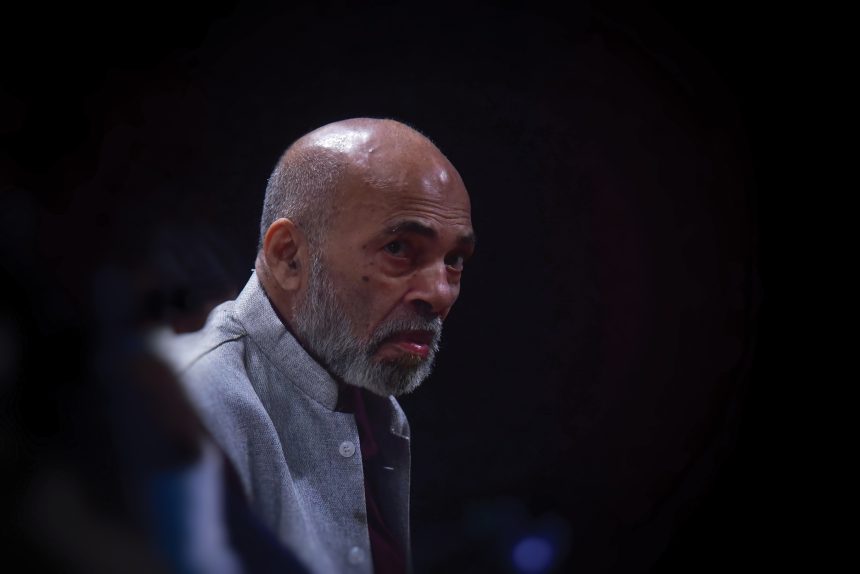
Playwright Pundalik Naik was honoured with the Jeevan Gaurav Puraskar yesterday. His collaborators
recall his work in Konkani theatre, literature, and the language movement
RAMANDEEP KAUR | NT BUZZ
Actor, writer and translator, Prashanti Talpankar first met Naik in 1983-84 through ‘Chitrangi’, a women’s literary organisation founded by Naik and his wife Hema. She had attended one of its gatherings after winning a prize in a poetry competition.
She says, “Their house was open to everybody. Many of us young girls used to go there. That is where I first saw and started reading his books. Later, I began watching his plays at
Kala Academy.”
Although she did not see Naik directing rehearsals, Talpankar says director Shridhar Kamat Bambolkar told her that Naik would sit through rehearsals, ask questions, and
suggest changes.
She and writer and filmmaker Jyoti Kunkoliekar performed Naik’s docudrama ‘Katha Asturi’ many times, mainly before women audiences. Kunkoliekar also produced it and played a lead role. “Women would tell us, ‘These are our stories’. Sometimes I feel he understood emotions that many women found difficult to express,” she says.
Talpankar says Naik’s plays are still relevant, citing ‘Khunn Khunn Mati’, which dealt with mining, ‘Pipul Petla’, which addressed exploitation of women, and his poem ‘Bangar Bail’, which portrays resistance against oppression. “The thinking that goes into his writing is what makes it important.”
The craft behind the plays
Naik, she says, cannot be compared with other Konkani playwrights. “His themes are universal. He wrote on a wide range of subjects and within the limitations of that time, also experimented. His language is superb,” she says, adding that Naik should not be seen as only a Goan writer.
Talpankar says Naik’s dialogues were among the strengths of his plays. She adds, “As an actor, I sometimes wonder whether he spoke the dialogues aloud before writing them. There is a rhythm to his dialogue. When you perform in his play, you stop thinking about acting. You become the character.”
Author, translator and playwright Mukesh Thali says Naik has contributed plays since the beginning of Kala Academy’s Konkani Drama Competition. “As Kala Academy completes 50 years, he has written around 25 plays for the competition, which is a record in itself,” he adds.
Thali says Naik balanced serious themes with humour. He adds that Naik’s plays employ symbolism, metaphor and poetic language, much of which is not immediately apparent to audiences.
Poet, author and theatre actor Ulhas Pai Raikar says Naik brought a new style of dialogue to Konkani theatre. His troupe, ‘Sanmachi’, staged the first performances of more than five of Naik’s plays, beginning with Khunn Khunn Mati’.
“He is a versatile writer. His dialogues were natural and appealing and the Konkani he wrote retained its original flavour,” says
Pai Raikar.
He says Naik’s characters were drawn from rural Goa, making them difficult to portray on stage. Pai Raikar played Rocksaib in ‘Khunn Khunn Mati’ a role for which he won first prize and which he considers among his most memorable. He also recalls acting in ‘Suring’, staged by his group ‘Thanthanpal’. The play was based on road-construction workers and used a “play within a play” format.
Pai Raikar says Naik gave directors and actors the freedom to interpret his scripts. “If we had doubts about a character, we would invite him and discuss it. But he always left room for an actor’s own interpretation.”
A legacy in cinema
Writer and filmmaker Kunkoliekar says Naik’s work also extended to cinema. “His plays reached the widest audience because theatre has always had a strong following. But his work also reached audiences through films, for which he wrote stories, screenplays, dialogues and lyrics.”
Kunkoliekar, who has worked in nine of Naik’s plays, says she co-produced and acted in ‘Dekhni Durai’, while ‘Dishta Daulat’, was her independent production. Both films, based on Naik’s writing, received awards at the Goa State Film Festival.
She adds that writing for the stage and the screen is equally challenging. “Naik has written both and his works keep audiences engaged while conveying a message.”
Champion of Konkani
Writer and activist Uday Bhembre recalls Naik’s role in the 1986 Konkani Language Agitation, when he served as convener of Konkani Porjecho Avaz, an organisation formed in 1985 to demand official language status
for Konkani.
He says, “We found that Naik was young, committed and articulate in his speeches as well as his work, and he was requested to be the convener.”
The organisation worked for nearly a year, pressing for an official language law and also raising demands for Goa’s statehood and inclusion of Konkani in the Eighth Schedule of the Constitution.
The agitation led to the Official Language Bill being introduced in 1986 and passed on February 4, 1987. “The movement also witnessed incidents of violence, including the theft of Naik’s family printing press at Volvoi, which forced it to shut down.” However, he says the agitation was largely
peaceful.
Bhembre adds that Naik’s plays also helped the Konkani movement because people understood the importance of the language through theatre. “He was fully committed to the language as well as Goa.”
Goa attained statehood on May 30, 1987, while Konkani was included in the Eighth Schedule of the Constitution in 1992.
Recognition long overdue
Associate professor of English at Carmel College of Arts, Science and Commerce for Women, Nuvem, Glenis Mendonca, says Naik’s recognition was long overdue. “He should have been felicitated much earlier, when he was in the best of health. His works were created over several decades, not recently. Better late than never.”
She says Naik’s writing captures the dialect, culture and everyday life of Goa’s mining belt. “It is very different from the urban Goa we
see today.”
Retired English professor and translator Augusto Pinto believes Naik has not received the national attention he deserves because so little of his writing is available in English.
He says, “Pundalik Naik is arguably the greatest litterateur Konkani has produced and certainly its greatest dramatist.” He recalls that Naik became a household name in Goa in the mid-1970s when his works were adapted for All India Radio. “People would eagerly tune in whenever they realised one of his dramas was being broadcast,” he says. His profile later grew across the country after winning Akashvani Awards for ‘Mornokotto’, ‘Shebai Shebai Bahujan Samaj’ and ‘Chaitanyak Mutt Na’.
Having studied Naik’s work, Pinto says the playwright belongs alongside India’s leading modern dramatists including, Vijay Tendulkar, Girish Karnad, and Badal Sircar.
The challenge of translation
Mendonca says more of Naik’s works need to be translated to reach wider audiences, pointing to ‘Acchev’, translated into English as ‘The Upheaval’ by Vidya Pai and included in the undergraduate NEP syllabus, as well as ‘5 Stories: Konkani’, also translated by Pai, which includes Naik’s short story ‘Victory’.
However, she says translating Naik’s plays is challenging because of his use of regional dialects and local cultural references.
Pinto too says that Naik’s plays are about the social milieu of rural Goa and the Bahujan Samaj, where many ideas and cultural concepts have no English equivalents. He adds, “His characters often break into poetry and song, which isn’t easy to translate.”
His biggest hurdle has been finding a publisher with a national distribution network. “Seven of his finest plays are still waiting to get into print.” They include ‘Mornokotto’ (Death Cliff), ‘Khunn Khunn Mati’ (A Muddle in a Mine), ‘Raktkhe’ (Bloodbath), ‘Suring’ (The Unexploded Dynamite), ‘Shebai Shebai Bahujan Samaj: A Political Disaster’, ‘Shri Vichitrachi Zatra’ (The Zatra of Shri Vichitra, God of the Bizarre) and ‘Chaitanyak Mutt Na’
(The Ashram).
Building institutions
President of Goa Konkani Akademi Purnanand Chari says Naik, who served two terms as Akademi president, introduced new schemes for literature and theatre, improved its functioning, and strengthened links with Konkani-speaking communities through various initiatives.
Lessons for the next generation
Talpankar says young playwrights can learn from Naik’s approach of researching subjects thoroughly and creating distinct characters through dialogue. “Anyone who wants to write plays should read Naik’s work along with those of Marathi playwright
Vijay Tendulkar.”
Thali, meanwhile, says they should study his language and dramatic technique while developing their own style.
For new readers, Mendonca recommends ‘Victory’ as a starting point, followed by
‘The Upheaval’.