The alumni of the historical Liceu Nacional Afonso de Albuquerque,
a former educational institution woven into Goa’s past will come together this Sunday
VINIKA VISWAMBHARAN | NT BUZZ
On a Sunday morning, laughter, overlapping conversations, and bursts of recognition will fill the air at Clube Tennis de Gaspar Dias, Miramar. Alumni of the Liceu Nacional Afonso de Albuquerque will gather once again, not as uniformed students, but as people in their 70s, 80s and 90s, drawn together by a school that shaped their lives and futures.
“This will be the fourth reunion,” says 83-year-old Cristo Prazeres da Costa, one of the organisers. “Many of us are old now. Some cannot move easily. Some cannot leave their homes. But in the heart, everyone wants to come.”
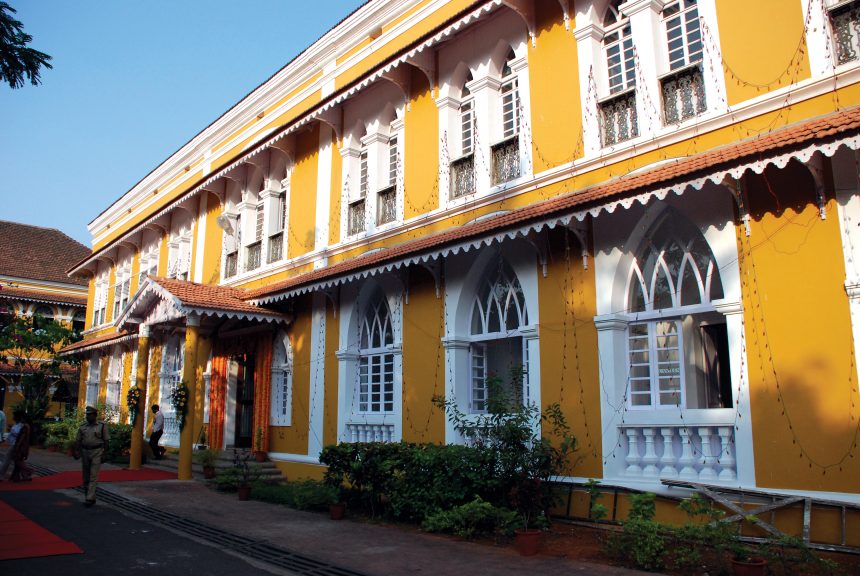
The Liceu, founded in 1854, was Goa’s most important secondary school during Portuguese rule. According to da Costa, for generations it was not simply a school but a foundation for life. “The Liceu was the basic education pillar in Goa,” he explains. “Anyone who wanted to study medicine, engineering, or go to university in Portugal had to come through the Liceu.”
The education system followed the European lycée model and was structured into three cycles spread over seven years. “It was a very old system, more than 200 years old,” he says. “The Portuguese followed it very closely. The Liceu in Panjim was an exact reflection of what existed in Portugal.”
Students were required to choose their path early. “At 15 or 16, you had to decide what you wanted to become,” recalls da Costa. “If you wanted medicine or engineering, you chose science. I chose science myself.”
Languages formed a major part of the curriculum. “We studied three years of English, five years of French, and at least five years of Portuguese,” he says. “In the last two years, if you continued, it became seven years of Portuguese.”
But the education extended far beyond academics. “We studied philosophy, religion and morals, and even the organisation of the state,” says da Costa. “Religion was not Catholic or Hindu. It was about values. It taught us how to be good citizens, independent of religion or politics. That stayed with us for life.”
Music and culture were equally important. “We had singing right from the first year,” he recalls. “Every year, at the end of the academic term, there was a gala dance. The governor attended. There was a prize-giving. The Liceu was the centre of youth culture in Goa.”
The institution came to an end after Goa’s Liberation. “The Portuguese left in December 1961,” he says. “The system continued briefly, then it was absorbed into the Indian education system. We were given equivalences so that we could continue studying.” Da Costa himself left Goa in 1960. “I went to Portugal for further studies and later to Germany where I stayed for 50 years.”
Despite lives lived across continents, the bond with the Liceu remains strong. Former students are spread across various regions like Goa, Portugal, England, Germany, and Switzerland. “There were no group chats in our time,” says da Costa with a smile. “Even now, we were somehow able to make a group chat of around 100 people.”
Tracking down former classmates required patience and personal networks. “We contacted people we knew,” he explains. “Then we asked them about others. One contact led to another. That is how we built the list.”
Around 60 former students are expected to attend this year, along with spouses and family members. “The oldest among us is 97. Four of our colleagues are over 90, and they are coming in person,” says da Costa.
The reunion is being organised by a small but experienced team. Along with da Costa, there is Francisco Noronha and Dr. Eduardo Fonseca.
The day will be anchored by Dr Sidney Pinto do Rosario, who will serve as master of ceremonies. “These reunions are usually a riot,” says da Costa laughing. “Everyone starts talking at once. The emcee has to calm people down. Former professors start going back to their professional roots by scolding the former noise makers and it all comes back to us, despite our age.”
As voices rise and memories flood back, order often gives way to emotion. “People forget their age,” he says. “They go back to their younger selves, to when they were students at the Lyceum.”
The programme will include talks by a professor from Lisbon and a former minister, along with music performed by the attendees themselves. “There will be guitars and ghumot playing, singing, and mando, which is the highlight,” says da Costa. Special recognition will be given to the oldest members. Books by historian late Vasco Pinho and others will also be displayed.
For da Costa, the reunion is about more than nostalgia. “Many of our colleagues are no longer here,” he says quietly. “Those who are alive want to remember. They want to feel that their school mattered.” He pauses, then adds, “The Lyceum gave us discipline, culture, and values. It prepared us for life, wherever we went. That is why, even now, we come back to it.”