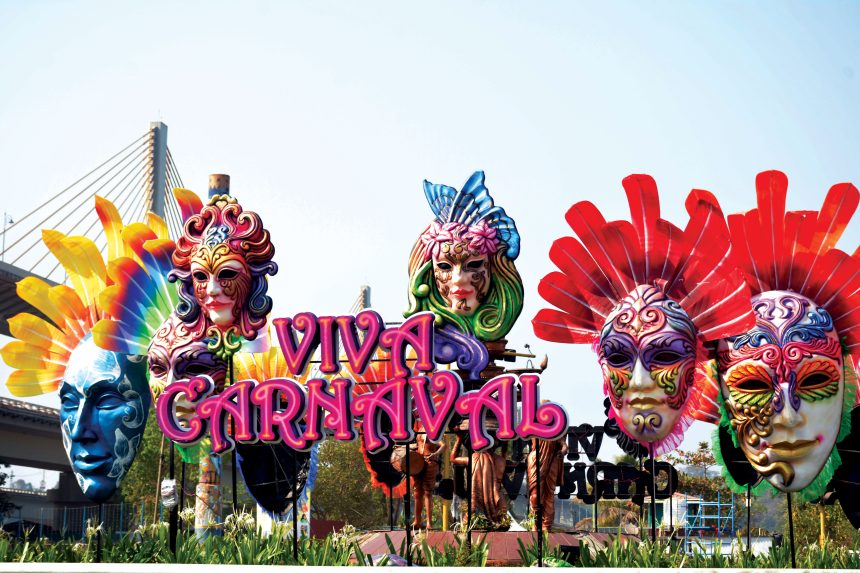
It’s the season of vibrant colours and revelry as Carnival begins towards the end of next week.
But what does this festival still evoke the same vibe and excitement?
NT NETWORK
The cheery-hued flags, ribbons, and masks are making their appearance. Special festive music and menus are being readied. In many towns and villages, groups are busy at work, putting together their floats, putting the final touches to their costumes, and practising their dance routines, all in anticipation of the grand Carnival float parade.
This year, Porvorim will open proceedings with their People’s Carnival Parade that aims to revive the original spirit of Goa’s Carnival and will have no motorised or fuel-driven vehicles, no generators, and no large
sound systems.
Over the following days, the parade will wind its way through the capital city on February 14 followed by Margao, Vasco, Mapusa, and Morjim. Alongside this, the festive period will also see many other cultural events across the state, including the coming alive of the Samba Square in Panaji.
And a lot of people are eagerly waiting for the festivities to begin. “Everybody looks forward to Carnival. For me, it’s a joyous time when the community comes together to celebrate just before Lent starts. I enjoy the street parties, meeting people, and celebrating with music and food,” says Ryan Fernandes, 45, from Panaji.
Rochelle D’Souza, 34, from Sernabatim agrees. “It’s the one time of year when the whole of Goa feels like one big family with the music on the streets, the colourful floats, the food, the laughter. Growing up, we waited all year for these few days. Now I look forward to seeing my kids experience the same joy,” she says.
Andrea Godinho from Panaji who is her 30s also enjoys the fun, the music, the food, and spending time with family and friends. “The place just feels happy and alive,” she says.
For Yachika Chopra e Vaz who originally hails from Bareilly, Gujarat, prior to her move to Goa, the only Carnival she had heard of was in Brazil. “It always felt grand, but distant.,” she says.
But after she experienced Goa’s Carnival she realised the festival is not just about floats or celebrations. “It’s about people. It’s about villages coming together for weeks, pouring their time, creativity, and heart into every detail. Each float tells a story, carries a theme, and reflects the spirit of the community behind it. You can actually feel the pride, the effort, the laughter, and the togetherness in the air,” says the Porvorim-based founder of Circa Pickles. What truly amazed her was how the entire state becomes part of it. “Streets feel alive, strangers feel familiar, and for those few days, there’s a shared joy that’s hard to put into words. It’s also something so unique — you simply don’t experience anywhere else in India,” she says.
“The energy is infectious,” agrees Arjun Choudhary, 26, who is down in the state from Mumbai. “I’ve seen pictures of the Goa Carnival for years, but being here in person is something else,” he says. “I’m looking forward to the street performances, local cuisine, and just soaking in the culture.”
But not everyone feels the same way. “I have seen the float parade before, it’s good but it lacks the ‘dhol tasha’ vibes of Shigmo. And it is predictable every year,” says 21-year-old Rigved A. from Panaji.
Naresh Sale from Miramar also agrees that the parade is nothing very special. “There are some floats from Mala that are worth watching out for. Apart from that it is the usual” he says.
Siya from Siolim meanwhile has never seen the floats parade in person. And has no plans to change that. “I have seen it on television. I don’t think I am up for the crowd and not very excited about
it,” she says.
For the older generation, the festival brings with it a tinge of nostalgia. “It no longer has the vibrant vibes,” says artist Querozito De Souza. “I remember the thrill of fancily dressing up and dousing friends and family with talcum powder, as the air filled with its fragrances. Then there was the music, street dances, and the impromptu street plays like khell tiatr in south Goa, electric with satire and humour.” Festivities like the traditional Potekar festival in Divar and the Samba Square programme however bring back some excitement and fervour, he says.
Author Willy Goes also shares that when he thinks of Carnival today, a deep sense of sadness comes over him. “What I see now feels like a superficial imitation of what Carnival once was. The parades no longer stir the soul. The floats lack meaning, and the spectators stand by as mere watchers, disconnected from the spirit that once bound us together.”
Goes counts himself fortunate to have experienced Carnival in its truest form during the 1970s and 1980s. “In those days, the joy was real and the participation sincere. We did not simply attend Carnival; we lived it. We spent weeks preparing our floats, practising our dances, and sharing laughter and excitement in our wards. Carnival belonged to all of us.”
But Goes holds on to hope. “Perhaps the spirit has not disappeared, but waits to be reawakened—in our communities, in our youth, in a renewed commitment to meaning over display,” he says. If we remember why Carnival mattered, and if we choose once again to participate with heart and purpose, then Carnival can find its way back to us. After all, Carnival was never just a parade. It was who we were—and who we can be again.”
(With inputs from Kalyani Jha, Vinika Viswambharan, and Christine Machado)