Miguel Braganza
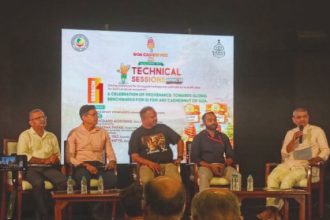
The word ‘Goa’ conjures an image of golden beaches with the slender coconut trees swaying in the gentle summer breeze from the Arabian Sea. The coconut tree promotes tourism industry in Goa by just being there. The tender coconut water is a major item of sale to the tourists on the beachfront and roadsides. It is not without reason that the first National Coconut Conclave held in Goa during October, 2025, drew participation of ministers, directors and scientists from many states. This has led to increased fund allocation for coconut in the Union
Budget of 2026-27.
Goa has three main cultivars of coconut: Benaulim, Calangute and Nadora. The Benaulim variety of coconut is now a candidate for registration of a ‘Geographical Indication’ or G.I. for Goa. The coconut palm, Cocos nucifera, is the state tree of Goa since 2017. The seemingly decorative notification in the ‘Official Gazette’ of Goa has kindled life in the traditional occupations like coconut plucking, toddy tapping and feni distillation. The tradition of coconut ‘Mother Palm’ and ‘Seed Nut’ selection now needs attention to ensure higher productivity in coconut and thereby ensure its sustainability.
The coconut palms produce one frond (leaf) and one spathe or coconut bunch every month to month and half (45 days). The short, newly bearing coconut trees are often used for toddy tapping and then for tender coconuts in order to reduce pilferage and earn an income to fund the manuring and care of the young coconut trees. Short trees also make these operations convenient. The older palms are used to harvest mature coconuts. They are the candidates for
seed production.
Coconut trees with large number of medium-sized coconuts must be selected as ‘Mother Palms’. This ensures higher probability of high yielding progeny through eugenics. The winter coolness slows down the evaporation of coconut water. Nuts harvested in the month of March have the highest water content when mature and are preferred for germination because coconut has a liquid endosperm. These are then stored in sand and provided with shade. With the onset of monsoon they are sown in the soil and allowed to germinate. The roots and shoot emerge from the liquid endosperm, that becomes the spongy ‘coconut apple’ or murundd , through the soft third ‘eye’ in the coconut shell. Raising seedlings is professional work that needs
knowledge and experience.
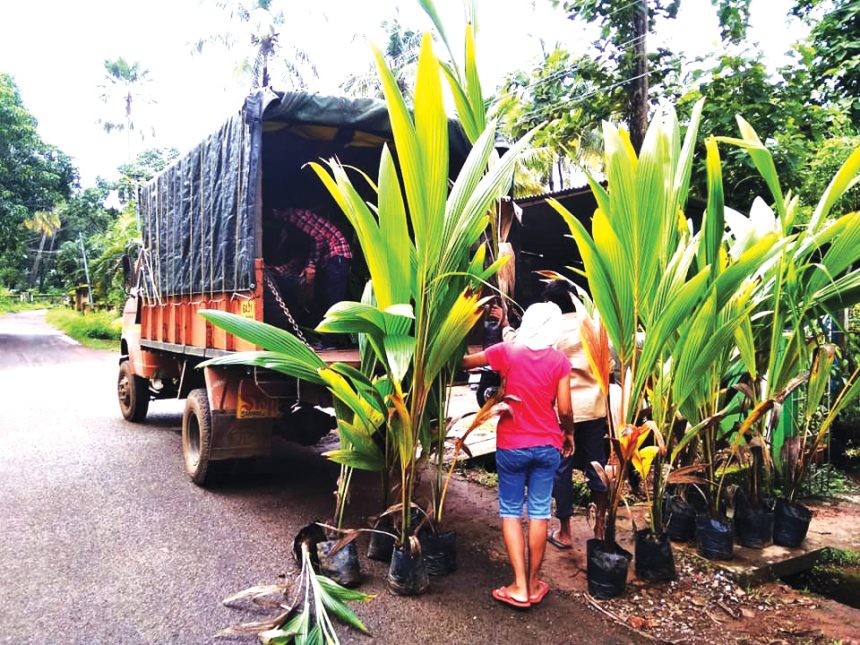
One year old seedlings having six to eight fronds, with early splitting of leaflets and a thick collar (or point of insertion of the leaf bases in the nut), are preferred. Germinated coconuts are now grown in large polybags to do away with the need to uproot the seedlings for transplanting. This makes the maintenance, transportation and transplanting easy. Planting is normally done in the months of June, with the onset of the monsoon rains. If irrigation water is available, planting is also done in March or August to avoid rain damage. We need to revive these specialised professions for establishing plantations with assured high productivity.
Since 2022, the Goa College of Agriculture at Ela Farm continues to bring hope for the revival of agriculture in Goa that was started in 2015 with the Don Bosco College of Agriculture at Sulcorna, Quepem. Homegrown agriculture graduates have startups that provide technical guidance and turnkey solutions to farmers. They also supply quality inputs including seeds and seedling to
garden enthusiasts.