On World Poetry Day, youth are reclaiming verse as an accessible medium to slow down, find community and make sense of their experiences
VINIKA VISWAMBHARAN
NT NETWORK
In a fast-paced world, poetry continues to find space. It does not try to keep up; instead, it creates a pause that stays with the reader.
Today, on World Poetry Day, young people across Goa are engaging with poetry in ways that feel both personal and shared. At a time when attention spans are often questioned, poetry continues to hold its ground, at open mics, in college corridors, on Instagram feeds and even in the “notes” apps of phones at 2 a.m. It is immediate, accessible and drawn from lived experience.
A personal arrival
For many, poetry no longer begins on textbooks or in classrooms. It begins in moments that feel too heavy or complicated to say out loud. “Poetry was my way of saying things I couldn’t express otherwise,” says Abigail De Noronha, a 21-year-old student from Colvale. “I got into it through performance videos online. I would watch them for hours, completely captivated by how people could tell stories so beautifully.”
The shift is subtle but important. Poetry is no longer distant or academic, but it is something people discover on their own. “Honestly, it’s not about getting it right,” says Princy Carol Gonsalves, 24, an assistant professor of English from Quepem and author of the anthology ‘Aspire in the Dark’. “It’s about being real. You don’t need complicated words or structures. If you feel something strongly enough, that is already a starting point.”
Community and
collective expression
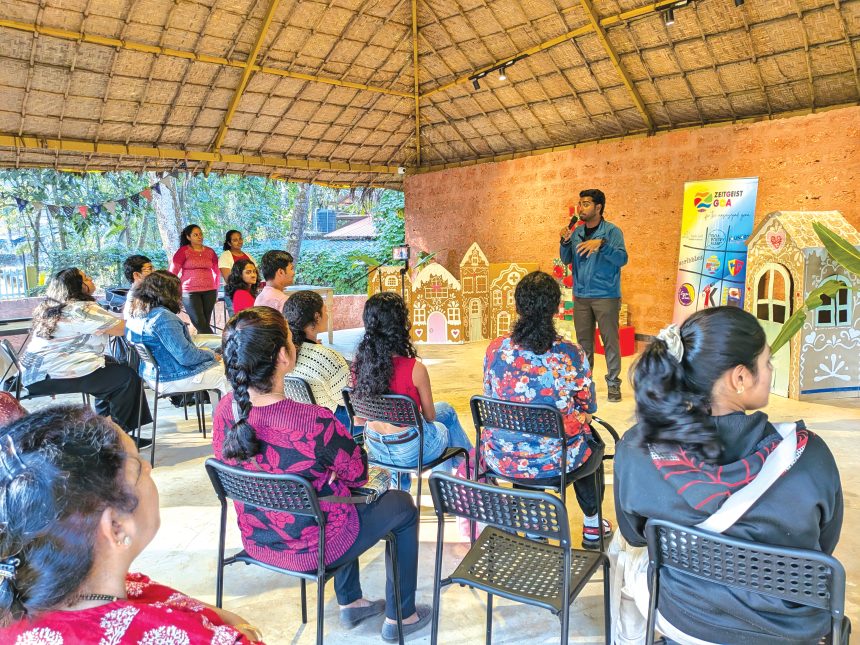
While poetry often begins in private, it rarely stays there. Across Goa, spaces are emerging where people come together to share, listen and respond. Andrew Barreto, founder of Zeitgeist Goa and initiatives such as the ‘Goa Poetry Slam’ and ‘Carpe Diem’ under Chowgule College’s English Tygers Club (etc), says the idea grew from a gap he noticed.
“There wasn’t really a space for young people to just show up and share,” says Barreto, an academician based in Margao. “A lot of what existed felt closed off or out of reach.” What he built instead was intentionally open. “Our sessions are very interactive,” he says. “It’s not just someone reading and leaving. People respond, they talk, they engage with what’s being said.”
That openness leads to unexpected moments. Barreto recalls one where a young poet spoke about struggles at home. “What stayed with me was how the audience responded,” he says. “There were older people there, even parents, and they did not judge. They simply listened and responded with empathy.” He says this is what gives such spaces their value. “It allows people to leave with a more open mind, not just about poetry, but about each other.” A similar approach defines Poets of Goa, led by writer and journalist Gargi Guha. “We keep it very simple,” she says. “We sit in a circle and anyone who wants to share can. There is really no pressure.” That simplicity changes how people engage. “A lot of people walk in thinking they will just listen,” she adds, “but by the end, they find themselves wanting to share something too.” For Guha, the absence of structure is intentional. “There is no stage, no hierarchy,” she says. “That changes everything. People let their guard down and show up more honestly.” Both spaces point to something larger than poetry itself. “It starts feeling like a community,” Guha says. “Almost like a tribe.”
The digital paradox
At the same time, poetry today is influenced by the digital space. “It is more accessible now,” says Gonsalves. “Platforms like Instagram, Facebook and YouTube bring poetry into everyday scrolling. You don’t need to buy a book. It is instant, free and easy to come across.”
She adds that this has also affected how poetry is written. “Shorter pieces tend to work better online. People connect with something they can read and respond to quickly.”
Guha sees this as part of the journey. “Many people discover poetry online first,” she says. “But when they experience it live, it feels very different, more real and personal.” Barreto shares a similar view. “Online platforms help bring people in,” he says. “But the real connection happens when people are in the same space, reacting to each other in real time.”
Not everyone is comfortable with these changes. “Sometimes it feels like people just break lines randomly and call it poetry,” says Kanaka Desai, a content writer from Fatorda. “While I am no poem police, I can be a bit old-school about it.” Even so, most agree that live and online experiences are different. “I still prefer live performances,” says Finoshka Rodrigues, an assistant professor from Margao. “There is something about being in that moment,” says Desai. She adds that when she posts her poems online, the response is often measured, unlike live performances where reactions play out in real time.
For Venicia Vaz, a photographer from Panaji who occasionally writes poetry, it comes down to connection. “Performing in person feels more real,” she says. “There is a sense of community you don’t quite get online.” “These days, people often just need someone to listen,” says Virginia Dias, an educator from Navelim. “For me, writing became a way to cope when I had no one. In today’s social media age, poetry connects the writer and the reader in a very real way.”
A tool for growth
The themes young poets return to are personal but rarely isolated. “A lot of what I write circles around trauma, love and even anger,” says Rodrigues. Vaz takes a more intuitive approach. “I write about the people around me and different phases of my life. It could be something as simple as a feeling I cannot quite explain.”
In organised spaces, these themes often come together in interesting ways. “We sometimes set themes for our sessions,” says Guha. “It could be grief, the sea or new beginnings. It helps people explore similar emotions from different perspectives.” Barreto sees this contrast often. “You will have someone older talking about nostalgia,” he says, “and then a younger person speaking about self-doubt or comparison. Both feel equally relevant.”
For Gonsalves, poetry is a form of growth. “I find myself writing a lot about self-doubt and becoming stronger,” she says. “I want people to see themselves in what I write.” Poetry often creates unexpected connections. “I was once asked to recite a poem in class and by the end, I could see tears in my teachers’ and classmates’ eyes,” says Dias. “That is the beauty of performing poetry; you can feel when people truly understand it.” “I once shared a poem thinking people would just read it and move on,” shares Gonsalves. “But someone reached out saying it felt like their exact story. That stayed with me.”
Not every response is easy. “I did receive a negative response once,” admits Noronha. “It was discouraging at the time but I’ve come to realise that criticism is part of the process.”
Why it still matters
Poetry matters because it forces a pause in a fast-paced world. “It allows individuals to reconnect with their internal states, a necessity that is often overlooked in daily life,” says Gonsalves. Barreto emphasises that the impact of poetry extends into the conversations and different perspectives that follow a reading. Noronha believes that poetry eventually evolves from a solitary act into a shared experience. Guha has observed that the medium has a way of making guarded people open up and share things they never planned to say.
For those who feel intimidated about starting their own journey, Rodrigues advises writing badly if necessary, as the skill develops along the way. “You don’t need to be a legendary figure like Shakespeare to start; you can simply write,” says Desai. “If a piece of writing makes you feel something, it has already become a poem.”