Drawing from extensive research and years of travel across Goa, A.P. Singh’s latest book explores the state’s overlooked temple heritage, tracing its relocation and cultural revival
VINIKA VISWAMBHARAN | NT BUZZ
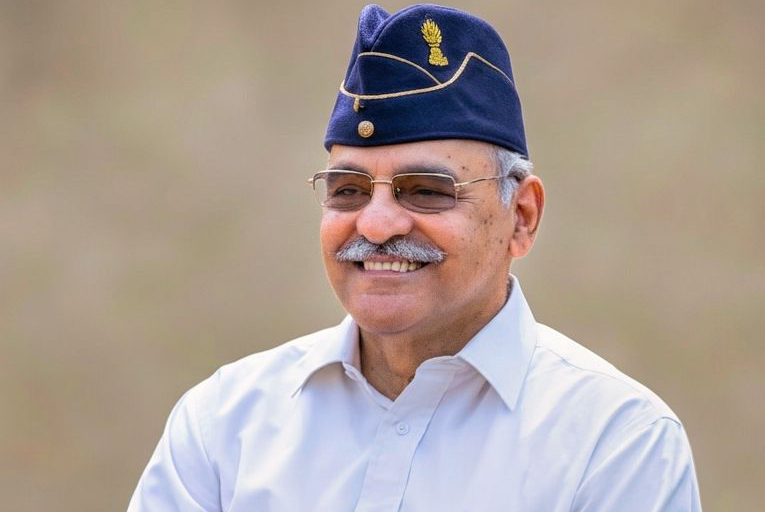
Goa’s temples are often overshadowed by the state’s image of beaches and nightlife. Brigadier AP Singh hopes his latest book changes that conversation.
The New Delhi-based author and former Army officer has spent the last four years travelling across Goa documenting temple histories, oral traditions, and architecture for ‘Temples of Goa: History, Portuguese Persecution & Revival’, a richly illustrated work that explores the state’s lesser-known spiritual and cultural heritage.
Born in Balrampur in Uttar Pradesh, Singh’s full name is Amreshwar Pratap Singh, though he prefers to publish under the name A.P. Singh.
The book features hundreds of photographs taken by Singh himself during extensive field visits across Goa. From remote village shrines to larger temple complexes, the project involved repeated journeys across the state, conversations with priests and temple trusts, and years of archival research. “A lot of effort went into travelling, documenting and speaking to people connected with these temples,” Singh says.
His interest in heritage and temples, he says, began long before he started writing books. Singh served in the Corps of Engineers of the Indian Army and travelled widely during his service years. “In the Army, I kept seeing new things and new places,” he says. “I was always interested in seeing the heritage and temples of wherever I was posted. After retirement, that interest became focused.”
Before writing about Goa, Singh authored ‘Kashmir: The Land of Rishis – A Journey Through Time’, a work centred on Kashmir’s civilisational history. He believes the histories of Kashmir and Goa are deeply interconnected. “Kashmir and Goa are interconnected through our civilisational memory,” he says. “The traditions, deities and communities all have links that travel across regions.” While researching Goa, Singh realised how little people knew about the state’s temple heritage. “When you tell people there are temples in Goa, they are surprised,” he says. “They ask, ‘Are there temples in Goa?’ I found that shocking. How can any part of India not have temples?” That disconnect became one of the driving forces behind the book.
“What people see in the media is only one version of Goa,” he says. “Go just five kilometres inside and you discover a completely different world.” Researching that “different world” was not easy. Singh says much of the historical documentation connected to the Goa Inquisition was destroyed during Portuguese rule, forcing him to rely on secondary sources, traveller accounts, and surviving archival material. “A lot of records were burned,” he says. “So I had to rely on missionary correspondence, British traveller accounts, and archival sources that still exist elsewhere.”
He was equally determined to avoid hearsay. “I wanted everything to be substantiated,” he says. “That is why the bibliography is so extensive. Every fact had to be backed by a source.”
The book traces Goa’s history from mythological origins associated with Parashuram and early dynasties to the Portuguese colonial period and the destruction and relocation of temples during the Inquisition. Alongside documented history, Singh also relied heavily on oral narratives preserved by local communities. “Each temple has its own story,” he says. “Some are linked to scriptures, while others survive through oral traditions passed down over generations.”
One of the aspects Singh found most fascinating was Goa’s distinctive temple architecture, shaped by centuries of political and cultural change. “Goa breaks the conventional rules of temple architecture,” he says. “You see a fusion of traditional Indian styles, Portuguese influences and even Islamic elements. That combination happened because of Goa’s history.”
He points to the brightly coloured temple exteriors and the towering ‘deepstambhas’, or lamp towers, found in many temple complexes. “Most of these ‘deepstambhas’ are never lit,” explains Singh. The reason is that many temples were relocated after the original temples were destroyed. “Since these are not the original sacred sites, the lamps are not lit there.”
Despite documenting persecution and loss, Singh says what stayed with him most was the devotion he witnessed in Goa’s villages. “I attended some of the local ‘zatras’ and the entire village would come dressed as though they were attending a wedding,” he recalls. “That level of enthusiasm and cultural continuity is extraordinary.”
The book’s foreword is written by François Gautier, whom Singh personally travelled to meet in Auroville. “He has done a lot of work bringing attention to Indian civilisation and the Goa Inquisition,” says Singh. “I felt he was the ideal person to write the foreword.” Historian Vikram Sampath and researcher Sushama Arur also endorsed the book.
The book’s cover itself draws from Goa’s traditional Kaavi art form, featuring terracotta-red motifs inspired by temple and mural traditions, created by a multidisciplinary artist Rinku Sood. Singh says the idea emerged during one of his temple visits to Morjai Temple in Morjim with heritage expert Shefali Vaidya, who introduced him to the visual language and symbolism associated with Kaavi art, a key architectural feature of the temple.
Ultimately, Singh says the book is about encouraging readers to look beyond Goa’s familiar image. “There are hidden gems everywhere,” he says. “People just need to look beyond the surface.”