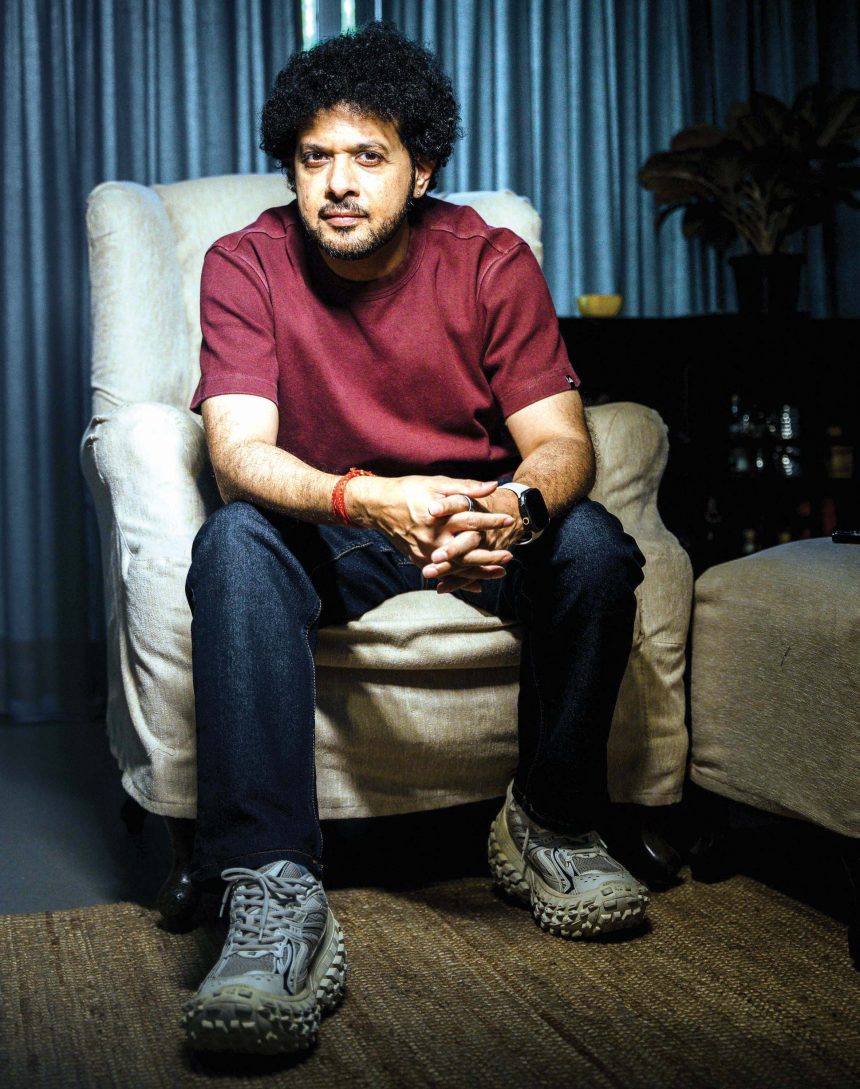
Ahead of bringing his genre-blending show ‘Infusion’ to Goa, Hindustani classical vocalist Mahesh Kale
speaks about why he believes Indian classical music still belongs to everyone
VINIKA VISWAMBHARAN | NT BUZZ
Hindustani classical music will blend with jazz, soft rock, and Western instrumentation when vocalist Mahesh Kale brings his concert ‘Infusion’ to Goa on May 30 at the Dr Shyama Prasad Mukherjee Stadium, Taleigao.
This idea for ‘Infusion’, says Kale, grew naturally from years of musical interactions across cultures.
“The environment around you inspires you,” he says. “If you look at history, music has always evolved through cultural exchange. The rabab became the sarod. Instruments travelled, adapted and transformed. Living in San Francisco for nearly 20 years, I was constantly surrounded by musicians from different traditions, and I started wondering if there was a way to have a conversation between Indian classical music and
Western instruments.”
That conversation began informally. Kale found himself singing raagas alongside jazz musicians, saxophonists and drummers during casual jam sessions. “I would respond to their music by singing what I know best, which is raaga music, and somehow it always felt beautiful,” he recalls. “I remember attending a friend’s wedding in Arizona where some incredible musicians had gathered. We started playing together casually, and there was such a meaningful exchange happening through music that I thought this possibility needed to be explored further.”
Yet ‘Infusion’ is driven by something larger than experimentation. At its heart lies Kale’s concern that younger audiences are slowly drifting away from Indian classical music. “The larger part of today’s youth unfortunately does not know instruments like the sarangi, tanpura or ravanahatta,” he says. “Sometimes you even see advertisements where somebody holds a sitar thinking it is a tanpura. That lack of awareness bothered me.”
Kale decided to approach the problem differently. “I thought, young listeners already understand the sonic space of pop, rock and jazz. So why not use that familiar soundscape to introduce them to Indian classical music?”
The experiment, he says, has worked. Kale has written nearly 150 original classical compositions, many of which are now being reimagined through contemporary arrangements. Some include jazz structures, soft rock elements and even English passages woven into traditional bandishes.
“In Pune, we created fan pits where youngsters stood for two or three hours listening to Indian classical music,” he says. “That tells me something important. Once they discover the music through these formats, many of them eventually come to my conventional classical concerts too.”
In fact, Kale stresses that classical music remains at the centre of everything he does. “Eighty per cent of my performances are still traditional concerts,” he says. “I have not moved away from my core.”
That balance between innovation and tradition also shapes the way ‘Infusion’ is created on stage. Rather than rigid arrangements, Kale prefers an organic rehearsal process where every musician contributes creatively. “We rehearse extensively, but I do not hand over music and ask musicians to play it mechanically,” he explains. “I want every artist to find themselves within the music. Once the musicians connect with it personally, the audience connects too.”
And while fusion projects often face criticism from classical purists who believe experimentation weakens tradition. Kale, however, sees it differently. “How does adding another instrument dilute music?” he asks. “The santoor itself entered Hindustani classical music much later. Did Shivkumar Sharma dilute tradition? Absolutely not.” For him, the question comes down to intent. “Dilution happens when people mindlessly use Indian elements without understanding them,” he says. “My intention is not market-driven. I genuinely want younger audiences to discover Indian classical music.” He pauses before adding, “You can call it dilution. I choose to call it enhancement.”
Interestingly, long before sold-out concerts and international tours, Kale was headed towards a very different life. Armed with a degree in engineering management in the United States, he was on track for a successful corporate career in Silicon Valley. Kale says his decision to leave behind a corporate career and pursue music full-time would not have been possible without the support of his family. He grew up in a deeply musical household, where devotional music and classical traditions were part of everyday life. “My mother completed her master’s in music, my father loved devotional music and taught me hundreds of ‘abhangs’, and my brother plays the tabla,” he says. When he eventually chose music over Silicon Valley, his family stood firmly behind him, especially his wife, who supported the decision during the uncertain early years.
“Yes, I could have earned a lot of money,” he says with a smile. “But I may not have created as much value. Instead of dying rich, I thought I would rather live meaningfully.”
Still, he believes his engineering background continues to shape the way he approaches his career. “I definitely systemise my process,” he says. “I travel across eight to 10 countries every year, so being organised and process-oriented helps enormously.”
When asked what advice he would give young people caught between stable careers and artistic passion, Kale says the choice does not always have to be absolute. Drawing from his own experience of balancing engineering, corporate work and music for years, he believes it is possible to nurture both. “The struggle is sometimes more mental because the idea of not doing what you could is what hurts. But music is like an elixir,” he says. “Even if you have a little of it, it still has the same effect.” According to him, as long as the passion remains alive, the connection to art
stays meaningful.
Despite his global success, Kale remains deeply rooted in the Gurukul tradition under legendary vocalist Pandit Jitendra Abhisheki, who was from Mardol. “It is like any meaningful relationship,” he says of classical music. “If you truly find happiness in it, then trends stop mattering.”
At the same time, he openly acknowledges that classical music today competes with shrinking attention spans and the fast pace of digital entertainment. “You would be lying if you said there was no challenge,” he says. “The committed listeners will always remain, but if you want the audience for classical music to grow, then you have to
communicate differently.”
His answer is participation. Kale often encourages audiences to sing during performances. “When people sing something themselves, they form a much deeper emotional connection with it,” he explains. “I make audiences sing traditional ‘bandishes’, ‘abhangs’ and compositions by my guruji. Once they participate, the music becomes theirs too.”
His travels across the world have only strengthened his belief that music transcends geography and language. “Whether it is Australia, Switzerland, Germany or Singapore, people respond emotionally before they intellectually understand the music,” he says. “Music reaches the heart first.”
Now, as he prepares to return to Goa, Kale says he feels especially connected to the state beyond its tourist image.
“Goa imagined through nightlife and crowded beaches is such a stereotype, because its so much more,” he says. “The Goan temples, villages and monsoon landscapes are completely different. Goa during monsoons is one of my favourite places in
the world.”
He recalls performing in Goa on New Year’s Eve before thousands of people. “There were people sitting on trees and standing everywhere, but they stayed through the concert and welcomed the New Year singing abhangs,” he says. “That is also Goa.”
With ‘Infusion’, Kale hopes to continue building that relationship with Goan audiences. Asked to describe the show in one sentence, he pauses briefly before answering. “It is when nutrition meets taste,” he says. “Taking classical music beyond where it has reached, through a familiar soundscape.”