DR. LUIS DIAS
The name ‘Homer’ today is more likely to conjure the portly yellow bumbling protagonist of the American animated sitcom ‘The Simpsons’ than the ancient Greek poet, widely credited as the author of ‘The Iliad’ and ‘The Odyssey’, two epic poems that are foundational works of ancient Greek literature.
A film adaptation of any epic is never easy. No matter how long (and Christopher Nolan’s epic retelling of ‘The Odyssey’ is just under three hours), it is impossible to fit in all the characters, sub-plots, and tales to
everyone’s satisfaction.
For instance, I was expecting to see Nausicaa, who falls unrequitedly in love with Odysseus, and whose father King Alcinous generously provides Odysseus with the ships that finally bring him home. We also do not get the ‘Bag of the Winds’ episode, where Odysseus’ mutinous men, thinking the bag contains treasure withheld from them, open it (despite being so close to Ithaca that they can smell the freshly baked bread from the land and see Odysseus’ mother Anticlea waving to him) and unleash the fury of the winds driving them back where they had come from.
The other issue is the depiction of time. The Trojan War according to the Homeric epic lasted a decade, and so does Odysseus’s ‘heroic’ journey home. How does one recount so many twists and turns in the storyline into a film without taxing the viewer’s attention span?
Lastly, how does one depict the intervention of gods and goddesses in the earthly realm?
The 2004 film ‘Troy’ attempted to address this challenge by compressing the whole Trojan War into a few weeks. So we don’t see the vagaries of age affect the fighting prowess of the men or the voluptuous beauty of the women being fought over. And while the gods were spoken of and even invoked, we didn’t actually see them in that film.
Nolan lets the passage of time weigh heavily on his Odysseus (Matt Damon). Athena, goodness of wisdom (Zendeya) flits in and out, and other supernatural beings (Charlize Theron’s Calypso and Samantha Morton’s Circe) only grace the screen because they are essential characters in the Odyssey saga. Nolan avoids adding more gods like Zeus or Poseidon into the mix.
I’ve been fascinated by both Homeric epics since childhood, and wrote a column about it back in 2017. Swept away by the hype surrounding the film, I refreshed my knowledge of them, and was halfway through a highly recommended English translation of ‘The Odyssey’ by professor of classical studies at the University of Pennsylvania Emily Wilson (and the first by a woman into English verse) when I went to the first screening of Nolan’s film on July 17, the day it was released.
There are repeated references in the film to Zeus’ Law, the ancient concept of ‘xenia’, the sacred code of hospitality (quite similar to our ‘Atithi Devo Bhava’) to strangers and travellers (and from where we get the word ‘xenophobia’ when ‘xenia’ is lacking). But ‘xenia’ is a two-way street; guests were also expected to be courteous and not exploit the host. This is a major sticking point in the behaviour of the suitors seeking the hand of Penelope while Odysseus is believed missing or dead.
The depiction of the Cyclops, despite all the technical wizardry at Nolan’s command, seemed too ‘gimmicky’ to me, as did Circe’s conversion of Odysseus’ men into swine.
(Incidentally, the first I came across ‘Circe’ was in Nirad Chaurhuri’s extremely provocative 1965 book ‘The Continent of Circe’. Just as Circe lured men and turned them to beasts, Chaudhuri argued that the Indian subcontinent drains its inhabitants of their vitality, individuality, and intellect, turning them into docile, ‘beast-like’ victims, a conclusion that would have endeared him to Macaulay. He heaped his vilest vitriol on what he called the ‘half-caste’ ‘Goanese’ Christian, especially the womenfolk. But I digress).
The flashback scenes to the beach of Troy, or when the voyagers disembark in battle-gear on unknown shores, were reminiscent of Nolan’s
‘Dunkirk’ (2017).
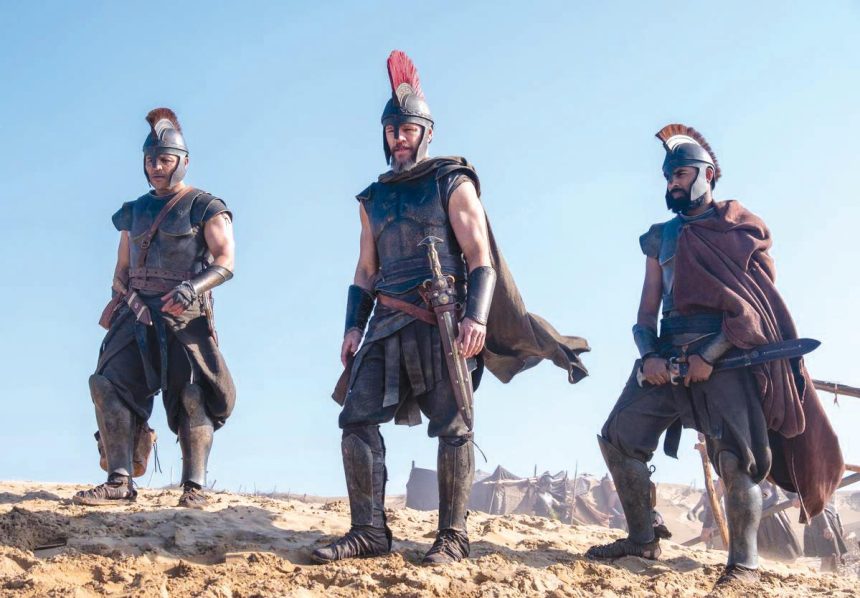
I was pleasantly surprised to find Indian-origin British actor Himesh Patel (who had the lead role in the Beatles-infused rom-com ‘Yesterday’) as Odysseus’ second-in-command Eurylochus. Even though he didn’t get much billing in the publicity, it is a sizeable role.
But Nolan drew flak, (most notably from Elon Musk, who called it “desecration” before even seeing the film) for his choice of a ‘non-white’ Helen (Lupita Nyong’o), and for the absence of Greek actors in a retelling of a Greek epic. One could argue that by now, Greece should have become used to ‘non-Greeks’ playing Greeks, from ‘Zorba the Greek’ (Anthony Quinn) to Achilles (Brad Pitt in ‘Troy’).
However, Greek-origin journalist Chris Cotonou asked (‘What the Hellenic! Why is Christopher Nolan’s new Greek epic entirely devoid of Greeks?’, The Guardian, June 3, 2026): “Are we unworthy of our myths?……It’s evident that Nolan selected his cast to be representative of the world. An honourable intention. But for us Greeks, it makes our absence even more glaring.”
“Tales like ‘The Odyssey’, while cornerstones of world literature, have an intimate resonance in the Greek subconscious and in our sense of identity – as a people, not a nation. I imagine it would be the same for Indian Hindus and their ‘Mahabharata’ or the Polynesian folklore that inspired
Disney’s Moana.”
I was more troubled by my discovery, reading up after watching the film, that a sizeable portion of the film was shot in Moroccan-occupied Western Sahara, where the human rights of the indigenous Sahrawi people are violently suppressed. “Sahrawis are aghast that scenes from ‘The Odyssey’ – an adaptation of Homer’s poem immersed in themes of displacement, family separation, betrayal, and the agonising, decades-long struggle to return home – were shot on our lands. The irony would be comical were it not so tragic: we, the Sahrawi people whose land was used to film parts of ‘The Odyssey’, have been living our own brutal odyssey for more than 50 years,” wrote Sahrawi artist Mohamed Sleiman Labat (The Guardian. ‘Christopher Nolan’s Odyssey used occupied land as a film set. That feels like a betrayal’, July 16.2026).
On reading the Emily Wilson translation (which also informed Nolan’s interpretation), I learned about ‘nostos’ (meaning ‘homecoming’ from which we also get ‘nostalgia’, the pain of missing home).
What is ‘The Odyssey’ really about? To me, in addition to the issues Labat mentioned, it is also about the futility of war, and what we today call PTSD (post-traumatic stress disorder). Could all the Odyssean phantasmagorical trials and tribulations be allegorical ‘just desserts’ for all the crimes Odysseus and his men committed (rape, pillage, murder of civilians, even babies) in their so-called ‘just’ war?
As in any great epic or story, there is a message or moral (or more than one) for everyone. At its most basic, as the name suggests, it’s about a journey, a journey ‘home’, ‘nostos’. However, both the home-comer and ‘home’ are not the same, each changed by time.
In the epic (but not the film), Odysseus’ suitor-massacring spree begets vengeance from their kin until Athena in the last line makes the warring sides swear to peace. Do they listen? Homer leaves us guessing.