

NT Reporter
Margao
Chief Election Commissioner (CEC) Gyanesh Kumar on Thursday said that the concept of ‘One Nation, One Election’ cannot currently be implemented in the country, as it is not stipulated in the Constitution of India.
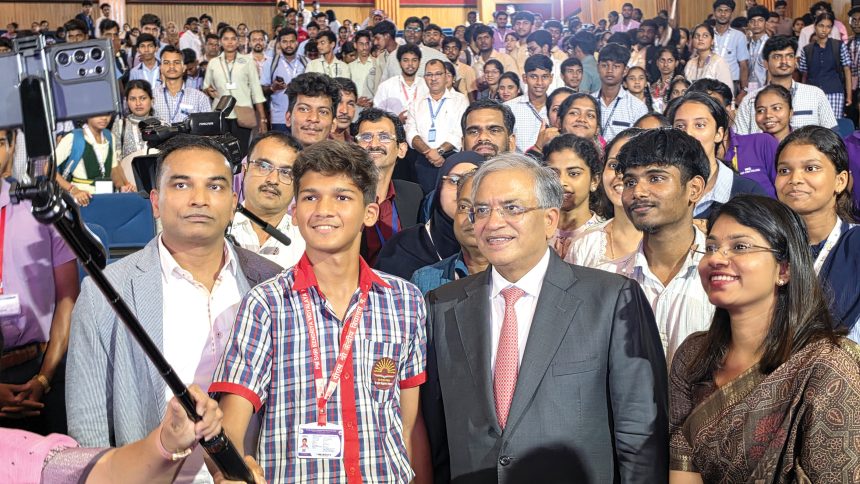
The CEC was interacting with students at the Ravindra Bhavan in Margao, providing a platform for the participants to seek clarifications regarding the country’s election procedures and electoral processes.
In response to a query from a student of Government Multipurpose High School concerning the feasibility of ‘One Nation, One Election,’ Kumar said that the concept is premature to define, given that it is not supported by the Constitution in its current form or by electoral laws.
Addressing a query on the controversies surrounding Electronic Voting Machines (EVMs), Kumar said that such doubts are mostly raised by candidates who lose elections. He clarified that EVMs merely record the number of times a button is pressed and added that they cannot be connected to the internet.
Encouraging the student to participate in mock voting demonstration outside the hall, Kumar stressed the importance of relying on facts and law rather than potentially inaccurate news. He said that the reliability of EVMs has been upheld in 41 cases before the Supreme Court.
Regarding why educational qualifications are not mandatory for election candidates, Kumar said that the Constitution does not mandate such requirements, adding that constitutional amendments suggested by audience members were beyond his jurisdiction.
Kumar also said that current laws do not permit internet or online voting, emphasising his obligation to operate within the existing legal framework to maintain the integrity of the process.
Responding to a question on how the Election Commission of India handles discrepancies between EVM and Voter Verifiable Paper Audit Trail (VVPAT) results, he said that VVPAT results are considered final due to their superior evidentiary value.
On combating social media misinformation without infringing upon freedom of speech, Kumar highlighted the importance of fact verification through the ‘ECI NET’ app to promote accuracy and engagement, while also sharing insights from his personal journey to motivate the students.
During a brief press interaction, when a media representative raised concerns over the significant number of voter deletions during the Special Intensive Revision process, Kumar suggested the reporter ask the students for their perspective.
Throughout the session, students posed several pertinent questions that proved challenging to address because current electoral laws did not account for them. Kumar said students were given an opportunity to understand how polling and counting are conducted. He said the children were also explained how electoral rolls are concurrently audited by political parties through their booth-level agents.
The interaction concluded with a renewed understanding among attendees of the responsibilities inherent in the electoral process.

