As part of this year’s World Theatre Day celebrations, Sunaparanta Goa Centre for the Arts, in collaboration with Abhivyaktee Panaji, presents the 15th edition of ‘Rang Mand’
VINIKA VISWAMBHARAN | NT BUZZ
Bringing together contemporary productions, ‘Rang Mand 2026’ which will be held from March 27 to 29 will create a space where theatre becomes a site for identity, reflection, and evolving artistic language.
Now in its 15th edition, the festival began in 2009 with ‘Girgit’, a children’s skit adapted from Anton Chekhov.
Over the years, the partnership between Sunaparanta Goa Centre for the Arts and Abhivyaktee Panaji for this festival has seen the presentation of a diverse range of productions, from children’s theatre and folk-inspired works to contemporary and experimental performances. This year’s edition brings together three distinct works.
Revisiting Sindabur
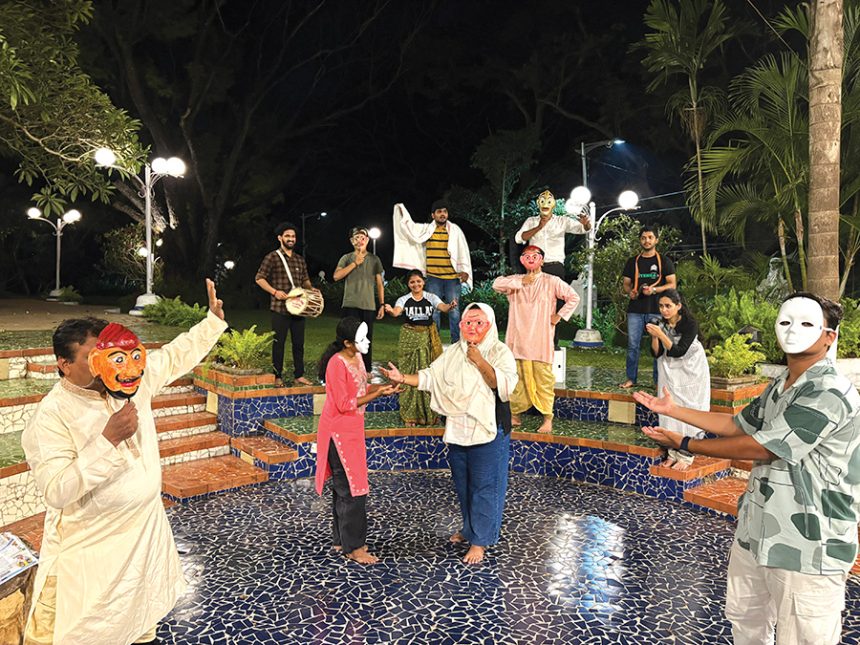
The opening production, ‘Sindaborchi Kaani’ (The Tale of Sindabur), has been written by Goan folklorist and Padma Shri awardee Vinayak Khedekar and directed by Dr. Saish Deshpande. Its title comes from a historical reference by Ptolemy, who, during his visit to Anjediva Island in 39 AD, referred to the region near Goa as “Sindabur”.
The production is structured on the conventions of Perani Jagar, an ancient Goan mask-dance drama. Khedekar emphasises the uniqueness of this form. “There is a major element here that is rarely found in the broader Indian folk theatre tradition, the form operates through a principle of emergence. There is no fixed story or linear plot. Instead, characters representing various natures, tendencies and temperaments appear,” he explains. “They reflect the prevailing conditions of their time, such as the ‘saudagar’ or the ‘pathan’, which are unique features of Goan folk theatre.”
At the heart of Perani Jagar lies the idea of continuity rather than progression. “In those days, the ecosystem and life cycles functioned in a very specific, predictable way,” says Khedekar. “Society followed a fixed pattern. Because of this, the question of ‘what comes next?’ never arose.” It is this absence of linear anticipation that sets the form apart. The narrative does not build towards resolution.
However, as Khedekar points out, this logic encounters a profound shift in the present. “Today, whether due to the invasion of media or the abundance of information technology, it is only natural for the common person to wonder, ‘What next?’” This tension becomes central to ‘Sindaborchi Kaani’. The play does not attempt to resolve it, but it leans into that uncertainty.
In keeping with the Indian folk theatre tradition of providing a true reflection of the ‘social man, Khedekar says, the play ends with the questions: ‘What is going to happen next?’ and ‘Tatah Kim?’”
For Deshpande, the engagement with Perani Jagar is both artistic and personal. “‘Sindaborchi Kaani’ is a performance born from my deep desire to help revive this traditional theatre form,” he says. “This project has been a personal journey of mine for several years.”
Working within the structure of the form required careful negotiation to keep the core elements intact while developing and flourishing them. “It is an attempt made without causing any harm or threat to the original structure,” says Deshpande.
At the same time, the production engages directly with contemporary realities. “By heightening the dramatic scenes through text and design,” he adds, “I have sought to address the modern issues and themes that haunt our current era.” The process also extends to pedagogy and community engagement. “The aim was to provide a hands-on experience that sparks a fresh interest in this theatre form among a new generation of actors,” he says. Cracking identity open
On the second evening, ‘Eggsistential Cracksis’ by Asavari Gurav, will shift the register to individual experience.
“The title came after the first draft,” says Gurav. “A friend felt it was like an existential crisis. So I thought, what if I do a wordplay, adding ‘eggs’ and ‘crack’? It added a light-heartedness and set the tone with the metaphor.” That metaphor becomes central to the piece. “Eggs symbolise creativity and making, but also something fragile,” she explains. “They connect to memories of lovers and friends, and to the act of juggling love and chaos through recipes.”
The idea of life as a process of making recurs throughout. “While I was writing this, I was thinking how our lives are our own recipes,” she says. “We are constantly mixing, changing, discovering.” The performance also reflects on shifting forms of intimacy.
Humour plays a crucial role in this exploration. “I wanted to go away from stereotypes of queer identity,” notes Gurav. “Through humour and satire, I wanted to make it universal yet humane.” The staging reinforces this blending of registers. “The space is both a kitchen and a studio,” she says. “For an artist, the studio is where ideas come to life. The kitchen is where everyday life unfolds. The overlap merges art and life.”
As a solo performer, she navigates this space dynamically. “Every time the performance changes,” she reflects. “It is not just me, it is also the people I am telling the story to, and the setting.” At its core, the work remains an invitation to reflect. “I want people to walk away understanding the nuances of love today,” she says, “to be kinder, to think, and to leave with some laughter.” Speaking the unsaid
The final day presents ‘AeioQ++’, by The Queer Arts Community, performed by Antara Bhide and Smriti Parhi, and directed by Daksha Shirodkar. Built from original poems and stories by Bhide and Parhi, the piece resists linearity, unfolding through fragments of memory and voice.
The collaboration itself is integral to the work. Bhide and Parhi, as co-founders of the collective, bring a shared history and understanding to the process. “Smriti and I are also co-writers and co-actors in this performance and co-passengers of life. It was a tremendously powerful experience to be able to do this together,” says Bhide.
Shirodkar’s role as director involves navigating this subjectivity, finding ways to translate deeply personal texts into a cohesive performance language. “I had been sensitive to queer identities since my teenage years,” she says, “but I hesitated to handle a performance on this topic because I felt it might be insensitive as I am straight.” That hesitation shifted through the process. “Knowing Antara and Smriti, and understanding how the struggle to define identity can be a real struggle, I started finding the strength to engage with it,” she explains.
For Bhide, the transformation from text to performance was revelatory. “Turning the poems into performances gave us completely new perspectives,” they say. On vulnerability, they are direct. “It is not something I am afraid of,” they note. “This process allowed me to address parts of myself that routine often hides.”
The collaborative nature of the process was central. “We built the piece through conversations and experimentation,” explains Parhi. “There was space to listen and to grow.”
For Shirodkar, her hope for the audience is simple. “Be more sensitive,” she says. “Be more aware that each life matters.”