SAMRUDHDI KERKAR
In the village of Parye, best known for the Bhumika temple, lie the silent ruins of an ancient Sateri temple.
Hidden amidst the village’s tranquil surroundings, the site draws scholars and history enthusiasts alike, for one of Goa’s oldest known stone inscriptions is engraved on a vertically erected stone.
According to studies, the ‘Brahmi’ inscription on this standing stone dates back to the 3rd or 4th century AD. Archaeologists believe it refers to one of the clans of the Haihaya dynasty. The king of the Haihaya dynasty once said to have performed a yajna at this serene spot, lending the place an enduring aura of sanctity.
Locally, the stone is known as Ubo Guno, meaning vertical stone, and continues to be worshipped as a sacred entity during festive occasions.
Parye once lay along the ancient route leading to Chorla Ghat. During the pre-Portuguese era, travellers and merchants passing through this route would pause to offer their prayers at the temple.
Lying opposite the shrine of Sankhaleshwar stood the roofless ruins of this ancient temple, embraced by the quiet presence of benevolent trees. A mango, a peepal, and an ‘Ovla’ (Mimusops elengi) gently spread their tranquil canopy over the graceful sculpture of goddess Mahishasuramardini.
Through the changing seasons, the fragrant ‘Bakul’ seemed to offer its tiny blossoms at the feet of the goddess, as though offering its flowers to the goddess. Whenever I visited the place, I found myself admiring not just the temple, but the thriving world the old tree had nurtured.
Epiphytes and delicate orchids clung to its weathered branches, turning it into a living sanctuary. It was the fruiting season then. The tree was alive with the cheerful twitter of birds, each branch echoing with life. I was fascinated to witness how a single tree can become home to countless forms of life.
It was always a quiet place, seldom visited by people on regular days. Perhaps that was why it had remained so serene. Surrounded by a sacred grove, the old shrine was never devoid of life. Whenever we visited, the villagers would happily speak about their deity with quiet pride. Yet to me, it was the trees that revealed the true divinity of the place. Their cool shade, birdsongs, and silent presence filled the surroundings with a peace that no structure could create.
The last time I visited, however, I overheard someone saying, “The goddess appeared in my dream and commanded us to build a temple.” Those words stirred an uneasy thought within me, would the trees have to make way for it? How could the goddess ask for the sacrifice of a tree that sheltered birds, nourished countless living beings, and offered its flowers at her own feet? Wasn’t the divine already present within that very tree?
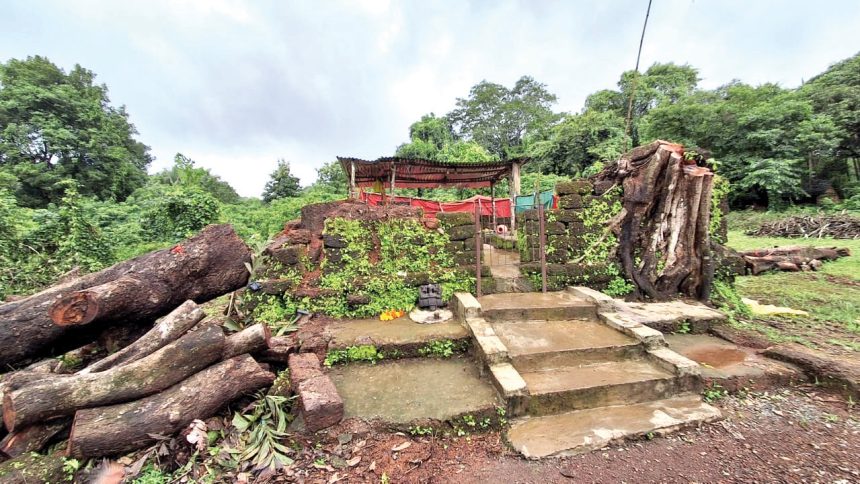
When I returned sometime later, a small roof had been erected over the idol. Plastic bags and empty oil cans lay scattered nearby. The simplicity that had once defined the place was quietly fading.
Then, one day, while passing along the same road, I stopped in disbelief. The old tree was gone. Only its stump remained and the branches were scattered everywhere. The place looked strangely empty, as though something far greater than a tree had vanished. It felt as if the very spirit of the grove had departed
with it.
Perhaps our earliest idea of God was born beneath the shade of such life-giving trees. Over time, we built temples to honour that divinity, yet somewhere along the way we began to forget where it first revealed itself. Like the breeze that gently brushes through our hair, we cannot see the divine, but we can feel its presence, in the rustling leaves, the cool shade, the songs of birds, and the countless forms of life that quietly sustain us. Can something so boundless ever truly be confined within walls or a single form?