Vivek Pereira’s visual reportage series ‘Living Frontline’ captures everyday life in Ukraine amid the realities of war
CHRISTINE MACHADO
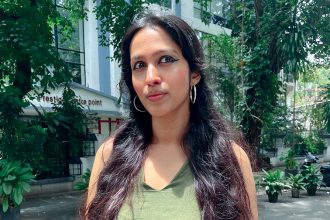
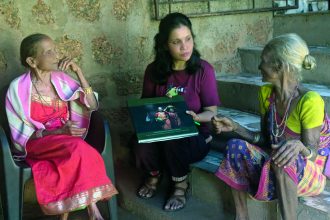
As reports of the war in Ukraine continued to emerge, multidisciplinary artist Vivek Pereira felt compelled to travel to the country. During his 10-day stay, he met civilians, displaced people, veterans and cultural workers, documenting their stories through sketches and conversations. He describes the trip as a “spiritual journey”.
Pereira had previously undertaken visual documentation in places such as the favelas of Rio and the urban slums of Cuba. His desire to work in Ukraine brought him in contact with the Pivden Cultural Hub, a centre for internally displaced people from southern Ukraine.
“My vision was to humanise the conflict and try and document as many testimonies of ordinary civilians, displaced youth, heritage and cultural workers and veterans navigating ongoing conflict,” he says.
The centre’s director, Marta Pogorila, helped arrange a list of people for Pereira to interview, giving him access to civilians, veterans and activists.
“My focus was to record what cameras often miss and by using ink and watercolour on paper to build a living visual archive of on-the-ground human experiences,” says the artist, who was raised in Goa. “While photography captures the immediate impact of the war in Ukraine, reportage art offers a ‘slow journalism’ alternative that reveals the persistence of daily life.”
But travelling into an active war zone in winter came with its own difficulties.
His first challenge came while travelling from Poland to Ukraine. “I had missed my coach bus and my battery was almost dead. Not even a cab would take me to the border,” he recalls. The project had been planned around specific dates and times, so the delay threatened to derail his schedule.
He eventually met a Ukrainian woman who gave him a seat in her shared ride and helped calm authorities at the border, who had initially wanted to refuse him entry.
In Lviv, where he was based, language barriers and increased scrutiny as an outsider added to the difficulties. “There used to be alerts issued on the street but since I didn’t know the language, I didn’t know whether it was best to stay under a building or continue being in an open space,” he recalls.
For his interviews as part of the project, Pereira sought to explore cultural, environmental, mental and emotional health themes. “But every individual had a unique perspective and everything intertwined as the conversations went further,” he says, adding that he found these accounts both inspiring and heartbreaking.
One of them was of Halya, who had left her home with her husband and children while her mother stayed behind to help elderly people in the area.
“She told me she worries constantly about her mother being there but can’t do anything about it,” he shares. “She also spoke of her wish to be near the seaside again. Her face glowed as she described the fertile soil there that grows the most delicious watermelons and tomatoes. But her face turned sad again because now with the bombings the soil is ruined.”
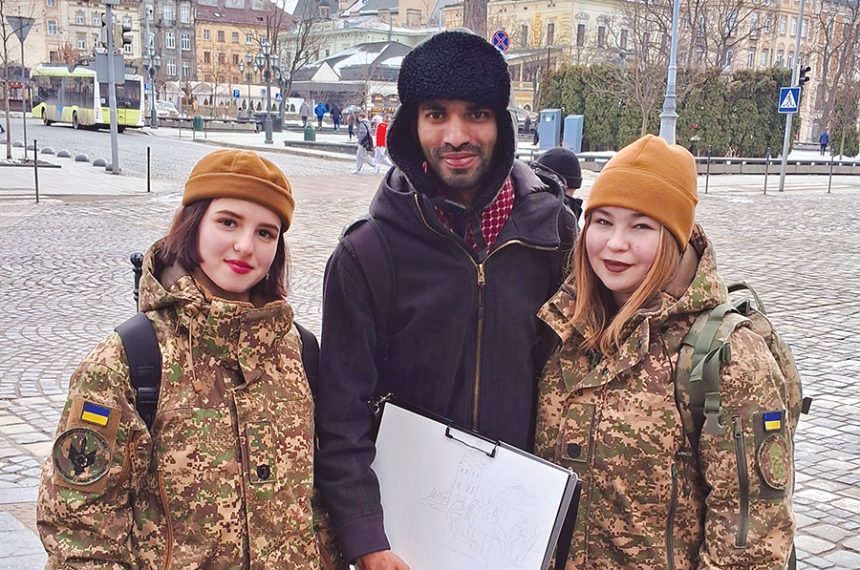
Pereira also recalls two teenagers, Llona and Yana, who approached him while he was sketching. They were being deployed but seemed joyful and optimistic. “I wished them well but in the back of my mind I hoped I would get to see them again,” he says.
The whole Ukraine experience reminded Pereira of how people coped during the COVID-19 pandemic. “People here were keeping busy and I very rarely saw constant grief. The teenagers and children were coping through play and activities,” he says.
Pereira’s finished work includes on-location sketches of objects that have become part of the landscape, such as shell fragments found in residential areas, alongside transcribed testimonies.
He intends to exhibit the project in public libraries and at Middlesex University. It may also be showcased at the Ukrainian Embassy in London.