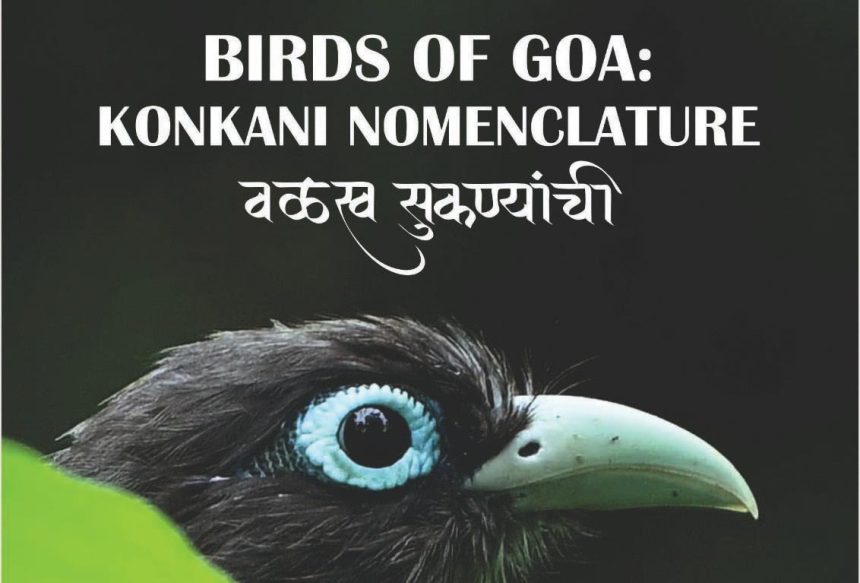
‘Birds of Goa: Konkani Nomenclature Vallak Sukhnyanchi’ blends ornithology and language to create a culturally rooted record of Goa’s rich birdlife for future generations
VINIKA VIsWAMBHARAN |
A kingfisher is a familiar sight across Goa’s rivers, backwaters and paddy fields. Yet, despite the state being home to eight different species of kingfishers, many people simply refer to all of them as Kirkiro. For researchers at Goa University, that gap between traditional knowledge and scientific understanding became the starting point of an ambitious new publication.
‘Birds of Goa: Konkani Nomenclature Vallak Sukhnyanchi’ documents 515 bird species through extensive fieldwork, literature surveys, and community interactions. Combining ornithology, language, and cultural heritage, the book preserves traditional Konkani names for 58 species while introducing scientifically coined Konkani names for 457 additional birds.
The project was led by programme director and assistant professor of Zoology at the School of Biological Sciences and Biotechnology, Goa University, Dr. Minal Shirodkar, along with PhD scholar Vaishnavi Bharti and Sahitya Akademi award-winning Konkani writer Dr. Prakash S. Parienkar.
Bharti’s journey into the project began with her long-standing fascination for birds and her academic work in zoology. “I have done my bachelor’s project on bird diversity in urban and hinterland areas, after that I joined MSc at the university,” she says. “During my second year, we had options to choose certain groups of animals and attain specialisation in them. One of the animals that I chose was ornithology and under ma’am’s guidance (Dr. Shirodkar), I completed that entire coursework. Once my MSc was ending, since she was doing this project, she asked if I would like to join in.”
She adds that she joined the project when only around 30 vernacular bird names had been collected. “From there, I continued the work and built upon a robust checklist for Goa,” she says. The Konkani title of the book was also her creative contribution to the project.
Speaking about the origins of the project, Shirodkar says that the idea emerged from a shared desire to bridge environmental science and Konkani language preservation. “We thought something could be done because Dr. Prakash Parienkar was also working on environmental research.”
The work formally began after the team received support under Goa University’s Intellectual Property Rights scheme in late 2023. Despite packed academic schedules, the researchers dedicated whatever time they could to the project. “For about one hour, half an hour, whatever time we got at the end of the day after doing our regular work, we would sit and do the naming,” recalls Shirodkar.
The researchers combined scientific taxonomy with local knowledge while developing names for species that previously had no distinct Konkani identity. According to Bharti, morphology, behaviour, habitat, bird calls and even Greek and Latin meanings were considered during the naming process. Fieldwork formed a major part of the project. The team travelled across Goa speaking to local communities, fishermen and residents at temple gatherings and village spaces.
“It was difficult to capture the entire Goa,” says Bharti. “Whenever we found communities together, we spoke to them.”
One of the biggest challenges was navigating the diversity of Konkani dialects across the state. “Each bird was named with the same name but the dialect varied. So it was difficult for us to decide on which one to keep,” says Parienkar, adding that they went through three to four rounds of discussions before finalising names in Konkani. “We named them based on certain characteristics, like colours, nesting styles or if they were local or migratory birds, etc,” he notes. Parienkar also noticed how people in his bird watching group are very enthusiastic about these creatures but only know the Latin scientific names. “This is when I realised that we also need proper Konkani names for the birds in our native vocabulary.”
Shirodkar explains that many birds traditionally shared umbrella names, which often created confusion between species. “All the smaller birds had a common name,” she says. “So what we have done is we have retained those names too, but we have put it in a proper classification.”
The book also attempts to make Konkani accessible beyond Goa. Alongside scientific, English and Konkani names, it includes IPA-based phonetic spellings to help readers pronounce Konkani words accurately.
For Shirodkar, documenting these names was as much about preserving culture as recording biodiversity. “This old generation is slowly reducing and the younger generation does not know about it,” she says. “So it is very important to document this work.”
Bharti described the response from local communities as overwhelmingly positive. “People were very surprised that we were trying to do something very different and innovative,” she says. “We had a good time talking to people. They were very friendly and approachable.”
The publication features over 460 high-definition photographs and detailed references for each species. Parienkar appreciates the initiative taken by the Directorate of Forest Department for providing the funds for the publication of the book.