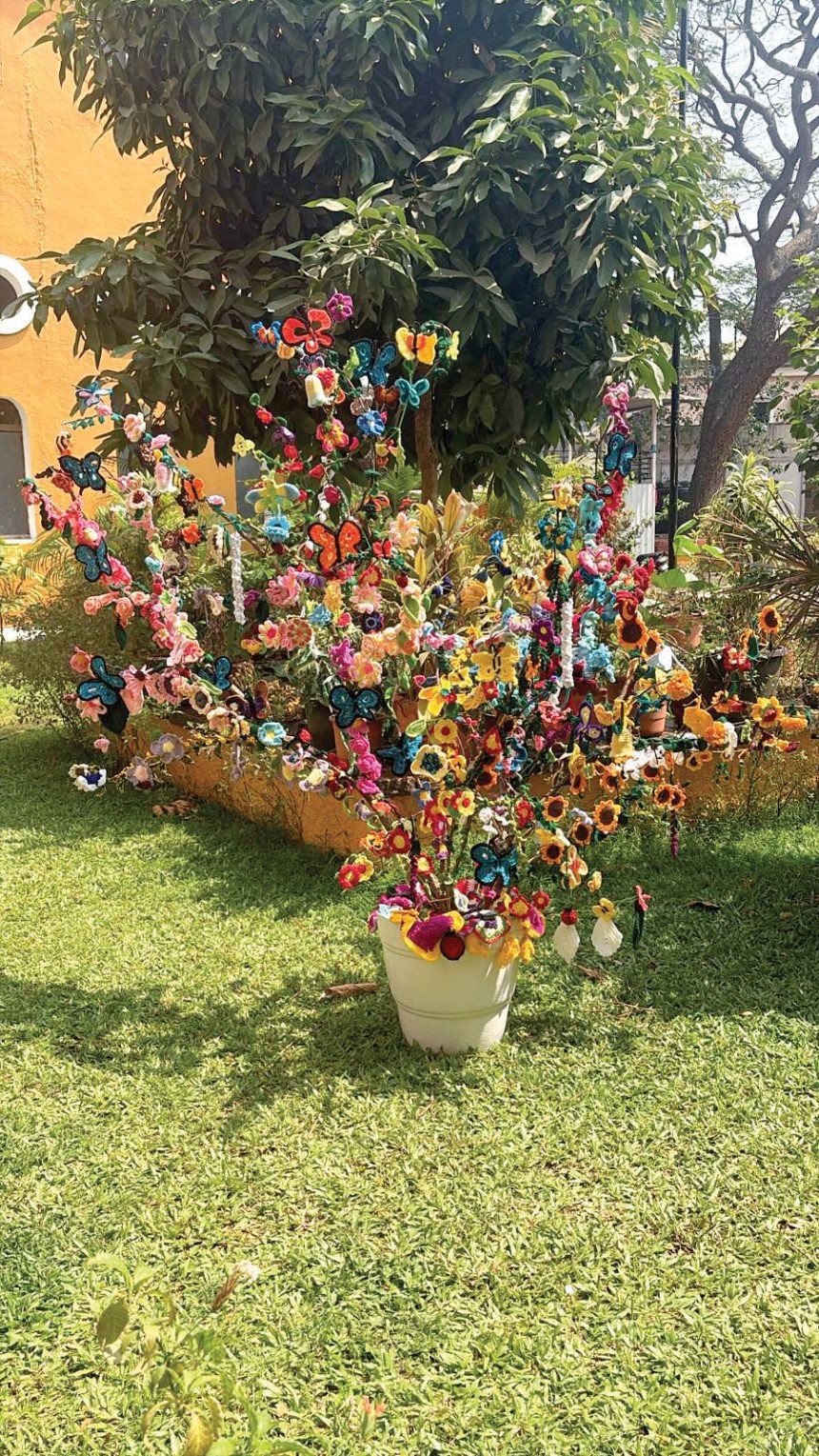
At the Goa Open Arts festival, the Crochet Collective Goa transforms crochet, community, and collected waste into a striking twin installation that contrasts environmental neglect with the possibility of renewal
VINIKA VISWAMBHARAN | NT BUZZ
Crochet is rarely associated with protest or public art, yet at this year’s Goa Open Arts Festival, yarn and discarded waste came together to deliver one of the event’s most striking environmental statements. Titled ‘Hook & Bloom’, the twin installation has been created by Crochet Collective Goa, led by co-founders Sharmila Majumdar, Sophy Sivaraman, and Sheena Pereira.
The first installation is built with dry branches and real non biodegradable waste encased in a crocheted net, to show how human excess traps the natural world. The net symbolises entanglement. The waste underscores the permanence of what we throw away.
“It is literally garbage we’ve picked up on our walks,” says Majumdar. “Everywhere you go in Goa, you see plastic bags, packets, things just lying around. We wanted people to look at it and recognise it. This is ours. This is what we generate.”
Majumdar cleaned and sorted much of this garbage herself. “We talk about pollution in abstract terms. But when you see it hanging on a tree, you realise it does not disappear. It stays.”
Just beside it stands its counterpoint. Using the same base structure, the second installation imagines what happens when nature is respected. Crocheted flowers, butterflies and insects transform the branches into a canopy of colour, symbolising balance, renewal, and the possibility of flourishing. “We wanted something hopeful next to something heavy,” says Sivaraman. “If we make conscious choices, this is what nature can look like. Nature wants to thrive. We are the ones holding it back.”
The flowers were made collectively by around two dozen contributors, each working with leftover yarn from home. “No new yarn was bought. Crocheters always have scraps lying around,” says Sivaraman laughing. “So it became completely sustainable.”
The result is rich with detail. Roses sit next to dragonflies. Tiny ladybirds hide among the leaves. Children and adults alike find themselves leaning in closer. “People keep discovering new things,” says Sivaraman. “It makes them slow down and appreciate what is in front of them.”
The installation also reflects the collective’s larger philosophy of crochet as community and care. Originally invited only to conduct a workshop, the group proposed the installation as well. “If someone asks you for something, you give a little extra,” says Sivaraman cheekily. “So we said, why not create something that speaks to the
environment too?”
Putting it together became a shared exercise. Members worked from home and then gathered on site to assemble the trees. “Those days are my favourite,” says Majumdar. “Otherwise we crochet alone. Here we talk, laugh, help each other. That camaraderie is what the collective is really about.”
Among the 24 participants is Cecilia Menezes, a retired banker and long time crochet enthusiast. Menezes has been part of large crochet communities since 2014, including a Guinness World Record blanket initiative across India, and also worked on the collective’s earlier 18- foot crocheted Christmas tree at the Museum of Goa, Pilerne.
“The festival gave us another opportunity to work as a team and showcase our skills,” she says. “Seeing visitors respond has been deeply satisfying. I feel proud that so many art lovers are appreciating crochet. Many thought it was a dying art, but we are helping revive it.”
For the co-founders, the message is simple. “I hope people understand the importance of waste management from the first installation. If we keep our environment clean, we can have surroundings like the second one, with trees, flowers and butterflies. If it creates even a little awareness, we have done our job,” say Majumdar and Sivaraman.