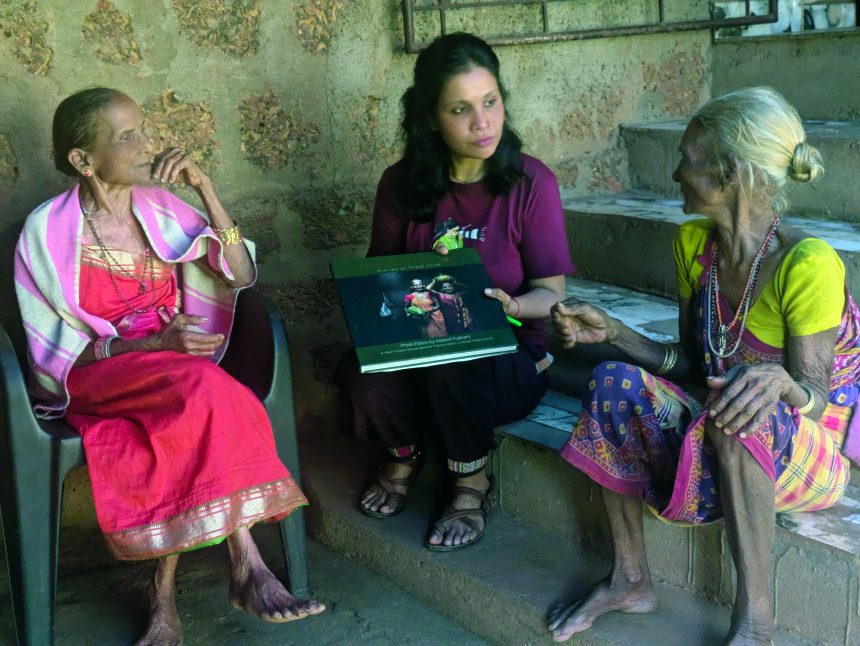
Photographer Assavri Kulkarni takes us into the kitchens of the forest dwellers of the state in her new insightful and cultural enriching coffee table book ‘Forest Recipes of Goa’
CHRISTINE MACHADO NT BUZZ
When one leafs through the pages of Assavri Kulkarni’s new coffee table book, you may be blown away by the beauty and the power of the images and the bounty of information in the accompanying text. But as the photographer herself puts, “people will see how pretty it looks, not knowing the stories that went into the making of it”.
And indeed, she describes ‘Forest Recipes of Goa’ as one that came together from “sweat, blood, and tears”. Quite literally. Created over a span of over five years, Assavri has driven miles, often alone, navigating unfamiliar terrains without the aid of Google Maps or any mobile signal to interact with the forest dwellers and learn their ways and their food. She has had to deal with fears of bear attacks, snakes, and leeches, while trekking for hours through the deepest forests of Goa.
But she has emerged with a treasure trove of invaluable information and lasting memories of a cherished experience, as is evident from the passion in her voice as she speaks about the creation of this book for well over an hour.
The seeds for this project were laid a long time ago. As the wife of wildlife expert Nirmal Kulkarni, Assavri often accompanied him on his treks to the mountains. And while he and his team studied the finer details of the wildlife they encountered, Assavri often found herself gravitating towards the kitchen. “It is where I felt most at home,” she admits. In fact, her participation at the recent edition of the Serendipity Arts Festival at the exhibition ‘Feeling Home: Where is Home?’ had her contributions of some snapshots taken from her excursions for this book project. “Whenever I used to go to the forests, I would ask the people there if I could sit in their kitchen. And that’s where the point of connection and the conversation would happen with these women,” she says. Intrigued by the food that they would offer her, she began accompanying them to the forests to forage for their food.
While at first she began by just posting a few images online, Assavri soon realises that there was so much information here that the world needed to know about the real Goa.
“Some of these women were very old and I realised that if I do not document their recipes, these will disappear after they pass away,” she says.
One recipe that particularly sparked the idea of the book was made of jackfruit. “I came across these jars of liquid with yellow pieces floating in it. Upon enquiry I learned that this was jackfruit which had been preserved and stored in water for six years,” narrates Assavri. Amazed to see that the fruit had not spoiled, she learned that they eat this when they do not have any food and it gives them instant energy. “If you are unwell or recovering from an illness, this is what they eat. It was mind-blowing,”
she says.
Another discovery was of what could be the world’s smallest cucumber that is eaten as a snack, especially while travelling. “I searched and searched Google for it and could not find anything about this species,” she says.
But building the trust with these women to open up their kitchen secrets to her took its time. “I had to be like them. There were times when I would take an assistant with me and I had to be careful about who it was. They would not open up if the person was too glamorous looking. They would feel embarrassed and awkward,” says Assavri, who ensured that each time she visited them she would pay them honorarium and respect. “I would go with a saree or coconut as a mark of respect. So they felt empowered and happy that their knowledge is respected,” says Assavri, while admitting that being a woman photographer also helped.
Assavri also came to be in awe of these brave women who would walk through the forests, often facing wildlife creatures while foraging for food. “These were 90-year-old ladies who were doing this every day. When I went with them into the forests, they were just hopping around while despite calling myself a trekker, I was barely managing!” she says, chuckling.
Assavri also came away with a new respect for nature’s bounty as seen through their eyes. “They don’t measure their food or look at its nutritional value. They eat the food with gratitude as the gift of the season. Everything was plucked and collected with such gentleness and compassion. And they always got extra for their neighbours,”
she says.
What also struck her was their worship of nature. “There is no idol worship here. They pray to nature. They have gods like a mountain god, or the man of the land which is very interesting and something that I would like to work on more,” she says. The book’s purpose is also to bring awareness to Goa’s forests. “Every time a forest is lost, we lose recipes; and thus we lose part of our culture,” she says, adding that the forest dwellers know that it is important for them to forage each year because if they do not, the plant will not return the next year.
Assavri adds that many of the women who are featured in the book do not care too much about the book, as one would usually expect when being featured. “They don’t know the extent of the importance of something like this,” she says, adding that she has already had interest being shown in this book by both national and international media. “When I was researching for my previous work ‘Markets of Goa’ there were some references to go through. But in this case, I could not find any. So it is one of a kind on the tribal food of Goa,” she says.
Looking back at the long journey, Assavri admits that there were many times when she had lost hope on this project as there were so many challenges. “But then quitting is not my cup of tea,”
she says.
And she is ever so grateful to the Goa Forest Development Corporation (GFDC) for supporting and publishing this book. “Over the last four years I applied to so many people with regards to this project. GFDC chairperson Deviya Rane was one of the very few who showed interest in taking this further,” she says. For a project this huge, one needs a lot of motivation, she states, adding that she is thankful to her silent backers including her husband and friends who supported her in every little
way possible.
“It’s been an amazing journey of learning experiences. I would love to separately do something about each woman I met because the forest looked different with every single one of them,” she says, while hinting that there could be more volumes to come.
Alongside the book, she is also going to be releasing a short documentary. “This won’t be about the recipes but about the songs that they sang, how the forest is, how they forage. These are things that you can›t show in still pictures,” says Assavri.
As for this book, she counts herself lucky and proud to offer it to the world. “Through this work, I want to show that this is my Goa. It’s not just what you commonly know or what the influencers are showing you. There is so much more that we have in our culture that we are not speaking about and eating enough of. And it’s there right in your backyard.”