Samrudhdi Kerkar
Spring heralds hot winds in tropical lands like Goa. To soothe their harshness, trees and bushes adorn themselves with bountiful sweet secrets, hiding treasures beneath their leaves.
Wild berries have always held a special place in my heart since childhood. The hot summer air still carries the fragrance of those cherished memories, when Baba would take me and all my cousins sauntering across the sun-kissed plateaus and through tangled thickets in search of wild
berries.
Chafra (Flacourtia montana) is one of Goa’s wild berries. The tree is endemic to the Western Ghats, yet today many people are hardly even aware of it. In earlier times, however, it was given sacred protection in Goan villages. Revered for its medicinal uses, it was considered holy and preserved within sacred groves such as Nirankarachi Rai of Maloli in Sattari, the historic Mahadev temple complex at Tambdi Surla, the Devachi Rai of Nagvem, and the Devachi Rai of Shiroli village near my own village of Keri in Sattari.
During winter, it is armed with simple and branched spines, guarding itself with quiet resilience. Later, it blooms with small yellowish flowers bearing spherical, hairy buds, which slowly transform into light green fruits. With time and warmth, they ripen into scarlet red, cherry-sized juicy berries, gleaming brightly against the foliage like tiny drops of summer.
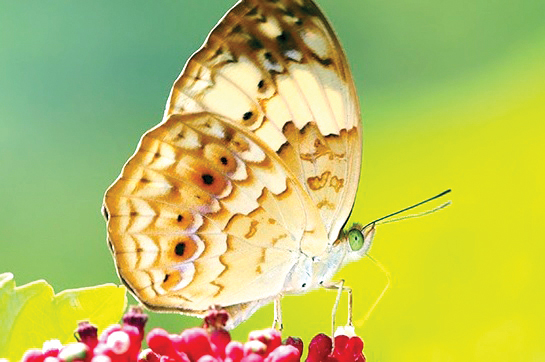
I was introduced to this tree by Baba. We would often go there during spring to pluck and relish the berries straight from the branches. These berries are tart and filled with many tiny seeds, which some might find unappealing. Yet the bloom of Chafra is like a grand feast for birds and many other creatures. It is a host tree for butterflies such as the Rustic and the Common Leopard. Bulbuls, drongos, jungle mynahs, koels and hornbills flock to relish the juicy fruits, turning the tree into a lively festive ground. The air fills with chirps, fluttering wings and the soft rustle of leaves, as if the tree itself is celebrating the season of abundance.
Recently, I visited the sacred grove of Shiroli after many years and, to our delight, the Chafra tree stood completely adorned with fruits. It was bustling with birds, yet the space retained its deep tranquillity. The atmosphere was filled with melodious chirps and the cackling calls of a group of Malabar pied hornbills perched on an adjacent tree. Usually, these birds fly away in the presence of humans, but perhaps the grove carried such a quiet aura that they did not feel disturbed enough to leave.
The Chafra tree was almost studded with fruits. But, as it is said, to pluck a rose you must also deal with its thorns. The tree was equally laden with the nests of Asian weaver ants, or humlo, ever ready to attack with their sharp fangs. It felt like a competition with the ants as we carefully plucked the fruits from the clusters they fiercely guarded.
After some time, we picked up a fallen stick and gently struck the branches, catching the shower of fruits and ants in our dupatta, just as we used to do in childhood. We looked at our collected treasure with quiet triumph. Our mouths watered at the sight of the fresh, bright red, chemical-free berries. We ate as many as we wished without worrying about sore throats, their tart sweetness lingering on our tongues.
Then came the other regular customers of the tree, a couple of Malabar grey hornbills. Without making a sound, they hid themselves among the leaves and peeked curiously at us, as if patiently waiting for us to leave and surrender the feast back to them. After waiting a few more minutes, letting the peace seep gently into our souls, we finally left the grove with slightly aching throats from the sour berries but hearts deeply content and full.