Samrudhi Kerkar
It was the last day of our Ganesh Chaturthi. We got the idol out of the house for its immersion. Our hearts were heavy as we looked at the empty seat where Ganesh had been seated for the previous five days.
I pondered how a simple idol bring families together, fills hearts with devotion, spread joy into our lives, and turns every household into a temple. How divine and memorable those five days feel. It may well be the favourite festival of every Goan.
The hardest part is to bid adieu to Lord Ganesh on the last day. But then we convince our hearts by reminding ourselves that the true ‘God’, who has neither beginning nor end, never really leaves us. He is the reason for our existence, our sustenance.
We walked towards the river to immerse the idol, our hearts filled with devotion, amidst chants and singing. As we walked along the road, there was suddenly a burst of crackers.
The atmosphere was enveloped in clouds of smoke. Dogs ran frantically, petrified and shivering. After the revelry, packets and waste from the fireworks lay scattered across the roads.
The whole scene interrupted my thoughts. I looked at the face of Ganesh, wondering, would God really like his festival to trouble innocent beings and to pollute the environment?
At the river, an array of Ganesh idols seemed to compete with each other, in size and in appearance. Most of them were made of Plaster of Paris (POP). But isn’t Lord Ganesh supposed to be made of soil?
Even the stories of his birth remind us of this connection. He is the son of mountain-dwelling Shiva and Goddess Parvati, the daughter of the mountains, closely associated with Mother Earth. Born out of her soil, Ganesh is the son of the very earth that grows our crops, gives birth to us, and sustains us.
His elephant form, too, reminds us of his deep connection with the natural world.
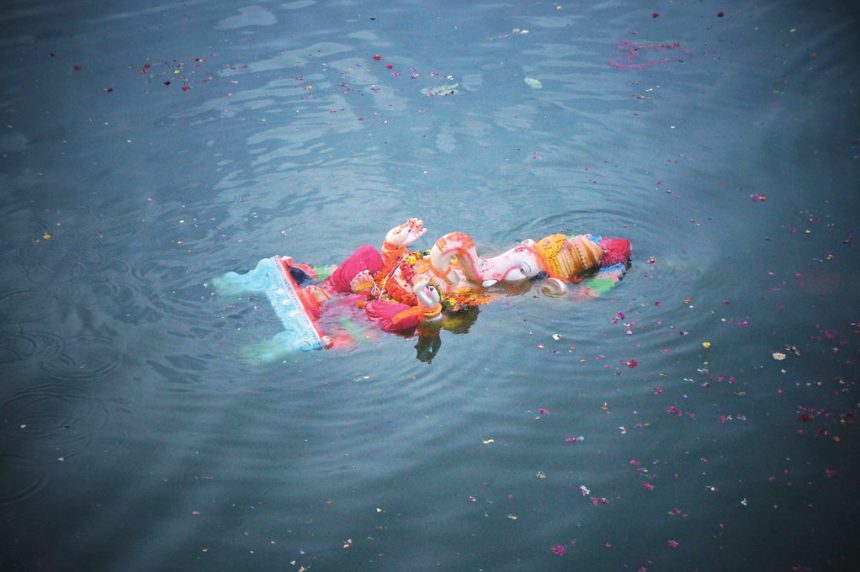
And yet today, POP has replaced soil, the very material that does not dissolve easily in soil or water, eventually polluting the rivers with which our lives are so closely intertwined.
If we come to the river some days after the visarjan, it can be heart-wrenching to see the dismembered parts of our beloved Ganesh floating in the water. The same Ganesh whom we worshipped with so much devotion and respect!
Doesn’t it pain our hearts to see our beloved God in this condition after the festival? Or do we sometimes think that He will cover our mistakes, just as we believe He will forgive us every time, only to escape our own responsibilities?
After the visarjan, floral offerings are often thrown into the water along with plastic bags. Even youngsters who are aware of plastic pollution sometimes carelessly throw everything into the river and walk away.
The quietly flowing river is left blemished. Sometimes, convincing people to care for nature can feel like a personal offence to them. But why can’t we take harm to nature personally? Isn’t it our river too? Isn’t it our village too?
Crackers keep bursting louder than the sounds of divine bhajans. Their wrappers are left behind, some eventually finding their way into the river. Huge clouds of smoke rise into the air, seeming like monsters eager to gobble up everything around them.
We already face the consequences of a changing climate. We speak of protecting the environment, reducing pollution and saving our rivers. But perhaps festivals give us an opportunity to ask ourselves something more intimate: What does our devotion mean if it causes suffering to the very world that sustains us?
Ganesh is worshipped as the remover of obstacles. Perhaps, then, the least we can do is not become an obstacle to the earth, the rivers, the animals and the life around us.
Because the God we worship does not live only inside the idol.
He lives in the soil from which it is made. He lives in the river into which we immerse it.
He lives in the trees, the animals, the air we breathe, and the earth that sustains us.
And perhaps the true essence of Ganesh Chaturthi is not merely bringing Him home and bidding Him farewell, but learning to recognise Him in all that surrounds us and treating it with the same reverence with which we treat the idol.