SAMRUDHDI KERKAR
This time, in our monthly heritage trail event, ‘Parikrama’, Baba took all of us to explore the Ravan village of Sattari. On the right bank of the River Valvont in Ravan lies a small hamlet called Pelavade, quiet, peaceful, and away from the main highway.
There was a small shrine known as Gothaneshwar. An idol of Krishna was installed in the shrine. It stood under the vast canopy of a towering mango tree, which itself formed a temple over the shrine. This tree is said to have been there for more than a century.
Baba told us that this place is known as Gothaneshwar. In Konkani, ‘Gothan’ or ‘Gotho’ means a cowshed.
Earlier, this mango tree provided a soothing shelter and resting place for the cattle and buffaloes that came to graze in the area, looking after them like a silent guardian. Over time, the place came to be known as Gothaneshwar.
Today, however, only a few cattle remain in the hamlet, and the place has gradually taken on the character of a religious shrine. On certain occasions during the year, villagers visit to offer prayers and seek blessings from the unseen divine spirit worshipped here as Gothaneshwar.
This place was the last stop of the ‘Parikrama’. By then, evening had settled in. The darkness, however, left me wanting to see the place again in daylight.
So, the next evening, I returned, hoping to spend a little more time soaking in its tranquillity. As we approached the shrine, we saw two women walking towards it. This time, we had arrived while there was still enough light to explore the place more closely.
The towering tree looked magnificent. But as we stood beneath its canopy, we realised that what had appeared to be a single tree was, in fact, a cluster of three trees intertwined with one another.
The women told us that the other two trees entwined with the mango tree were Ficus tsjela, locally known as ‘Kel’ or ‘Payari’, and ‘kokam’. A vine of Celastrus paniculatus, known locally as ‘Kangla’, had also wound its way through the trees, binding the entire cluster together.
The closer we looked, the more intriguing the sight became. The old mango tree seemed to be struggling beneath the tight embrace of the Ficus. The latter had climbed over its trunk and spread its branches in every direction, its growth resembling the strangling habit characteristic of certain figs.
The women swept the surrounding area, lit the lamp and joined their hands in reverence before the idol of Krishna and the gigantic trees sprawling overhead.
Curious, I asked one of them, “Do you know anything about this place or this tree?”
She gazed reverently at the sprawling canopy and replied, “Toh jagrut aasa,” (He is awake).
She explained that the shrine and the idol of Krishna had been installed only recently, but “he”, the protective spirit, had always been here, looking after everyone. And whenever they called upon him, he responded.
There was a sense of pride in her voice, accompanied by a deep reverence for the unseen presence she believed had always watched over the place.
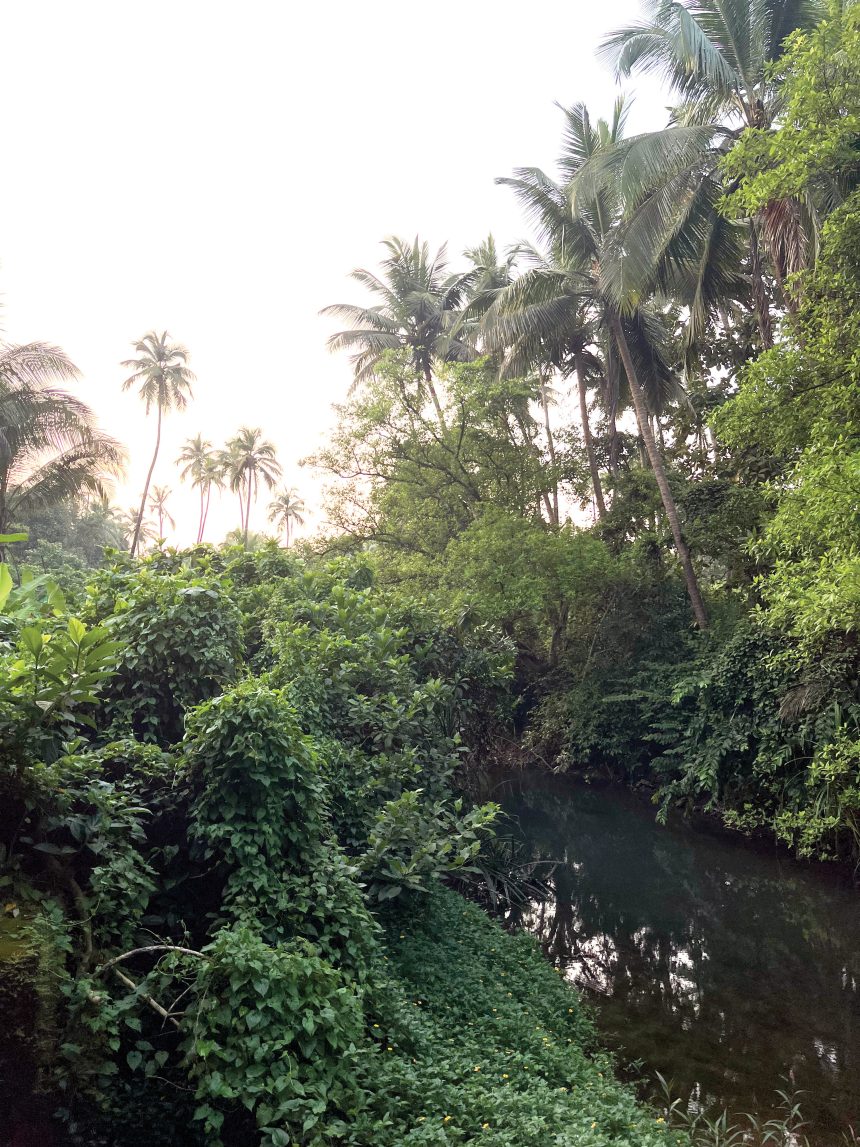
Next to the shrine, a stream flowed gently. The spring originates in the forests of Talekhol in Dodamarg, from where its waters flow towards Ravan, irrigating the agricultural fields of Ghoteli and Ravan villages in Sattari. Eventually, the stream joins the River Valvonti at Pelavade, near Gothan. In this area, the stream is known as Gataro. Trees such as kadamba, rumod, pandanus and coconut stood peacefully along its banks.
An unusual stillness prevailed at the place, broken only by the faint chatter drifting from distant houses and the sounds of evening birds. The cackle of a woodpecker. The distant, echoing calls of barbets. The rising chorus of cicadas and crickets. It all felt so meditative. These sounds seemed to quieten my mind.
As I sat there, listening to the stream and watching the evening settle around the shrine, I felt, in some way, the divinity the women had described.
I felt that divinity is present everywhere, especially in nature. We just need a few peaceful moments to connect with it and feel grateful for its presence. At Gothaneshwar, I had found such a moment.