Justice Ferdino Inacio Rebello, former Chief Justice of the Allahabad High Court, recalls his involvement in a death sentence appeal as a young lawyer, while author Abhijit B. Patil, in his recent book on the subject, raises questions over the preservation of Aguada’s legal history
NARESH S. | NT NETWORK
“I was a young lawyer in Goa when I went to meet Kumar after the Sessions Court awarded him the death sentence. I pursued an appeal before the Supreme Court, but the appeal was rejected,” recalls Justice Ferdino Inacio Rebello, former Chief Justice of the Allahabad High Court.
Rebello was living in Panaji when he was asked to prepare an appeal for Kumar, who had been sentenced to death for murder. Kumar was brought to Rebello’s house before the appeal was taken up. The Supreme Court subsequently rejected the appeal.
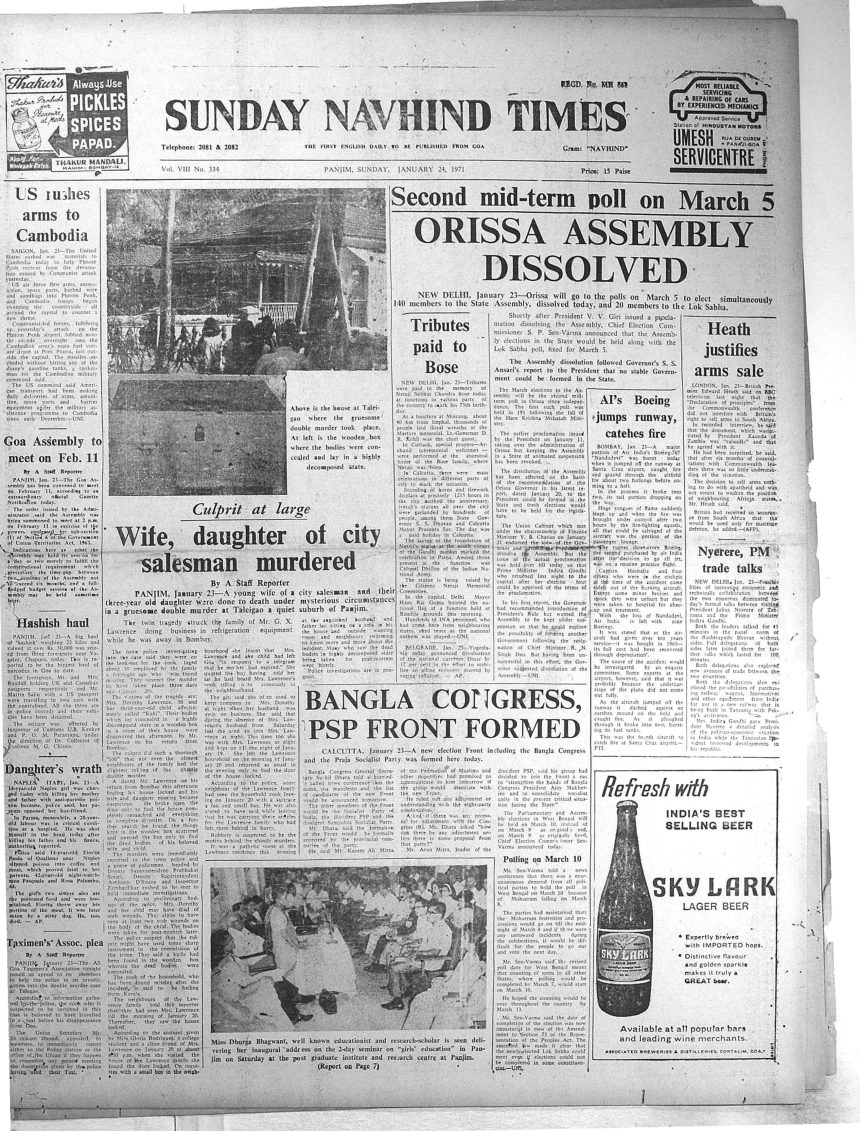
The case forms part of Goa’s post-Liberation legal history and offers a starting point for examining how India’s approach to capital punishment has evolved. The case concerned Joseph Peter, alias Kumar, who was sentenced to death for murdering the wife and child of the Lawrence family where he was employed as a maid. The Judicial Commissioner’s Court in Goa confirmed the sentence in September 1973, and the Supreme Court dismissed his appeal on May 4, 1977. Kumar was executed at Central Jail, Aguada, on January 28, 1978, in what became a significant episode in Goa’s post-Liberation legal history.
Describing the crime, Rebello says the murders were gruesome and reflects on the changes in judicial thinking over the years. Rebello points to differences between countries in their approach to capital punishment. The United States retains the death penalty in some jurisdictions, while European countries have largely abolished it; this clearly shows the evolution of the judiciary in different parts of the world.
India continues to retain capital punishment, but its application is restricted by the Supreme Court’s “rarest of rare” doctrine. Established in Bachan Singh v. State of Punjab in 1980, the doctrine requires courts to reserve the death penalty for exceptional cases in which life imprisonment is considered inadequate.
Rebello refers to offences involving national security and large-scale drug trafficking while discussing crimes that can pose serious risks to society. The availability of capital punishment, however, depends on the applicable law and the circumstances of the individual offence. Apart from the gravity of the crime, courts must also weigh mitigating circumstances, including the possibility of rehabilitation. The stakes are particularly high when a sentence cannot be reversed.
Rebello also highlights the difficulty of judicial decisions when judges disagree over whether capital punishment should be imposed. “When three judges examine a case, two may take one view while the third may take another. This creates a risk when a person’s life is at stake,” he says.
Death sentences can be overturned or commuted by higher courts after further scrutiny of the evidence, sentencing principles and mitigating circumstances. Such outcomes underline the importance of judicial safeguards when the punishment involves taking a human life.
Article 21 of the Constitution protects life and personal liberty, permitting deprivation of life only according to a procedure established by law and subject to constitutional safeguards. Article 22 provides protections relating to arrest and detention. The interpretation and application of constitutional provisions remain central to debates over capital punishment.
Rebello’s recollection of Kumar’s case also sits alongside his opposition to the death penalty. He believes that capital punishment requires particularly close scrutiny because the circumstances surrounding a crime can be complex, and an act of extreme violence may be committed in the heat of the moment rather than as the result of a deliberate plan.
Recalling another case involving a gruesome crime, Rebello says he had sentenced the accused to life imprisonment after considering the circumstances. His approach underscores the importance of examining the facts of each case before deciding whether the death penalty is justified.
A case at risk of being forgotten
The question of how this chapter of Goa’s legal history is remembered has been raised by Dr. Abhijit B. Patil, author of ‘I Was Murdered: A Case of Capital Punishment’.
Patil questions whether the location associated with the execution at Aguada Central Jail can still be precisely identified and whether its history has been adequately documented. “Heritage is not merely what remains visible. It is also what the authorities choose to document, explain, and preserve,” says Patil.
He argues that preserving a former prison’s history requires more than maintaining its physical structure. Prison registers, court records, execution warrants, photographs, and historical plans could help establish what happened, where it happened, and how the criminal justice system operated at the time.
Patil distinguishes between a site that has physically disappeared and one whose location can no longer be established from information available to the public. “The absence of a public explanation is not proof of deliberate erasure. But it is a compelling reason to demand a proper explanation,” he says.
Establishing whether the original execution site survives, whether subsequent construction altered it, and whether relevant records remain with government departments or archival institutions would help clarify its status.
Preserving the history
of punishment
The questions surrounding Aguada extend beyond the fate of a physical structure. They concern whether Goa’s legal history, including its early experience with capital punishment after Liberation, is being adequately documented for future generations.
“If this event belongs to Goa’s legal history, where is the physical and archival trail that allows the public to understand it?” Patil asks.
A documented account of Kumar’s case could help researchers examine the legal reasoning behind the sentence, the grounds of appeal, and the Supreme Court’s decision. It could also place the case within the wider evolution of capital punishment in India, where judicial safeguards have developed alongside continuing debate over the legitimacy and necessity of the death penalty. For Rebello, the case remains part of his experience as a young lawyer confronting the consequences of a death sentence. For Patil, recovering the historical record is an opportunity to ensure that the case and the site associated with it do not disappear from
public memory.
“A heritage institution should never be afraid of its own history,” says Patil.