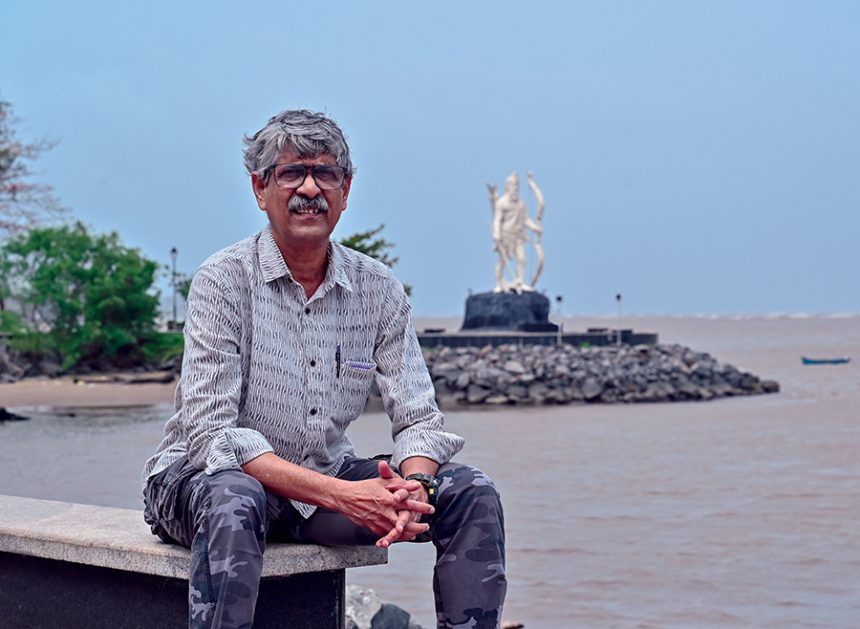
In an effort to preserve Goa’s fading oral traditions, hands-on historian Sanjeev V Sardesai has documented 50 narratives in his debut book ‘Ta’ Mi Janai’
CHRISTINE MACHADO
Sanjeev V. Sardesai’s curiosity about Goa began with a tunnel. “For Mahashivratri, my mother and sister had gone to the Gomanteshwar Temple at Ella, Old Goa, dedicated to Lord Mahadev. According to them, there was a huge crowd when suddenly a man appeared and requested them to follow him. He took them about 20 metres away, where they descended a flight of stairs and found a tunnel that they were allowed to walk through,” he recalls.
When his mother later narrated the incident to him, Sardesai realised that there must be many more such stories hidden across the land he called home.
Over the years, however, he feels that such knowledge passed down by ancestors has gradually faded. “Earlier, Goans lived in joint families and every night, children would gather around an elder who would narrate stories before they went to sleep. These stories usually carried a moral,” he says.
Sardesai believes these stories were told with a purpose, to pass on knowledge, as stories play an important role in educating young minds. However, with the rise of nuclear families and many elderly people moving to old age homes, he feels there is now little opportunity for such stories to reach younger generations. “In fact, 90% of locals today do not know enough about Goa. I realised that promoting heritage, especially intangible heritage, was important,” says the
heritage activist.
The need to safeguard and document Goa’s stories grew stronger in 2015, when a UNESCO team visited the state and met heritage promoters. “We were told that UNESCO was encouraging governments across the world to preserve their intangible heritage, including traditional songs, dialects, unique recipes, and especially stories,” he shares.
While filming heritage-based episodes in Goa for his YouTube channel, Sardesai also noticed that many Goans were unaware of these narratives. “So, wherever I could, I would collect these stories and write them down. There are many stories that need to be told and recorded before they disappear,” he says.
This collection has now been compiled into a book of 50 stories titled ‘Ta’ Mi Janai’ (That I know!). Published by Qurate Books Private Limited, the book will be released on July 20. “My mother was the main person who told me stories about Goa and July 19 would have been her 105th birthday. Since I could not find a venue on that day, the release will take place a day later,” he says.
The stories in the book, he says, are based on as much factual historical background as possible. “Although these are short stories for elders to read to their grandchildren, I believe the present generation too needs to read them to learn about Goa,” he adds.
The book explores stories across various themes. These include religious narratives such as the tale of the St Anthony statue and the snake in Siolim and why Goddess Lairai walks through the fire. It also looks at the possible origins of village identities like the ‘wise fools of Moira’, along with the origins of popular Goan foods such as bebinca and cafreal.
Other sections focus on royalty, animals, forests and ghostly tales.
One of the challenges while compiling the book, Sardesai says, was ensuring that the stories did not offend anyone. “There is a lot of anger among some people, especially when it comes to sensitive topics. That is why I have clearly mentioned that these are myths and legends,” he says.
Sardesai has also chosen to write the book in English to make it accessible to a wider audience. “I want it to reach the Goan diaspora across India and the world, so that they can also narrate these to their children and stay connected to their roots,” he says. He also plans to reach out to Goan associations across the world.
“If there is a good readership, I would like to do a Konkani translation later,” he says. He is also working on a sequel to the book.
(The book will be released by freedom fighter, Padma Shri Libia Lobo Sardesai on July 20, 5 p.m. at Clube Tennis de Gaspar Dias, Miramar. Also present on the dais will be advocate and author Uday Bhembre; director, Department of Archives and executive editor of Goa Gazetter
Balaji Shenoy; and CEO, Qurate Books Private Limited, Pramod Khera.)