Amresh Parab
Panaji
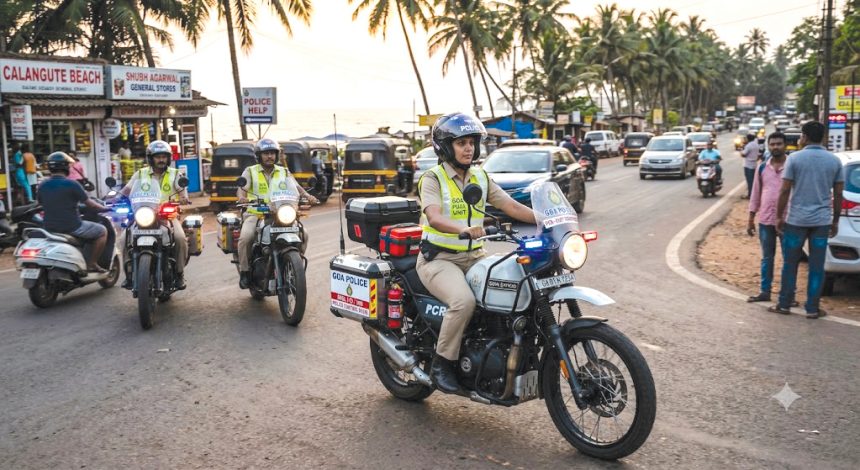
For the first time, Goa Police are introducing two-wheelers to the Police Control Room (PCR) fleet, which currently has over 55 four-wheelers, to respond to distress calls within minutes.
A senior police officer said the introduction of two-wheelers will help the police reach incident spots without any hurdles, thereby improving the response time.
In situations involving traffic congestion or narrow roads, a four-wheeler usually takes extra time, the officer said, adding that PCR two-wheelers will be able to easily manoeuvre to reach the incident scene as soon as possible. The move will also increase police visibility and significantly boost public confidence.
Director General of Police (DGP) Alok Kumar told ‘The Navhind Times’ that 40 new two-wheelers will be added to the PCR fleet soon. “Besides, 15 more four-wheelers will also be added to the PCR vehicles,” Kumar said, expressing confidence that this will reduce the PCR response time to distress calls.
Goa Police have already succeeded in considerably improving the PCR vehicle response time, cutting it down from over 18 minutes in December 2023 to 8.27 minutes in June 2026. Kumar said the target is to bring the response time down to around six minutes.
According to police, the two-wheelers will be especially helpful along the coastal belt in areas such as Calangute, Baga and Candolim. Sources said the two-wheelers will also carry an emergency kit, which will include a mini or compact fire extinguisher.
Currently, the fleet consists of 48 PCR vehicles, which include highway patrol vehicles, as well as an additional 10 pink force vehicles. In October 2019, Chief Minister Pramod Sawant inaugurated the Emergency Response Support System (ERSS) control room and flagged off PCR vans fitted with mobile data terminals (MDT).
The project was executed by the Centre for Development of Advanced Computing (C-DAC), a premier institution under the Ministry of Electronics and Information Technology, Government of India.
A significant feature of this system is that a call receiver can instantly see the caller’s details on-screen. The built-in software enables the receiver to find the exact location of the caller on a Geographical Information System (GIS) map, after which the call connects immediately to the MDT of the nearest emergency vehicle without delay.