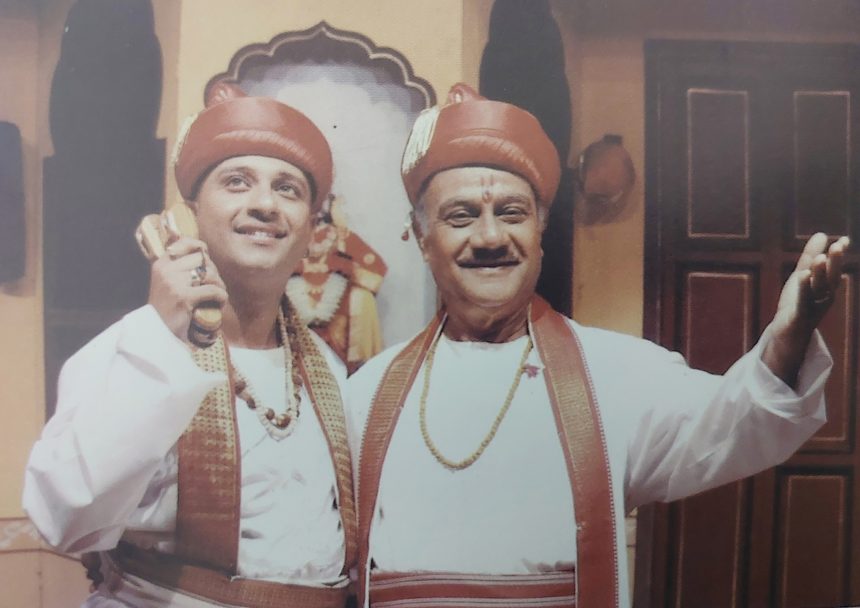
By Ramnath N Pai Raikar
A celebrated exponent of Indian classical, semi-classical and devotional music, Prasad Sawkar, in his passing, has left behind an enduring legacy for Marathi musical theatre.
Born Sambprasad Sawkar into a family of musicians and actors, and originally hailing from Mapusa, he was widely respected for his immense contribution to Indian culture and the performing arts.
The son of the iconic actor and singer of the Marathi musical stage, ‘Rangdevta’ Raghuvir Sawkar, who had set up a drama company in Maharashtra called ‘Rangbodhechhu’, Prasad Sawkar received his formal education in music and acting from his father. Later, he came under the influence of great musicians such as Jitendra Abhisheki and Nivruttibuwa Sarnaik.
Beginning his stage journey as a child artist in the play ‘Jinjihun Sutka’ in the role of young Shivaji, Sawkar later played important roles for the ‘Natyaniketan’ drama company in plays such as ‘Rambha’, ‘Kulvadhu’, ‘Kone Eke Kali’, ‘Ek Hota Mhatara’ and ‘Lagnachi Bedi’.
When the tradition of Marathi stage musicals was revived at the start of the 1960s, Sawkar was the natural choice as the singing actor in plays such as ‘Panditraj Jagannath’ and ‘Suvarnatula’, which received wide popularity. The highlight of his career was the role of Sadashiv in the play ‘Katyar Kaljat Ghusli’, produced by ‘Natyasampada’ in 1967. The song ‘Ghei Chhand Makarand’, sung by him, became a milestone in the history of Marathi musical theatre. He also acted in other musicals such as ‘Saubhadra’, ‘Manapman’, ‘Mandarmala’, ‘Jai Jai Gaurishankar’, ‘To Rajhans Ek’ and ‘Amrit Mohini’.
Sawkar also acted with his late wife, Shalini, in many stage productions. She was a familiar voice on All India Radio for a long time.
Sawkar further made a career in Marathi cinema, which included productions such as ‘Pedgaoche Shahane’ and ‘Gora Kumbhar’.
After retiring from the stage, Sawkar returned to Goa with his family and settled in the state. He advised young singers on the nuances of singing. He also wrote his autobiography in Marathi titled ‘Mee Natakwala’ (I’m a Theatre Person). Post-retirement, he made a comeback to the stage as a character artiste and acted in the specially written 2008 stage musical ‘Avagha Rang Ekachi Jhala’.
Speaking about his most successful play, ‘Katyar Kaljat Ghusli’, to The Navhind Times, Sawkar had stated, “Any normal musical play requires a maximum of two months to get ready, including its rehearsals; however, we rehearsed for three months for this play.”
Sawkar had further informed that the play was also technically strong, using three revolving stages — one large, with two smaller ones on either side — a feat achieved for the first time in India.
“Finally, when the first show of the play was presented before the audiences on December 24, 1967, at the Sahitya Sangh Mandir in Girgaum, Mumbai, it stretched to nearly five-and-a-half hours, including 30 to 45 minutes of speeches by the chief guests at the beginning of this inaugural show; however, it turned very engaging and people stayed till the very end,” he had stated.
“The producer nevertheless found it difficult to continue with such a long play and cut it short to three-and-a-half hours without harming the storyline, which unfortunately witnessed deletion of some of the best scenes as well as three songs from the play,” he had stated.