Project to receive central financial assistance
Shoma Patnaik
Panaji: Tivim and Dabolim are set to become Goa’s model solar villages after the state government identified them as fully feasible for 24×7 solar power.
The project is being implemented by Goa Energy Development Agency (GEDA), which assessed the electricity requirements of both the villages to determine the solar capacity needed to make them fully self-sufficient in the coming years.
According to GEDA’s evaluation, Tivim’s current solar power generation capacity stands at 1,989 kWp (kilowatt-peak). With an average daily electricity consumption of 1,95,080 kWh (kilowatt-hour), the village will require an estimated photovoltaic (PV) capacity of approximately 50 MW (megawatt) to meet its future needs. Photovoltaic capacity is the maximum direct current power a solar panel system can generate under ideal conditions. Dabolim, which currently generates 432.96 kWp and consumes an average of 1,17,528 kWh daily, requires roughly 30 MW of solar power to complete its transformation.
Both the villages are critical transport hubs due to their rail and airport connectivity. Once established as models, they are expected to fulfil the government’s renewable energy goals and provide a template for other villages.
Member Secretary of GEDA Sanjeev Joglekar said that the project falls under the Ministry of New and Renewable Energy’s (MNRE) PM Surya Ghar Muft Bijli Yojana.
The scheme tasked states with selecting one model village per district.
The selection was based on a competition where villages had to meet specific criteria for solar transformation. In North Goa, Tivim was chosen from a shortlist of eight villages, including Korgao, Dhargalim, Chorao, Ela, Carambolim, Latambarcem and Mayem. In South Goa, Dabolim beat out Bethora, Shiroda, Loutolim, Velim, Cola and Poinguinim.
The next phase involves preparing a Detailed Project Report (DPR) to identify infrastructure gaps and costs. This report will be submitted to the MNRE for approval and federal financial assistance.
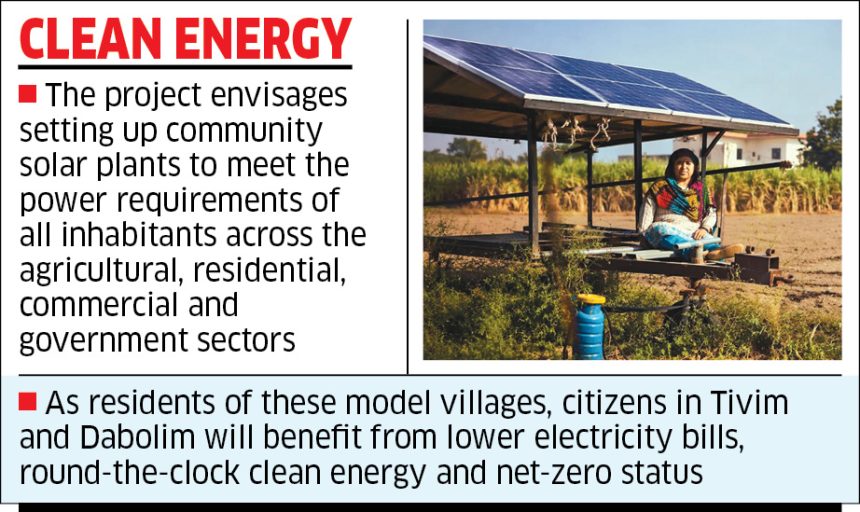
The project envisages setting up community solar plants to meet the power requirements of all inhabitants across the agricultural, residential, commercial and government sectors. As residents of these model villages, citizens in Tivim and Dabolim will benefit from lower electricity bills, round-the-clock clean energy and net-zero status.
“The objective is to promote rooftop solar adoption and enhance energy self-sufficiency at the grassroots level,” said Joglekar.