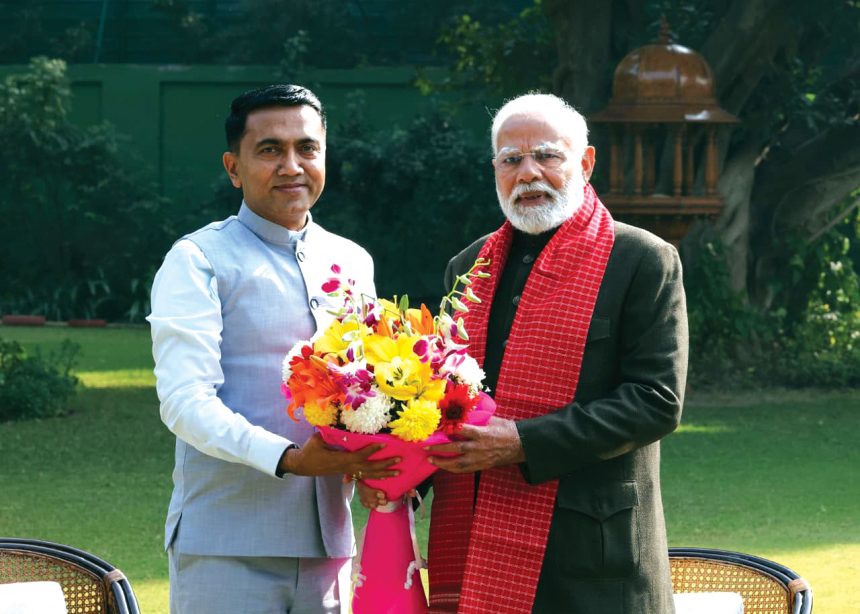
Pramod Sawant
Chief Minister, Goa
There are young Indians entering adulthood today who have known only one kind of India: an India of digital payments, expanding infrastructure and a growing presence on the world stage. For them, these realities
feel natural.
As India marks 12 years under the leadership of Prime Minister Narendra Modi, another significant milestone has been achieved. With over 4,000 days in office, he has become the longest-serving elected Prime Minister in India’s history. Beyond the record itself, the milestone reflects a period of stability in governance, allowing long-term reforms and national priorities to be pursued with consistency.
As India completes 12 years under the leadership of Prime Minister Narendra Modi, I find myself reflecting on the transformation that has taken place. What makes this period particularly significant is not that India changed in one sector alone. The change can be seen in the expectations citizens have from governance, in the pace at which infrastructure is being created, in the way young people approach opportunity, and in the growing respect India commands globally.
When PM Modi assumed office in 2014, he chose to describe himself as a Pradhan Sevak. Over the years, that expression has come to define much of his
public approach.
Building a Stronger, More Inclusive India
For me, one of the most striking aspects of these 12 years has been the scale at which change has been attempted. Over the last decade, some of the most significant changes have taken place in areas that do not always dominate headlines but profoundly influence everyday life. Access to a toilet, a house, clean drinking water, healthcare and banking facilities are often taken for granted until one has
lived without them.
Through Swachh Bharat, more than 12 crore toilets were built across the country. Through PM Awas Yojana, more than 4 crore homes have been constructed for families. Ayushman Bharat has extended healthcare coverage to millions of families, ensuring that a medical emergency does not automatically become
a financial crisis.
This period has also seen the growing emergence of Nari Shakti as a central force in India’s development. Across the country, women have stepped into larger leadership and economic roles through self-help groups, entrepreneurship and financial inclusion.
The same is true of India’s youth. Through initiatives such as Startup India and Skill India, a generation has been encouraged to innovate, create and build. Today, India is home to over 1.8 lakh recognised startups.
Transforming Infrastructure and Lives
As these changes were taking shape in people’s lives, another transformation was becoming visible across the country. India began building at a speed and scale that few would have imagined a decade earlier.
The impact can be seen across the physical landscape of the nation. More than 1.46 lakh kilometres of National Highways have been constructed, improving connectivity and economic activity across regions. Vande Bharat trains have introduced a new standard in rail travel. The number of operational airports has more than doubled, making connectivity accessible to more parts of the country.
The same spirit of transformation is visible in the digital space. The rise of UPI has become one of the most remarkable examples of public digital infrastructure anywhere in the world.
Alongside these changes, India has focused on strengthening its economic foundations. Manufacturing has received renewed attention through initiatives such as Make in India, while emerging sectors including electronics, semiconductors and advanced technology are creating new opportunities. India today stands among the world’s leading economies.
The country’s approach to sustainability has evolved as well. India has emerged as one of the fastest-growing renewable energy markets in the world. In 2026, India became the second-largest solar growth market globally.
The effects of change are often felt first at home, but over time they begin to shape how a nation is viewed beyond its borders as well. Whether through the G20 Presidency or its growing role in international forums, India has emerged as a voice that carries greater weight. Prime Minister Modi’s ability to build relationships across regions and political systems has contributed significantly to this shift. One indication of this changing global perception can be seen in the 32 major international honours conferred upon him, making him one of the world’s most decorated leaders. This reflects the regard and attention that India commands internationally today.
At the same time, India’s growing stature abroad has been accompanied by a clear willingness to protect its interests at home. From the Surgical Strikes and the Balakot operation to more recent actions such as Operation Sindoor, the message has remained consistent: the safety of Indian citizens and the security of the nation will be defended
without compromise. What stands out to me is that these developments have contributed to a larger shift in how Indians view their place in the world. Today, there is a growing expectation that India should be present wherever major decisions about the future are being discussed.
Moulding Goa’s Future Together
In Goa, we have experienced many of these changes first-hand. The partnership between the Centre and the State has accelerated progress across sectors while invigorating our own efforts through initiatives such as Swayampurna Goa. Reducing dependency and preparing Goa for the future have all drawn strength from this larger national direction.
As one reflects on these 12 years, it becomes clear that the story is larger than any single project or programme. It is the story of a nation that has found a greater sense of purpose.