With this year marking 134 years since Swami’s visit to the state as part of his Bharat Darshan that eventually led to his historic Chicago Address, NT NETWORK recounts the places he visited and his relevance in today’s day and age
DIANA FERNANDES | NT NETWORK
In 1892, Swami Vivekananda decided to travel around India as part of his research to understand the country’s spiritual and cultural diversity. Among the places he visited was Goa. This trip was part of his Bharat Darshan before his historic Chicago Address that was held the following year.
Travelling back in time
According to historical records, after his trip to Belgaum and on his way to Rameswaram, Swami Vivekananda found himself in Margao which was a Portuguese coastal colony at the time. He arrived in Margao on October 27, 1892 and stayed in the state for about a week.
In a letter to Haripada Mitra who was a forest officer in Belgaum, Swami said he had reached safely and had visited Panaji and a few other villages and temples nearby. “The town of Panjim is very neat and clean. Most of the Christians here are literate. The Hindus are mostly uneducated,” he wrote in the letter.
From an article published in The Hindu in January 1964, author Shri V. S. Sukhthanker wrote that Swami Vivekananda had expressed a desire to visit Goa to Dr. V. V. Shirgaonkar who was a prominent citizen of the city with whom he had come in close contact with.
Dr. Shirgaonkar wrote to Subrai Naik, his learned friend from Margao to be of service to Swamiji. He received a rousing welcome at the Margao Railway Station where hundreds turned up to welcome him. In a grand procession, he was taken to the house of Subrai in a horse carriage. Subrai, a scholar in Sanskrit, was well versed in Hindu scriptures and was charmed by Swamiji’s intellect and the depth of his religious knowledge.
Visiting Rachol
The main object of Swami Vivekananda’s visit to Goa was to study Christian theology from old Latin texts and manuscripts that were unavailable anywhere else in India. On learning about this, Subrai invited his learned Christian friend J. P. Alvares to meet Swamiji. Alvares made special arrangements for him to stay at the Rachol Seminary, which is the oldest convent- college of theology in Goa. Located around four kilometres away from Margao, the seminary held rare religious literature in manuscripts and printed works in Latin. Today, the Rachol Seminary has a framed coloured picture of Swamiji in its library that testifies to his historic visit to the place. It also has the two volume books titled ‘The Life of Swami Vivekananda by His Eastern and Western Disciples’ that shares his life and provides a glimpse into the Goa visit and his experiences throughout India and the world.
In fact, a chapter from the book shows Swamiji’s appreciation of Christian Rome. It says that everything he saw greatly interested him. In Christian Rome, he walked through the early catacombs, visited palaces, churches and basilicas and was greatly impressed with the immense Vatican chapels and its magnificent Renaissance art treasures. Beneath the vast dome of the St. Peter’s, he entered into the silence of meditation into the apostolic world in which Saint Paul preached and inspired followers of Christ.
Swami Vivekananda spent awhile going through the manuscripts and interacting with the priests at Rachol. Sukhthanker writes, “Swamiji spent three days in this seminary assiduously perusing all the important theological works that he found there. His gigantic intellect and original views about Christianity based on sound knowledge were indeed a marvel to the Father Superior and to the other Padres and also to all students of this Seminary.” The priests also later participated in the farewell meeting organised for Swami on the eve of his departure.
Another book ‘Goa-Blessed by His Sacred Touch’ published by Adhyaksha, Sri Ramakrishna Math, also mentions Swami Vivekananda’s visit to the state. It states that Swamiji and Subrai mostly conversed in Sanskrit and that Naik deeply admired Swamiji’s scholarship and broad views. He also accompanied Swamiji to the Rachol Seminary and acted as an interpreter between Swamiji and the Father Superior at the seminary. It is said that the rector of the seminary Monsenhor Pedro Remigio Das Merces Barreto was also surprised at his grasp on the subject.
Recording history
Swami Vivekananda also visited and sang at several ancient temples in Goa. Sri Datta Naik Dalal in his Marathi book ‘Yati Subrahmanyananda’ mentions that at the Shanta Durga Temple in Kavala, Swamiji sang songs in praise of Mother Kali in his melodious voice and won the hearts of the devotees present. It was here that people understood his profound and vast knowledge of Vedanta.
At Mardol’s Mhalasa Temple, he sang a khayal and at Mangueshi Temple through a beautiful raga he sang a dhrupad that drew admiration from those present. In Margao’s Subrai Baba’s Hall he went on singing a part of the raga for nearly 45 minutes leaving many wondering of his extraordinary singing skills.
Dalal also mentions some interesting associations of Swamiji with Subrai Naik. He says that Swamiji sang at Subrai’s residence several times. On one of these occasions, Swamiji sang devotional songs and was accompanied on the tabla by a reputed tabla player named Kharupji. After the singing session was over, Swamiji spoke to Kharupji of his habit of distorting his face while playing the tabla. Swamiji explained that one could play the tabla without making faces, but Kharupji said that was impossible. Swamiji played the tabla himself and showed that it was possible.
From Margao, Swamiji went by train to Dharwar and from there to Bengaluru.
A house with history
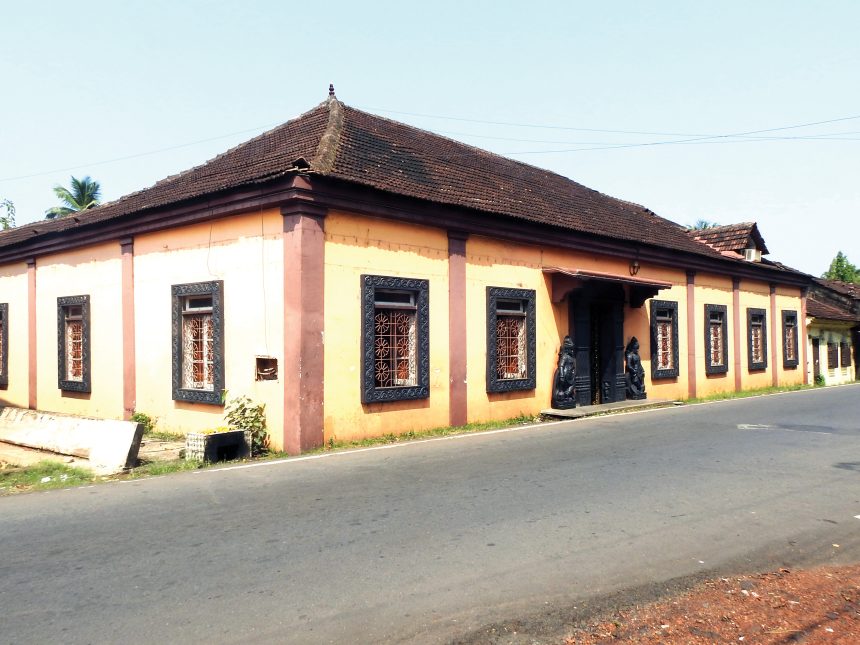
Today, the Naik house, where Swami Vivekananda stayed for seven days, is located on Abade Faria Road in Margao. Pradeep Naik today has taken over and ensures its upkeep and maintenance. Since its renovation, it was opened to the public in 2006 and is now opened to visitors on request.
As you enter the house, marble pieces recall the historical significance of the place, with one reading, “This place was sanctified by Swami Vivekananda’s visit in October 1892” and another reading, “Birth-home of Shri Subrai Laxman Naik (April 1854-January 1916) later Srimat Subrahmanyananda Tirth, Sanskrit scholar and Ayurvedacharya, who hosted Swami Vivekananda in October 1892.”
On the left, is the temple dedicated to Sri Damodar and is often called the Damodar Sal. On the right of the entrance is the room that Swami Vivekananda stayed in. In the past, the room was separated by a wooden partition. Pradeep, since taking over, replaced it with a glass partition.
“It is a pride for us that Swami came all the way and stayed in our house. For me, it is a privilege to help in preserving this room that is steeped in history and has stood the test of time and generations,” says Pradeep, who recalls running around the room as a child. He beams with pride as he shows the pristinely preserved sofas, tables and items around the room from the traditional lamps to the photographs of his ancestors.
It is said that at the request of Subrai, a photograph of Swamiji was taken before he left Goa- a colour portrait which adorns the Damodar Sal now. A self photograph given by Swamiji is also preserved by Subrai’s descendants.
Later in life, in 1910, Subrai took monastic vows and assumed the name Swami Subrahmanyananda Tirtha. He lived a devout life and was respected for his saintly character. He was also invited to speak at religious gatherings in Goa including at a meeting to commemorate the 54th birth anniversary of Swami Vivekananda. Here, he spoke at length in Marathi on the life and mission of Swami Vivekananda and personally described his personal interviews. He lived in the same room where Swamiji lived in his house until his passing away in 1916.
In 2021, Chief Minister Pramod Sawant had also lauded and complimented the Naik family for protecting and maintaining the room. At the time he said, “They have protected and maintained all the items used by the Swami in the house, be it the chair, sofa set, radio etc. This is the fourth generation of the Subrai family that has maintained the premises and Swami’s items,” adding that the government would assist with the cleanliness and maintenance of the items.
Learning from Swami’s teachings
While many look to this visit as a historic moment, others say there is a lot that can be learned not just from the visit but from the teachings of Swami Vivekananda.
General secretary, Ramkrishna Mission Goa Swami Aryananda says the relevance of Swami Vivekananda’s visit to Goa is immense, especially for the youth. “He is a youth icon and the Government of India has declared January 12, his birthday, as National Youth Day. Goa is a beautiful place and compared to what movies have projected of the state, we know that Goa is much more. I want to change this image. I hope to create a centre that can help in this,” he says, while also pointing out the need for strong character building education among the youth. “There are so many cases of suicide and depression which leads them to drugs. They cannot face the stress,” he says, adding that reading Swamiji’s works could help
the youth.
He also shares the stories of two people whose lives were changed with the teachings of Swami Vivekananda. One was of a boy who was a backbencher in school. Out of frustration one day, his father gave him a book on Swami Vivekananda which changed his life. He is today a retired director general of police, Dr. Vikram Singh. Another was of a boy who failed the Class 10 exams four times and appeared for the Class 12 exams four times. It was presumed that he would grow up to be unsuccessful in life. Finding it difficult to hold jobs in a hotel and then as a truck driver, the youngster was on the verge of committing suicide when he read a book by Swami Vivekananda. Changed by this, he then went to college, appeared for UPSC exams and became an IRS officer and a motivational speaker. His name is Satyanarayan Raju.
“This is how Swamiji can inspire the youth. It is thus up to us to take his works to the youth. Reading books is a very good practice in life. We regularly organise character building and other personality building workshops among the youth. One of Swamiji’s messages is to inspire the youth, for the liberation and the welfare of the world. It is a message that uplifts the entire society and his concept is to work for the betterment of the society,” he says.
Konkani writer Anant Agni who recently released the Konkani translation of Swami Vivekananda’s famous Chicago Address says his teachings are relevant in today’s day especially in philosophy, Hinduism, religious harmony and youth development. “At a time when religious intolerance and communal divisions are increasing, his message reminds us that religion should unite people, not divide them,” says Agni. He states that a true follower of Swami Vivekananda can take pride in Hindu philosophy while respecting Christians, Muslims, Buddhists, Sikhs and people of all other faiths.
“His teachings inspire us to be strong without being arrogant, have faith without hatred, take pride in our religion without disrespecting others, and express our spirituality through service to humanity,” he says. “The real tribute to Swami Vivekananda is not just celebrating Hinduism, but practising its highest values through wisdom, compassion, self-discipline and respect for all religions.”