MIGUEL BRAGANZA
The rise in the day temperatures is palpable especially after noon time. During this time, there is nothing better than a cool cucumber salad or a refreshing watermelon to beat the heat. One can bite into a slice of a ripe watermelon or drink a glassful of chilled watermelon juice and feel the difference.
The Cucumber and the watermelon belong the same family. Botanically, both are fruits, but the cucumber is considered as a salad or a cooking vegetable. All these cucurbits are creepers that can be grown from seed, trailed on the ground, on a fence or on the roof. They produce vegetable with very little care, except watering during the summer. Watermelons are best grown in sandy soils in coastal villages like Palolem, Benaulim, Calangute, Parra, and Arambol. Sandy banks of rivers with receding flow after the monsoons are often used for planting watermelons. They can withstand drought but not flooding. Avoid excess irrigation.
Traditional farmers have grown cucumbers and gourds on the hillsides and kulaghars, especially in Ponda Taluka, which is famous for the tender ‘peepri’ cucumbers. The other extreme is the tavshem or the mature cucumber that is cooked with coconut juice to make a curry or grated to make a tavsali or halwa, similar to the one made with Konkan dudhi or bottle gourd, Lagenaria sineraria, that is also called as lauki. It should not be confused with the dudhi or pumpkin, Cucurbita pepo. The whole pumpkin can be stored for months without spoilage and used during periods when vegetables are difficult to find. It may be a good buy if the U.S.A.- Iran conflict becomes a long-drawn war and vegetables become expensive because of increase in the price of petrol
and diesel.
Watermelons are susceptible to blossom-end fruit rot due to calcium deficiency. This can be corrected by applying lime-containing rock phosphate fertiliser or lime powder (chuna) to the soil. On a home-scale, even crushed eggshells can supply the calcium needed by the vine. Calcium also makes the soil less acidic and increases production of female flowers and fruits in watermelons and other cucurbits.
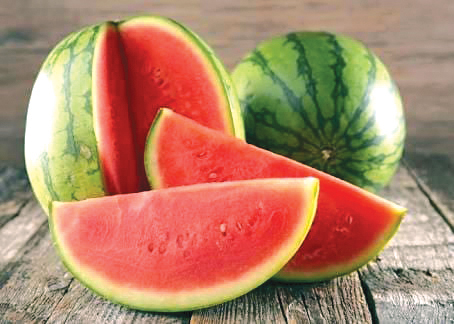
The new hybrid Agusta and older variety, Sugar Baby, are two popular dark green skinned and red fleshed varieties of watermelon. They are marketed as the ‘local’ variety of Parra village because of the dark green skin colour similar to some unknown variety that was grown in the village earlier. There are varieties with alternate light and dark green stripes along the longitudes. These varieties have red flesh and are popular in India. Watermelons are sweeter when grown with organic manures.
The sweetness and taste depend on the ripening. The discoloured ‘resting patch’, where the watermelon rested on the ground, indicates whether the watermelon was ripe when harvested. It should be creamy or yellow but not white. A white patch indicates that it was harvested before ripening and is unlikely to be sweet. Remember to check the ‘resting patch’ when buying a watermelon from the trader in the market.