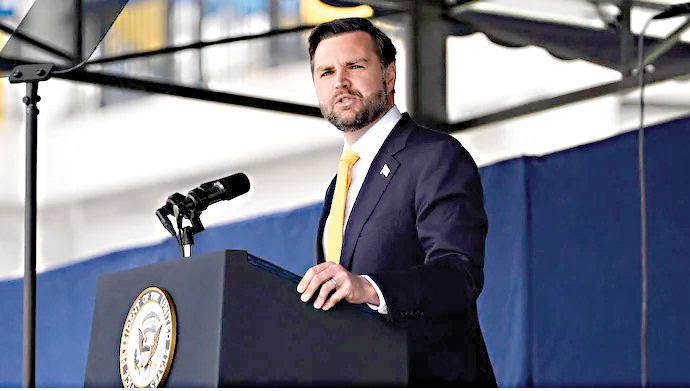
Washington: The US-Iran peace deal to end the 107-day war received a cautious welcome with Vice President J D Vance saying that it presented an opportunity to Tehran to turn a new leaf in its 47-year failed relationship with Washington.
In remarks to CBS News and ABC News, Vance said the achievements of the peace deal are two-fold it ensures that Iran will never have a nuclear weapon and will open the doors for it to join the world economy should it honour the obligations reached in the agreement.
“What this agreement does is really twofold – on the one hand, it ensures that Iran will never have a nuclear weapon, while simultaneously opening the Strait of Hormuz it also fundamentally extends a hand to Iran and says, ‘Look, if you guys are willing to honor your obligations, if you’re willing to allow real inspections of your nuclear program, then we will welcome you back into the world economy’,” Vance told CBS News.
“I think what the President wants to do is turn over a leaf of 47 years of a failed relationship between the United States and Iran, but that requires the Iranians to actually honour their end of the bargain,” the Vice President added.
Vance said the agreement with Iran was “performance-based.”
“We have to remember, their economy is fundamentally destroyed. Their nuclear program is fundamentally destroyed. If they don’t do the right things [in the deal], they’re never going to have the money to rebuild their nuclear program to begin with,” Vance said.
He said the deal was signed “digitally” ahead of a formal signing ceremony scheduled for Friday in Switzerland.
Vance said Iran would gain access to a USD 300 billion reconstruction fund if it met its obligations to end its nuclear program, but that money would not come from the United States.
“That’s the sort of thing they could have access to, funded by the (Gulf Cooperation Council), so long as they honor their end of the obligation,” Vance told “CBS Mornings” when asked about the fund.
“We absolutely are open to the [GCC] countries investing in the reconstruction of Iran only if Iran ends their nuclear program,” Vance said
Vance also told ABC News that “not a single dollar of American money will go to Iran” and emphasised that any financial benefit would come after Tehran hits certain benchmarks regarding ending its uranium enrichment program.
Democrat Congressman Ro Khanna welcomed the ceasefire agreement with Iran and the opening of the Strait of Hormuz and hoped that gas and food prices would start coming down soon.
“The ceasefire agreement with Iran, with the opening of the Strait of Hormuz, is welcome news. Democrats should support it. I am glad it includes a provision for mutual respect of the US and Iran’s sovereignty so we do not launch a dumb war of choice again,” Khanna, a member of the US Congress from California, said.
Khanna said the war was a costly lesson for the US, and as expected, Trump failed to bring about regime change.
“The terms seem no better than what Obama secured under the JCPOA nearly a decade ago. America lost 14 precious service members and wasted billions of dollars on this foolish endeavour,” he said.
“It also shows that when the Congress votes to end war –as we did last week — it can be a wake-up call for the President to listen to the anti-war sentiments of the American people,” Khanna said.
Republican Senator Lindsey Graham said he was pleased to hear that the memorandum of understanding with Iran to allow the Strait of Hormuz to open has been agreed to.
«I am somewhat concerned that Iran›s view of the agreement seems different from what the American negotiating team is claiming,» Graham said.
«Under our law, any nuclear deal with Iran will be sent to Congress for review and a vote. I look forward to reviewing the final product, and I believe it is imperative that the architect of the deal, Vice President Vance and his negotiating partners, be part of the process in presenting the final deal to Congress,» Graham said.
«Congratulations to all in getting us to this point. Time will tell,» the Senator from South Carolina, said.
The deal was negotiated through mediators that included Pakistan and Qatar, who initially got a two-week ceasefire agreement on April 8. The ceasefire was extended till the completion of the talks.
The US and Israel launched attacks on Iran on February 28, killing Supreme Leader Ayatollah Ali Khamenei and several top commanders.