From observing wetlands to designing for their recovery, Biopod+Co. brings its approach to Goa
VINIKA VISWAMBHARAN
What if the wetlands around us were not just landscapes to protect, but systems we could learn from? That question lies at the heart of Biopod+Co.’s ‘Designing with Nature’, an exhibition at Sunaparanta Goa Centre for the Arts, Altinho, exploring how ecology and design can work together to restore Goa’s wetlands.
Biopod+ Co. is an ecosystem restoration consultancy that develops nature-based solutions for wetlands and aquatic ecosystems, combining ecological science, biomaterials and design. At the centre of its approach is the Biopod, a modular, 100% nature-based system designed for degraded wetlands and waterways. It carries native wetland plants and biomaterials into affected environments, helping restore biodiversity while supporting the natural remediation of polluted water.
“Goa felt like the natural starting point because, for many members of our team, it is home,” say Biopod+Co. co-founders Avantika Velho and Manini Banerjee. Growing up here, they say, meant witnessing natural environments gradually come under pressure or disappear altogether. “Starting in Goa is therefore about understanding and caring for the ecosystems closest to them before imagining solutions elsewhere,” the founders say.
The exhibition reflects that philosophy by making the wetland itself the starting point. Rather than presenting restoration as a conventional science display, Biopod+Co. uses design to create what creative strategist Malvika Agarwal describes as a more immersive and emotional entry point into the subject. “We built this exhibition to do something a wall of text cannot capture: put people inside the wetland,” say the founders.
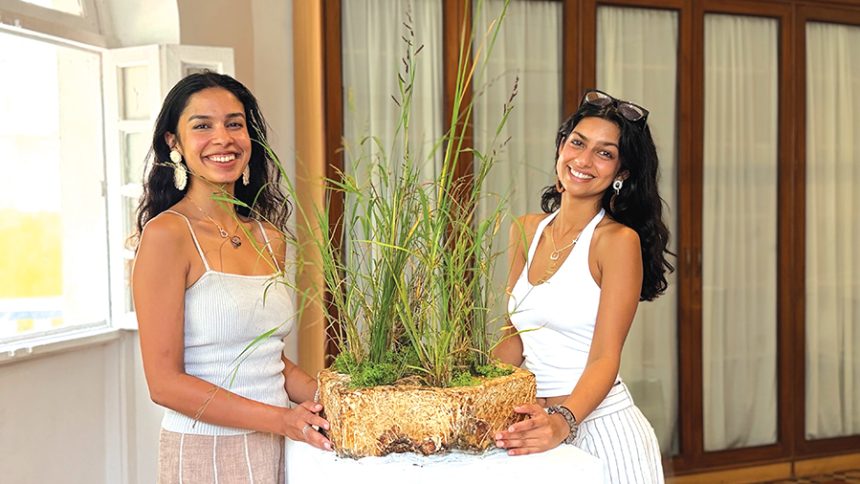
The first gallery immerses visitors in imagery of Goan wetlands, their diversity and the species threatened by human activity. The next gallery then moves from observation to intervention, featuring a transplanted fragment of wetland ecology alongside a bespoke Biopod module developed from its analysis.
The exhibition also seeks to challenge how wetlands are understood. Business strategist at Biopod+Co., Shamika Velho, points out that they are often associated only with mangroves, overlooking the variety of ecosystems that fall under the term. “Beyond housing an incredible amount of biodiversity, wetlands help filter our waterbodies, regulate water systems and sequester carbon,” she says.
Biopod+Co. points to the scale of the problem: more than 40% of Goa’s wetlands have been damaged or lost in the last 12 years.
That understanding feeds directly into the company’s restoration work. Instead of looking for a single technological fix, Biopod+Co. study the relationships between plants, fungi, microorganisms, water and soil. “Ecosystems do not function through a single organism doing all the work,” the team says, explaining its multi-species approach to restoration.
For Shamika, the principle is simple: “Look at the environment around you, learn from it, and design with it rather than against it.”
Their work with mycelium illustrates the principle. Instead of introducing an entirely foreign material into a wetland, Biopod+Co. has explored how a naturally occurring organism can be incorporated into structures that support ecological processes. The Biopod itself follows the same thinking. “The goal is not to make nature fit our design,” says Shamika. “It is to design in a way that allows nature to do what it already knows how to do.” Designed to become part of the ecosystem rather than simply sit within it, the Biopod system is also kept at a human scale, making it practical to handle, deploy, and maintain.
That philosophy also asks designers to slow down. “The most valuable thing designers can learn from ecosystems is the importance of looking more closely at the problem,” says Agarwal. Designing with nature, she adds, requires curiosity, patience, and a willingness to understand existing systems.
It has also changed how Biopod+Co. approach engineering. “In many cases, the solution already existed in nature,” says Agarwal. The challenge was understanding it well enough to apply it to a real-world problem.
The founders’ design-engineering backgrounds have also led them to see ecosystems as systems that can be actively redesigned, but fieldwork has also taught them the limits of control. “Working in the field has taught us humility,” say the founders. “In a laboratory, you can isolate variables and create relatively controlled conditions. An ecosystem never gives you that luxury.”
The need for that connection is particularly pressing in Goa. “Wetland degradation can happen gradually through pollution, encroachment, habitat fragmentation and changes to natural water flows,” says Shamika, adding that communities can become disconnected from ecosystems that exist close to them.
Biopod+Co. is now looking at how its work can move beyond the gallery. Its Goa restoration node is scoping potential deployment sites, while research and development for a local Biopod have begun. A pilot would involve site analysis, research, prototyping, manufacturing and deployment.
“This is the beginning of what we hope is a long relationship with Goa,” say the founders. The company is looking for deployment sites, collaborators and institutions interested in researching, building or working alongside it.
The ambition extends beyond a single project. Biopod+Co. envision a network of restoration nodes that can respond to local ecosystems while sharing knowledge across regions. “We believe global change is the sum of a billion local success stories,” say the founders.
(‘Designing with Nature’ will be on display at Sunaparanta Goa Centre for the Arts, Altinho until September 19, Monday to Saturday, 10 a.m. to 6.30 p.m.)