

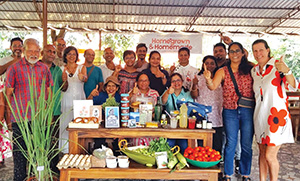
The Homegrown and Homemade Market recently completed a year after being launched on World Consumer Rights Day, March 15 last year, and during this period has helped Goan vendors connect with interested customers while also learning capacity-building techniques and growing as entrepreneurs
Every second Saturday of the month, Goacan and Green Essentials bring together 20 vendors for the initiative, which is held at Laban Farms in Nuvem. The products range from locally grown fresh vegetables, homemade pickles and sweets, snacks, eco-friendly jewellery, artisanal soaps, shampoos and serums, homemade wines and Irish cream liqueur, honey and associated products, and desi chicken and quail eggs, among a host of other offerings, often accompanied by music.
The idea for the market arose from the need to act on their previous initiative of ‘Friday Balcao’. “We have been talking for a long time at the Friday Balcao talks on topics of organic farming and similar ideas. So, we thought of launching something based on it. The main idea is for fresh produce like for example, we have small farmers bringing in fresh vegetables like radish, sweet potatoes and drumsticks and what we sell we give it directly to the farmers. Along with that from a consumer’s perspective we take up one issue and create awareness and speak about it. So we have dealt with garbage management and most recently we have been discussing the LPG issue from the consumer’s point of view,” said Goacan convenor Roland Martins.
While Goacan deals with the consumer rights aspect and assists vendors in capacity building, Green Essentials is helping vendors transition to organic practices.
Founder of Green Essentials Yogita Mehra stated, “We used to farm in Taleigao and Santa Cruz and we saw there was a lot of interest in growing. At the core we ensure that people have access to safe, clean food. One of the ways is by making inputs available. As we began to do this, we had people come and ask us if we have produce, but we don’t have the resources to do that. So we thought about it and wondered how we can have the customers come and interface with the actual growers and makers.”
She added, “We would like to have exclusively organic produce, but we don’t have that here. In Goa organic growers are not very many. So if we exclude who is not organic, we won’t have anyone. So our idea is that if there is a grower who wants to sell here who is local and fresh, you can come here and if you want to switch to organic, we can help in that with expertise that we have at Green Essentials or Laban Farms. The idea is not only to sell stuff but also to be a source of education for people who want to do this kind of organic growing.”
Though the market limits the number of vendors to 20 stalls, participants are encouraged to remain consistent and build their own networks of customers. “When we started, the vendors, who are predominantly from Salcete, focused mainly on displaying their products at the market. Over time we encouraged them to start getting customers before the next month’s market as well as to take pre-orders. So there was a vendor who pre-ordered fish and the customer took around 9 kilos of fresh fish,” said Martins.
Organisations from across the state are also welcomed to present their innovative ideas. For instance, at the recent market, NGO Arz showcased its concept of ‘Poti’, under which if a person gives one kilo of old clothes they receive a stitched bag.
The organisers now plan to introduce more capacity-building initiatives to help Goan vendors further develop their brands and products. “We are planning to now have regular meetings of the vendors on how to make it grow and increase the footfalls. The second is that we want to run training programs by tying up with state departments like legal meteorology and the Food and Drug Administration so that vendors start increasing his capacities,” said Martins.
One example is Lee’s Bees, which has primarily been working with bees to produce honey while also providing services such as hive installation and management, crop pollination, and beehive removal. More recently, the enterprise ventured into mud crab cultivation, which proved popular at the market.
However, organisers stated that while some vendors remain hesitant about technical requirements, support from the organisers and the need to keep pace with larger brands in the digital age are essential. “Many say they are not registered and don’t want to put labels or other technicalities. But what we have said is that’s not the way and we have to fall in line, so we have to work it out. Now that we have completed one year, we know more or less who is there and who needs this assistance. We want to present an alternative. We want to inform them that we are living in a social media era where if we don’t build our capacities, we are up against big guys and then we always crib that we are not able to compete. That is not the answer, you have to work,” said Martins.
Ideas and concepts such as solar cooking and other sustainable practices are also planned to be introduced to vendors to encourage their adoption. The market, organisers said, also has the potential to be introduced in other parts of the state, but this would require the initiative of two or three dedicated individuals who understand its purpose and avoid pushing it towards commercialisation.

