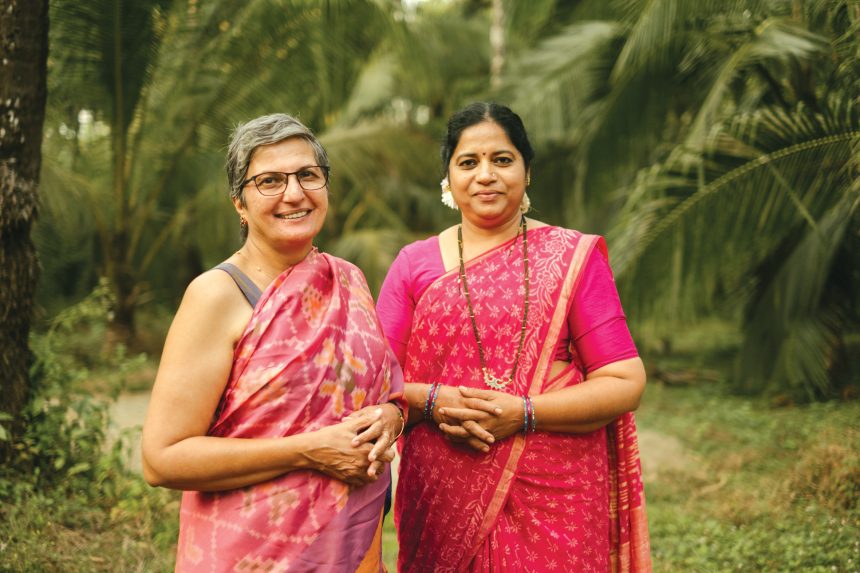
Through fieldwork, photography and conversations with local people, Heta Pandit’s translation of Pournima Kerkar’s
‘Vismrutichya Umbarthyavar’ captures the knowledge and experiences behind the objects documented in the book
RAMANDEEP KAUR | NT BUZZ
Many traditional household objects are no longer used as they once were, but their stories survive in the memories of those who grew up with them. Pournima Kerkar’s Marathi book ‘Vismrutichya Umbarthyavar’, published in 2019, documents their place in Goan homes and cultural life. Its English translation, ‘Objects and Memories from Goa’, by Heta Pandit, will be launched on October 30.
Kerkar, who has been teaching Marathi to Classes 11 and 12 for the past 33 years, says, “I have been interested in folk culture since childhood. I often watched my mother and grandmother use traditional household objects.”
Her research began in 1996, after her marriage to environmentalist Rajendra Kerkar, who encouraged her to document traditional practices. She later wrote columns on household utensils for a Marathi daily and visited villages in Goa, Karnataka and Maharashtra to learn about the objects and their uses. She credits four women, her mother-in-law Mase Gawas from Ibrampur, Babali Parab from Mulgao, Puti Gaonkar from Sanguem and Subhadra Gawas from Keri, for sharing their knowledge. Her students, Shubhada Chari and Vithal Shelke, helped with the photographs.
The Marathi edition documents 99 objects, including the ‘kundia’ (also known as ‘kundala’) (cooking pot), ‘sup’ (winnowing fan), jaatey (grinding stone), ‘mussel’ (mortar and pestle) and ‘chul’ (stove). The book received the Shrimati Draupadi Kumbhar Puraskar in Kanakavali.
“Many of these items were used for cooking and were also part of folk traditions such as ‘oviyos’ and ‘fugdi’, as well as in rituals and social gatherings,” says Kerkar.
Her research also revealed regional differences in the names and forms of household objects. She found that an object called ‘Unimand’ in Goa is known as ‘don’ in the Konkan, where it is slightly larger and deeper. A traditional umbrella called ‘Gorbi’ in Goa is known as ‘Irli’ in the Konkan. Kerkar’s other books include ‘Anubandh Lokagangeche’, ‘Govyatil Dhalotsavache Swarup’ and the poetry collection ‘Spandan’. She has also edited ‘Gomantkiy Loksahitya: Ek Drushtikshep’, a book on Goan folk literature and writes columns for Marathi newspapers. Pandit says her long association with Pournima, her husband Rajendra and their associate Shubhada Chari helped lead to the translation project. She says, “They introduced me to ‘oviyos’, songs sung at the grinding stone and to ‘kaavi’ art in remote temples in Goa and beyond its borders.”
She and Chari had also worked on an unpublished translation of Pournima’s book on Goa’s Dhangar women. “Perhaps this gave us the impetus to think of doing a translation of ‘Vismrutichya Umberthyavar’,” says Pandit.
A writer of 11 books on Goan architecture, culture and heritage, Pandit says translating the book required a deep understanding of both language and culture. “Some words or phrases simply don’t have an English language equivalent but Pournima and I worked closely together. Once she unravelled the Marathi terms and phrases, I gave them my own interpretation.”
The English edition contains 52 objects, as some were no longer available to be photographed. “We also had to consider portability and affordability,” says Pandit.
The photographs by Aaron Monteiro and Daniel D’Souza document the objects and the people who continue to use or preserve them. Pandit had previously worked with D’Souza on ‘Stories from Goan Houses’, for which Monteiro took promotional photographs. The team also includes communications consultant Harihara S S.
The book involved both primary and secondary research, with the photography process taking the team to people in different parts of Goa. Pandit says, “When my photographers and I go to a subject, we look around to see what else we can learn about the subject and his or her life.”
Pandit recalls that a woman featured on the book’s back cover showed the team some of her treasured belongings. However, they were mindful that asking too many questions or touching the items could intrude on her privacy.
The project also stirred personal memories for Pandit. “When we took pictures of a bride at her ‘chudo’ (bangle) ceremony, I was in tears. The ‘moddki’ also reminded me of my childhood,” she says. “My mother was born in 1922 and we still have her baby cot. So many children have used that cot!”
Pandit challenges the assumption that younger Goans are indifferent to their heritage. “People seem to think that the younger generation of Goans do not care about their heritage. Our experience is different. Yes, they do care and they are sensitive to their culture and their legacy,” she says.
She believes objects need not remain in use to be valued. “They can be repurposed and recycled or simply displayed. They hold the memories of family members, of a place, an ancestral home perhaps and we lose all of that when we put the object away and forget about it.”
Pandit says her earlier work on ‘oviyos’ was a more emotional experience. “Oviyos were sung by women in the isolation of their homes, with the grinding stone as their only confidant, their friend. This book is more about objects that are no longer in use but live on in people’s memories through songs, lullabies, wedding songs, riddles, idioms and proverbs.”
Her collection includes tiffin boxes, brass buckets, milk jugs, toffee tins, cutlery, coconut scrapers, storage bins and cooking pots dating to the 1920s. Though most are no longer used, she cleans and polishes them regularly and displays them as conversation pieces.
Kerkar, meanwhile, continues her research into Goan folk traditions and heritage. Her current work focuses on ‘Ranmale’, a traditional folk drama and the ecological and socio-cultural significance of traditional structures in Goa.
(‘Objects and Memories from Goa’ will be launched at 6 p.m. on Friday, October 30, at the Xavier Centre for Historical Research in Porvorim. The event will include a panel discussion with Heta Pandit, Pournima Kerkar and filmmaker, illustrator and educator Nina Sabnani, moderated by independent art historian and curator Lina Vincent.)