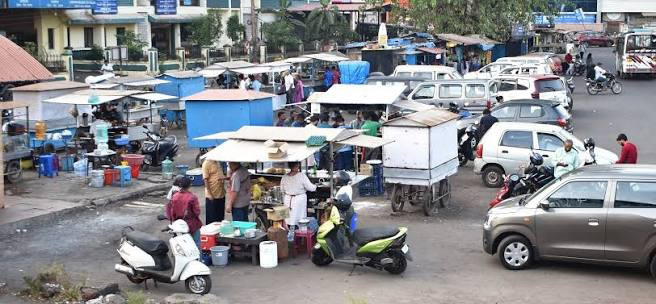
By Roque Dias
Margao
While the Supreme Court judgment on Friday on pedestrian safety came as a big relief in the country, twenty-eight years ago, on June 4, 1997, the High Court of Bombay at Goa (Panaji bench) had delivered a similar verdict in a writ petition categorically stating that no permanent structure can be permitted on the public streets, which include footpaths, by the municipalities or the chief officers serving these civic
bodies.
This ruling back then, delivered by Justice Ferdino Rebello (now retired), had promised the reshaping of the streetscape of the state’s urban centres.
“In my judgment, I had directed the clearance of footpaths for pedestrians. While serving in Bombay, I observed that this issue severely impacted pedestrian safety. Later, while sitting on the vacation bench in Goa, a matter came before me from Mormugao-Vasco regarding an illegal structure on a footpath. The petitioners rightly maintained that footpaths are meant exclusively for pedestrians as a matter of right. I held that no structures could be permitted on footpaths. Upon examining the Goa Municipalities Act, 1968, I noted that the power to remove such obstructions rests solely with the chief officer, and the municipal council itself possesses no such authority. Following my judgment, footpaths across Goa were promptly cleared,” Justice Rebello said, while speaking to this daily.
According to the case, the High Court of Bombay at Goa had categorically held in the writ petition number 148/97 (Pedestrians versus the Chief Officer of the Mormugao), that no permanent structure — including kiosks, stalls or platforms — can be permitted by any municipal council or chief officer on public streets, which by statutory definition include footpaths.
Justice Rebello had declared that the Goa, Daman and Diu Municipalities Act, 1968, contains “no provision whatsoever” permitting such structures, and issued a battery of directions to four municipal councils to dismantle illegal encroachments forthwith. This includes, Mormugao, Margao, Panaji and Mapusa and the director of municipal administration.
The key directions issued to the chief officers of the municipalities included the publishing of public notices within 15 days requiring shop-owners to remove all encroachments, failing which chief officers must act under Section 174(3) without notice; (ii) a blanket ban on issuing fresh licences for kiosks or earmarked hawking spots; (iii) non-renewal of licences on road-widening areas; (iv) demarcation of hawking zones after public objections; and (v) constitution of a special cell under each chief officer to dispose of encroachment complaints within 30 days, with the chief officer held personally liable.
Chief officer of Panaji Municipal Council, AT Kamat, had set out in his affidavit, that a “demolition squad” has been constituted by the Panaji Municipal Council and it is the duty of this squad to check that no unauthorised structures are being erected on the footpaths, set back areas and road-widening spaces left at the time of construction of buildings.
“The municipal councils construct the roads and footpaths out of public funds, so that vehicular traffic moves unimpeded and pedestrians have a safe access for movement along public streets. The taxpayers rights cannot be usurped because of those in power, under compulsions of some of their constituents and supporters to carry on trade and business. Footpaths in some places are taken over completely with the pedestrians at the mercy of the encroachers. Increase in vehicular traffic further congests the roads because most of the time the parking places which have to be provided when buildings are constructed, are used for purposes other than parking and those cars also have to be parked on the roads. One has not heard of any action taken by the municipal councils in such matters. It is therefore necessary that a stone be cast so that the ripples carry home the message,” Justice Rebello had said in his judgment.