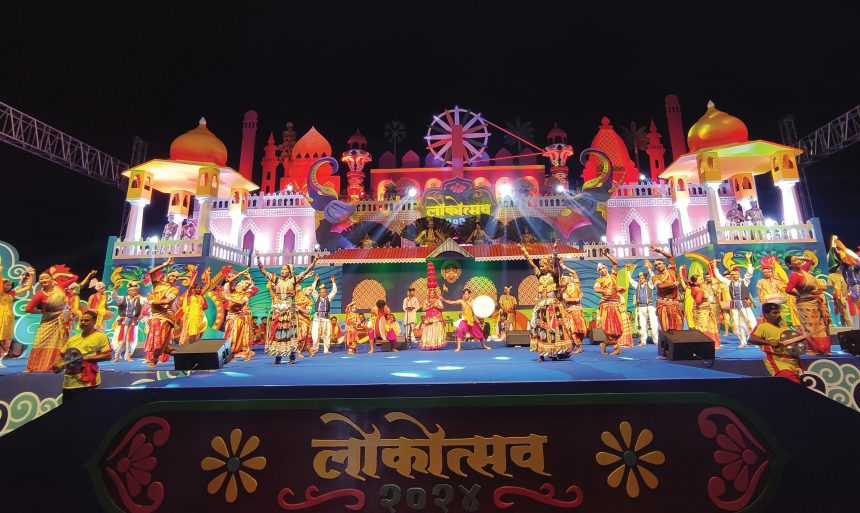
As the annual celebration of folk art, music and handicrafts in the capital city marks its silver jubilee, NT NETWORK takes a closer look at its evolution and the challenges still confronting it
KALYANI JHA | NT NETWORK
Come January every year, the Darya Sangam at Kala Academy, Panaji, transforms into a vibrant showcase of Indian folk art, handicrafts, and cuisine, attracting crowds by the thousands.
Organised by the Directorate of Art & Culture, Government of Goa in joint collaboration with the West Zone Cultural Centre, Udaipur, Kala Academy, Sports Authority of Goa, and Corporation of the City of Panaji, this 10-day celebration witnesses participation from artisans from across the country. These range from puppeteers from Rajasthan, Lavani and Koli from Maharshtra, and Gotipua from Odisha, to the Rouf dance of Jammu and Kashmir, Charkula from Uttar Pradesh, and Dholu Kunitha from Karnataka.
Modest beginnings
This year, marks a landmark, as the festival which began in 1999 under the tenure of former Chief Minister Francisco Cosme Sardinha and the then director of art and culture, V. M. Naik, marks 25 years. And indeed, the event which began with just 25 stalls at the Darya Sangam, has grown significantly over the years with the stalls spreading over to the adjoining DB grounds too.
In fact, when Prasad Lolayekar took over the directorship of the Art and Culture Department in 2006, he took the festival to a larger level by introducing over 400 stalls, and taking the number of folk presentations from around five to 15-20. Lolayekar also introduced the idea of thematic stages ranging from the architecture of Goa in one year to Mario Miranda in another.
“The artisans are always happy to come to Goa because they find that people in Goa, purchase. In other states, while the footfall is large, they don’t buy,” says Lolayekar who served as director from 2006 to 2017.
This year however the number of handicraft stalls has been reduced from 575 to 425 and only 50 food stalls are allowed. This has been done following the recent Birch fire incident in Arpora which raised major safety concerns in public places and gatherings. “There is a collective guideline from the fire department that public safety has to be kept at highest priority,” says the current director of the Directorate of Art and Culture, Government of Goa Vivek Krishna Naik.
Sharing about the evolution of Lokotsav over 25 years, Naik, who took over the directorship in August 2025 says, “The structure is more or less the same, but the scale of the festival and the glamour quotient has increased. Earlier, things were easily manageable in-house. Now, some sections of management are outsourced to an event company.”
Participants’ perspectives
With regards to Goa government agencies, 53 stalls have been allotted by the Art and Culture Department for handicrafts and more.
Paulina of St. Francis Xavier Welfare Centre, a self help group, has been coming to Lokotsav for the past four years with works of embroidery, crochet, bed sheets and handkerchiefs done by underprivileged women that she has been teaching and who hail from regions like Shirgao, Velim, and Canacona.
She shares that while business went down during the COVID-19 pandemic, since she began participating in this fest, she has gained customers who regularly buy from her.
“Goa’s Lokotsav is the best compared to all the places I have been to. Sales are good here,” says Banamali from Raghurajpur, Odissa who is here with his traditional art, Pattachitra. This is his 14th year at this fest.
Traditionally, he says, Pattachitra is carved on the ‘bhojpatra’ (palm leaf) with the help of a needle. For the fine lines, mongoose hair is used as a brush. Its also made on paper and cloth and only natural colour is used. While limited people are aware about this art form, in Goa however, he states, he has many loyal customers who buy from him.
In contrast, Poonam Gurjar from Delhi is participating at the festival for the first time with block printed, Kalamkari clothes, and fabric. Her experience so far has been good and she already has offers from wholesalers.
However, while the Department of Art and Culture has previously provided accommodation for artists, Gurjar states that she has had to arrange for her own stay, commute and food.
Naveen Kumar Jha from Madhubani, Bihar, meanwhile has been staying at his stall itself each night. The artist who has conducted workshops in NID, CEPT universities, and has also painted at Ayodhya and Patna airport, is here with his Madhubani paintings for the second time. Having previously had good sales, he is hopeful to repeat the success this time again.
Meanwhile, for artisans from the North Eastern Handloom Artisan Welfare Association, the accommodation has been taken care of by their NGO providers, says president G. C. Borkotoki.
The North Eastern handicrafts and handlooms have got seven stalls showcasing seven different crafts like bamboo products, Sital Pati mats, Kona mats, handloom woven sarees, dress materials, and
handmade jewellery.
Borkotoki states that he has been coming for the festival for the past 15 years. “We get a very good response in Goa because our products are all natural products,” he says.
However, he would like there to be more stalls allocated for them. “We applied online for 10 stalls but due to constraints, they allowed us seven,”
he says.
Infrastructure wise, he says, things have improved with provision of water and toilet facilities. But he has one main request- a confirmation for participation at least 15 days in advance.
“This year, they did not give any advance invitation. All our products are handmade, so it takes time. We need a leniency in the stall rent too,” shared Borkotoki.
Stall chaos
Artisans and craftsmen who want to participate in Lokotsav need to fill a form and apply, following which a committee selects them. Those selected receive an invitation confirming their participation following which they need to submit the due charges of the stall and are allotted a stall through an unbiased lottery at the Directorate of Art and Culture.
However, there have been instances this time around where local regular participants didn’t receive any update until two days before
Lokotsav started.
Suchita Kolvekar who makes baby quilts and sheets in a self help group from Margao has been participating at Lokotsav for 18 years now. “There is never a dull moment. Our regular customers come searching for us to purchase our products,” she shares. But, she does admit that getting her allotted stall this year was no easy task. “We did all the formalities required. We woke up at five in the morning just to stand in line to fill the forms. But we didn’t get a call to come and pick the chits for the stalls. We have been coming here for so long. So this was surprising,” she says, adding that it was due to the help of a local MLA that they finally managed to get
things sorted.
Jyoti Chari who had been coming here for the past two years with her handmade torans, blouse pieces, petticoats etc, also has a similar story.
“This year, I received my stall on the afternoon of the festival inaugural. I had filled the form on the day I received it. The ones who were along with me to fill the form got their stalls long ago,” she says, adding that she finally got a stall on sharing basis with Vaishali Kudalkar.
In fact, Kudalkar, who sells baby clothes, torans and other fabric items, and has been coming for the festival for the last 15 years, also faced stall issues. “We completed all the formalities on time but we didn’t get any call. Earlier calls were made eight days in advance. But this time, for three days, I went back and forth to the office for updates. Our business is of handmade items. We need to prepare well beforehand. We come here for some amount of exposure and sale,” she says, adding that they finally got a call two days ago. “Before this, we did not have any major issues. But after this year’s experience, I don’t feel like participating next year.”
Addressing this, Naik states that owing to the reduction of stalls, many people could not
be accommodated.
“Those who were approved got calls long back. But many interested participants came for the festival this time even without any invitation. Many know that they have not got calls but still they have come thinking that they would be given a space adjacent to the venue. However, as per assurance of our Chief Minister, we have tried to adjust,” he says adding that wherever possible on humanitarian grounds, permissions have been granted to some
extra stalls.
He adds that next year, they will do better to address the glitches in the selection process. “We’ll complete it one month prior and put out the list so there should be no issues with that,” he assures.
Enhancing the experience
Naik also states that going forward he plans to add more ideas to the Lokotsav for better experience for
all participants.
“Next year onwards, we may ask West Zone, which is a joint collaboration partner to select the list of artists. We could also ask other cultural centres like North East Centre and South Cultural Zone to send a selected list. When it comes to Goa, we are planning to form a committee which will go around all stalls to ascertain whether the person allotted the stall is actually selling handicraft wares or ready-made materials. Our focus will be on it being a handicrafts event,” he shares. “I want the event to be better curated and structured so that all can have a better
feel next year.”