‘We will strengthen supply chain resilience in strategic sectors’
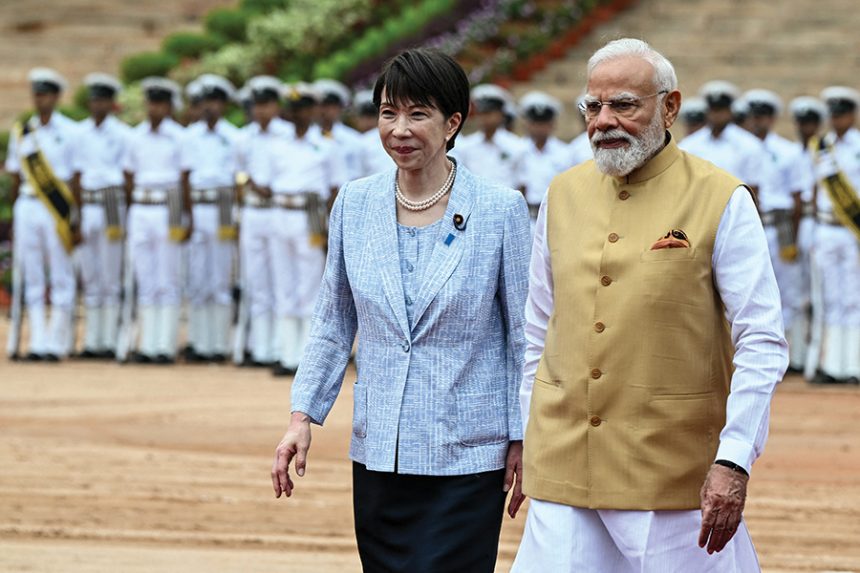
New Delhi: India and Japan on Thursday unveiled a raft of landmark initiatives including an economic partnership framework, a defence pact to co-develop military hardware and steps to enhance energy ties to tackle oil shocks following summit talks between Prime Minister Narendra Modi and his Japanese counterpart Sanae Takaichi.
The major outcomes from the meeting included a declaration on economic security, a joint statement for cooperation in the field of artificial intelligence and a document to bolster engagement in the energy supply chain.
The two sides also finalised a mobility framework to facilitate required framework for cooperation in shipbuilding, aviation and logistics. “In today’s era of uncertainty, both India and Japan fully understand the importance of economic security and energy security. With this in mind, we have today prepared a joint roadmap for economic security,” Modi said in his media
statement.
“Through this, we will strengthen supply chain resilience in strategic sectors such as semiconductors, quantum technology, and advanced materials,” he said.
Modi and Takaichi also deliberated on the situation in Indo-Pacific, a region that has witnessed growing Chinese military muscle flexing.
“Today, both India and Japan are among the world’s largest economies. A free, prosperous, and rules-based Indo-Pacific is our shared priority.”
“As the region’s largest democratic and market economies, we have launched several significant initiatives today. Through these, we will jointly pave the way for peace, stability, and progress across the entire region,” he said.
Modi said both the sides have also taken several significant decisions in the field of energy security.
“Through the India-Japan Bio-gas Initiative, we will receive assistance in setting up one thousand bio-gas and organic fertiliser plants in India.”
Modi said it will give new impetus to sustainability, prosperity, and rural livelihoods in India’s villages.
“We have also taken a significant initiative regarding energy resilience to tackle situations like oil shocks.”
“Furthermore, our cooperation in batteries, green hydrogen, and nuclear energy will make a vital contribution to the world’s clean energy future,” he said.
Modi said India and Japan view economic security as shared security and the energy transition as a shared opportunity.
“We will work to advance this agenda and drive transformation in this direction,” he said.
Highlighting the upswing in bilateral trade, Modi said over the past year, more than 100 new business agreements have been signed, which will bring over $10 billion in Japanese investment to India.
“Our goal is clear: to achieve an investment of 10 trillion yen from Japan into India over the next 10 years and to double the number of Japanese companies in India,” he said.
The Japanese Prime Minister, who is on a three-day visit to India, said both sides are focusing on economic growth through investment and innovation collaboration.
“I am committed to realising a strong economy and aiming to enhance Japan’s supply chain and technological capabilities through investment in 17 strategic areas.”
“Prime Minister Modi launched Viksit Bharat, a national goal to make India a developed nation by 2047 and is strongly driving India’s growth,” she said.
“In this way we share the goal of making our countries strong and prosperous through investments in the future,” she added.
There has been an upswing in India-Japan ties.