FILM REVIEWS SACHIN CHATTE
Film: Prahaar: The Untold Story
of Ujjwal Nikam
Cast: Rajkummar Rao, Wamiqa Gabbi,
Sikander Kher
Directed by: Avinash Arun
Duration: 2 hours 20 minutes
Rating: * * *
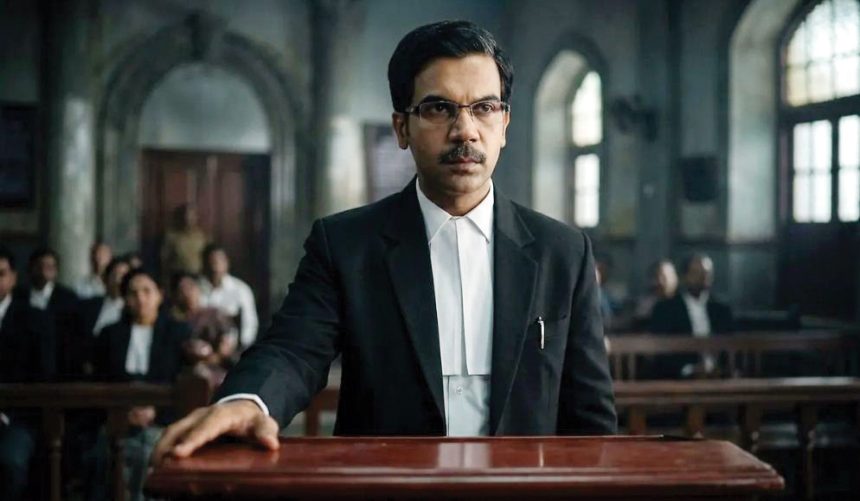
To begin with, the title of the film is slightly misleading — or, more specifically, the latter half of it. There is very little that is truly ‘untold’ here, apart from the personal life of the celebrated public prosecutor who fought several high-profile cases, none more consequential than the 26/11 Mumbai terror attacks involving Ajmal Kasab. The details of the case are already in the public domain, but director Avinash Arun does a commendable job of dramatising them in Prahaar: The Untold Story of Ujjwal Nikam.
Written by Sumit Roy, whose filmography swings from Gehraiyaan to Homebound, with Rocky Aur Rani Kii Prem Kahaani sandwiched in between, the film is primarily a courtroom drama about how Kasab was brought to justice. The events of the terror attacks themselves are well known and have been depicted on screen before. The courtroom proceedings, however, have received considerably less attention, giving the film a relatively fresh angle on a familiar chapter of recent history.
The film does a reasonably good job of walking a tightrope without tipping over into excessive jingoism. It uses the opportunity to make sense of the madness surrounding the attacks, rather than simply exploiting it for patriotic fervour. Nikam is portrayed as a prosecutor who firmly believes in the rule of law — a system that affords everyone the right to defend themselves, even someone like Ajmal Kasab. This point is reiterated several times without becoming unduly preachy. The film also suggests that terrorists like Kasab are, in part, products of rogue states. In attempting to understand the villain, it offers a cautionary message about the forces that create and sustain such individuals.
The film opens with Nikam (Rajkummar Rao) emerging victorious from the 1993 Bombay blasts case. We are also introduced to a workaholic who has little time for his family. His wife (Wamiqa Gabbi) understands that his work is his overriding priority and stands by him through thick and thin.
During a family function, the horrific 26/11 terror attacks unfold in 2008. Kasab (Lalit Prabhakar) is arrested, and Nikam is appointed public prosecutor. There is little doubt about Kasab’s involvement, but suspicion and public outrage alone cannot secure a conviction; the case must be established through evidence and witnesses. Sikandar Kher plays Qazmi, the court-appointed defence lawyer, who is simply doing his job by representing the accused. Unfortunately, his Muslim identity becomes a liability in the process, and he is made to pay a price for it. “Main Kumar hota toh personal nahi hota, Qazmi hoon toh personal hai,” he says at one point — a pointed observation on how professional duty can become entangled with
communal prejudice.
The film charts the twists and turns of the trial, exploring the defence’s various tactics and the prosecution’s counterstrategies. We also get glimpses of Nikam’s domestic life. His relationship with his son is handled with great depth and
emotional resonance.
Jaideep Ahlawat plays Chaudhary Zulfiqar Ali, Nikam’s Pakistani counterpart, with whom he shares a camaraderie. Zulfiqar is told that he is regarded as Pakistan’s answer to Nikam. When he meets the Indian prosecutor, he responds with, “Suna hai aapko Hindustan ka Zulfiqar Ali kaha jaata hai” — a neat exchange that establishes their mutual regard. This is the second time in less than a year that Ahlawat has played a good-hearted Pakistani, following Ikkis earlier this year. Like any genuine patriot, Zulfiqar wants the best for his country and its people, but siyasat(politics) repeatedly comes in the way. It is a familiar idea, but one that the film puts to reasonably effective use.
There is a welcome degree of objectivity in the storytelling, along with some interesting narrative choices. Certain flashbacks that one might expect to appear immediately during the courtroom proceedings are deliberately held back, making their eventual arrival more effective. The film demonstrates a fair degree of restraint in its handling of the material, allowing the drama to emerge from the proceedings rather than relying entirely on the emotional weight of the events themselves.
The film also benefits from some terrific performances, including those in relatively minor roles. The little girl who testifies against Kasab in court, for instance, delivers her part with remarkable assurance. Ashish Vidyarthi lends credibility to his portrayal of Justice M.L. Tahaliyani, while Sikandar Kher gets the nuances right as a defence lawyer caught in the crossfire of public sentiment despite merely doing his professional duty. Marathi actor Lalit Prabhakar is aptly cast as Kasab, managing to inhabit the role without reducing it to a caricature.
Rajkummar Rao, who previously played a lawyer in Shahid (2012), takes on a markedly different character here. Where that earlier performance was defined by a different set of moral and emotional conflicts, his Nikam is a man driven by professional conviction, dignity and a sense of duty, but also susceptible to frustration and anger. Rao navigates these shades with considerable control. His closing-arguments monologue is a particular highlight — a tour de force that brings the courtroom drama to a
compelling climax.
Ultimately, Prahaar: The Untold Story of Ujjwal Nikam works best when it stays focused on the courtroom drama that followed the attacks. It reminds us that justice is not merely about knowing who is guilty — it is about proving it within the framework of the law.
Witches brew
Film: Nayyi Navelli
Cast: Yami Gautam, Adinath Kothare
Directed by: Balaji Mohan
Duration: 2 hours 18 minutes
Rating: * *
Horror, comedy and horror-comedy may all work perfectly well as genres in their own right. But Nayyi Navelli proves that horror-comedy-mythology is a genre caught in no man’s land — or, in this case, no woman’s land. The film seems to have an idea but hasn’t the faintest clue what to do with it. Directed by Balaji Mohan, a Tamil filmmaker making his Hindi debut, Nayyi Navelli loses its way by introducing supernatural and mythological elements that are not only unnecessary but also end up derailing the narrative.
Set in Meerut, the film follows Mohini (Yami Gautam), who marries Raja (Adinath Kothare). Raja’s brother, Bantu (Anurag Thakur), follows Mohini into a forest one day and finds her performing a ritual, leaving him deeply unsettled. When she returns home, she is locked up, and Bantu takes it upon himself to convince the rest of the family that his sister-in-law is a witch. Clearly, he has decided that exposing her alleged supernatural leanings is now his
full-time occupation.
Meanwhile, the women in the household are rather pleased with Mohini, finding her presence liberating. There are complications ahead, of course, but up to this point, the film holds its own. The characters are reasonably well fleshed out, and their colloquial dialogue lends the proceedings a certain authenticity. But once the supernatural elements — and, more particularly, the mythology — take over, the film begins to unravel. It feels as though you have accidentally walked into an
entirely different movie.
As if the mumbo-jumbo in The Vvaan: Force of the Forrest last week wasn’t enough, we now have another film determined to muddy the waters with mythological grandstanding. Nayyi Navelli throws in the Kaal Sheel, a mysterious stone linked to Raavan and Mandodari, because apparently an ordinary family mansion and a regular birth just aren’t dramatic enough. The ancestral haveli conveniently comes with mythological baggage, while Raja’s birth under the same nakshatra as Raavan makes him the ideal candidate for an ancient evil’s comeback. Naturally, dark forces want to resurrect Raavan. Why bother with a coherent plot when you can throw in a cursed stone, a suspicious horoscope, and
a mythological villain?
The problem isn’t merely that the film introduces these elements; it is that it expects us to buy into their supposed credibility. There is a difference between invoking mythology as a storytelling device and asking the audience to swallow every supernatural contrivance with a straight face. Imagine Marvel attempting to convince us that there is some real-world plausibility to Doctor Doom’s mother being a Romani witch who struck a deal with the demon Mephisto in exchange for power. Within the Marvel universe, such a premise has its own internal logic. But simply throwing mythology, magic and demonic forces into a story does not automatically make it compelling. Nayyi Navelli seems to mistake the addition of more lore for the development of a better plot.
In the end, Nayyi Navelli could have been an engaging horror-comedy had it trusted its original premise instead of getting lost in its own mythological maze. The result is a muddled concoction that is neither scary enough to be horror nor funny enough to be comedy, with the mythology not adding to either element but instead sucking
the life out of both.