

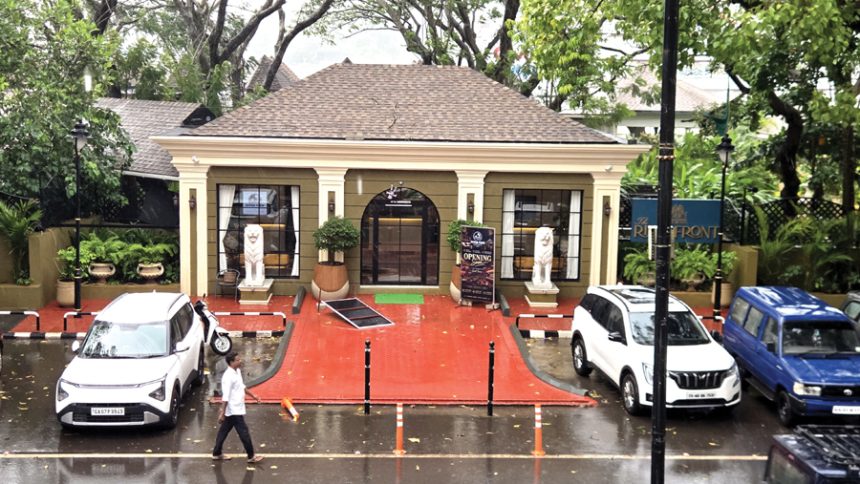
Panaji: The High Court of Bombay at Goa on Wednesday issued notices to the Goa government and other respondents on a public interest litigation (PIL) filed by Goa Bachao Abhiyan (GBA) challenging the alleged commercialisation of Panaji park, popularly known as Quarter Deck, on the banks of Mandovi River.
The matter has been posted for hearing on August 11. In the petition, GBA alleged that the Tourism Department illegally leased the public recreational space to private entities for tourism infrastructure.
The NGO also alleged that the government changed the land’s zoning from FP Recreational Zone to Special Commercial Zone, increasing the permissible development from an FAR of 5 and a maximum height of five metres to an FAR of 300 and a height of 40 metres.
The petition further stated that the work carried out exceeded the scope of the repair licence issued by the Corporation of the City of Panaji for plastering and waterproofing.
It also contended that the recreational land belongs to the public and cannot be converted into a private commercial enclave.
According to the petition, the land is government property and forms part of a sensitive riverfront and Coastal Regulation Zone (CRZ), where development is regulated by planning, land revenue and environmental laws, as well as previous High Court directions relating to CRZ violations.
GBA convener Sabina Martins stated that the plot is largely zoned as ‘Recreational-R Conservation’, while a small portion used as a parking area is zoned as ‘FP Public (Conservation)’.
She alleged that the project site had been illegally extended into the river by constructing a cantilevered deck in an area under the jurisdiction of the Captain of Ports.
Ritu Sarin, GBA member, said the CCP had issued a show-cause notice along with a transgression report, but work at the site had continued.
“The CCP has sent them a show cause notice with a transgression report… but there’s a board over there saying ‘opening soon’,” Sarin said.
She also said the Captain of Ports had issued stop-work letters in November 2025, but construction continued.
The NGO further alleged that the Tourism Department secured the zoning change by misrepresenting facts, showing the entire plot as falling within the FP Zone while concealing that most of it lies in the Recreation Zone, where development norms are far more restrictive.
“Public spaces are governed by the doctrine of public trust which clearly states that natural resources like rivers and public open spaces are held by the state as trustee for the public and future generation and cannot be alienated or degraded for narrow commercial greed,” said Martins.

